On the eve of Hungary's most consequential election in thirty-five years, Donald Trump took to Truth Social to offer Viktor Orbán his "Complete and Total Endorsement," pledging the "full Economic Might" of the United States behind a man whose own internal polling suggests he will lose [3]. It was, by any measure, a generous gesture. It was also, by any available evidence, a futile one.
As this paper noted yesterday in its account of Hungary's path to a supermajority, the arithmetic has not moved in Orbán's direction. Among decided voters, Péter Magyar's Tisza party leads Fidesz 50 to 37 percent [6]. Prediction markets place the probability of a Magyar victory at 82 percent. The final pre-election surveys from Median and the Idea Institute project Tisza at 138 to 142 seats — five to nine above the 133 needed for the constitutional supermajority that would allow Magyar to dismantle, brick by brick, the illiberal state that Orbán spent sixteen years constructing [6].
Orbán himself appears to understand what is coming. "We could lose," he told supporters at a rally on Thursday — a sentence that no Hungarian prime minister has uttered publicly in the modern era and that, in its plainness, carried the weight of confession [4]. He said it without elaboration, as though the fact required no analysis.
The American Pilgrimage
Trump's endorsement did not arrive in isolation. Vice President JD Vance traveled to Budapest on April 7 — ostensibly en route to Islamabad — and rallied with Orbán at a joint event in the Buda Castle district [1]. Vance called Trump from the podium so the president could address the crowd via speakerphone, then delivered remarks framing Orbán as a defender of sovereignty against Brussels overreach [5]. "Election interference," Vance called the European Union's rule-of-law conditionality — the mechanism by which Brussels has frozen approximately €20 to 22 billion in Hungarian funds over judicial independence concerns [5].
The Guardian situated the Vance-Orbán rally within a broader pattern in which the American right has adopted Hungary as a laboratory for the politics it wishes to practice at home — illiberal democracy as aspirational model rather than cautionary tale [2]. Trump and Orbán share a political vocabulary — sovereignty, elite capture, the deep state — and a political method — institutional capture, media consolidation, the personalization of state power. That the American president would pledge his country's economic might to save the Hungarian prime minister is less a strategic calculation than a reflex, the instinct of one strongman reaching for another as the floor gives way.
Heroes' Square
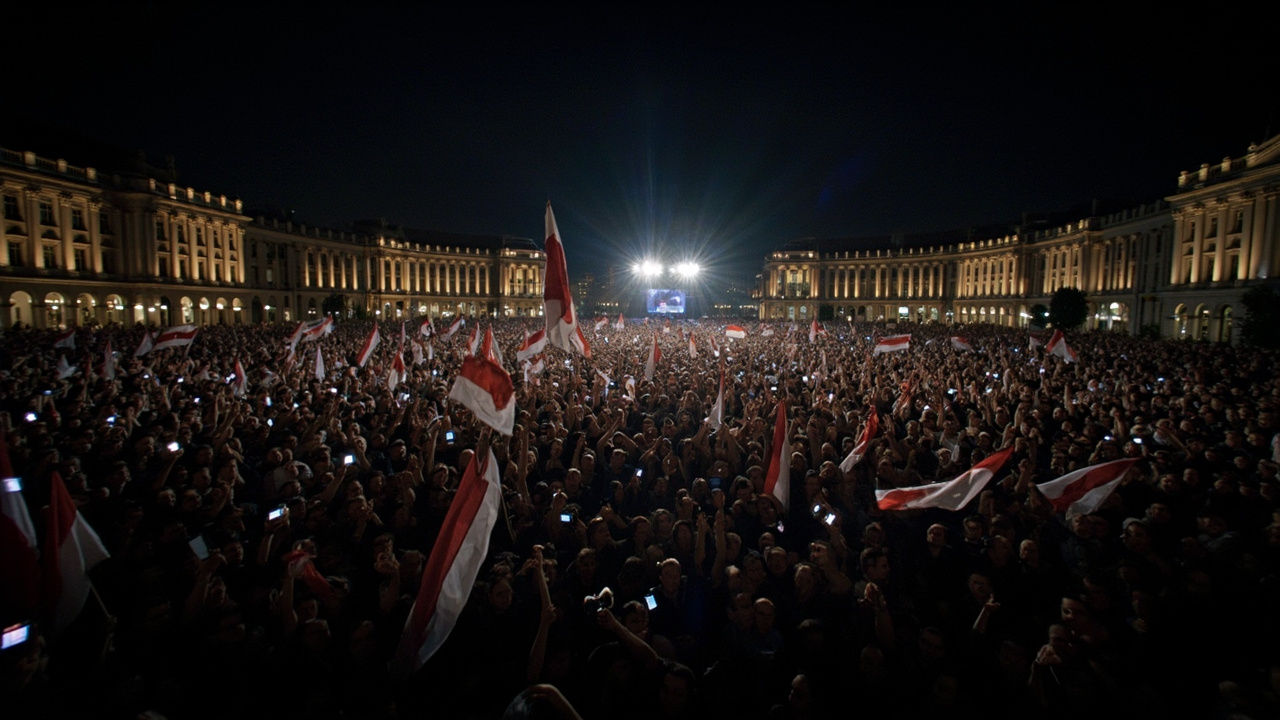
The floor is giving way. On Thursday evening, Magyar held his final rally at Heroes' Square in Budapest — the same square where, in 1989, Orbán himself delivered the speech that launched his political career, demanding the withdrawal of Soviet troops [4]. The symbolism was not subtle, and it did not need to be.
The Washington Post reported that over 100,000 people attended a combined concert and rally on April 10, making it the largest political gathering in Hungary since the transition from communism [4]. Photographs from the event showed the square and the surrounding avenues filled to capacity, a sea of Tisza's blue-and-white banners and the glow of tens of thousands of phone screens held aloft like votive candles. Magyar spoke for forty minutes. He did not mention Trump's endorsement. He did not need to.
The Associated Press, covering both Magyar's rally and a simultaneous Fidesz event across the city, noted the contrast in scale — Magyar's crowd filling a public square, Orbán's supporters gathered in an indoor arena that held perhaps fifteen thousand [6]. The visual disparity was the kind of evidence that polls can suggest but only crowds can confirm.
The Day After
Hungary votes on Saturday, April 12. Polls open at six in the morning. The Organization for Security and Co-operation in Europe has deployed 200 election observers — a number that reflects both the international significance of the vote and the longstanding concerns about the neutrality of Hungary's election infrastructure [6]. Orbán's government controls the election commission, the state broadcaster, and the postal voting system that serves the diaspora. A Tisza victory requires not just a majority of votes but a margin sufficient to overwhelm whatever structural advantages sixteen years of institutional capture have embedded in the process.
If Magyar achieves the supermajority, the consequences extend well beyond Hungary's borders. A 133-seat majority would enable a constitutional rewrite, unlock the €20 to 22 billion in frozen EU funds, and represent the first time a country has voted itself out of illiberal democracy through the very constitutional mechanisms that illiberal democracy was designed to make permanent.
Trump's endorsement, in this context, reads less as an intervention than as an epitaph. Orbán said "We could lose." The polls say he already has. Tomorrow's voters will determine whether the polls were right, or whether the machinery of a sixteen-year state can produce one more surprise.
The history of democratic transitions suggests that when a hundred thousand people fill a public square on the eve of an election, the transition has already begun. But in Hungary, where nothing has been formal for sixteen years, even formalities matter.
-- HENDRIK VAN DER BERG, Brussels