The seventy-one-member Iranian delegation that landed at Islamabad International Airport at 2:14 PM local time on Friday flew in on an aircraft the government in Tehran had formally dedicated to the memory of the schoolchildren killed in the Minab strike — thirty-seven students and four teachers, their names printed on a banner draped across the fuselage — and if you wanted a single image to capture the difference between what these talks are supposed to accomplish and what they will actually produce, it was there on the tarmac before anyone walked into the Serena Hotel. [1] [5] As yesterday's account of how the two sides arrived carrying irreconcilable positions made clear, the architecture of negotiation was already straining under the weight of the demands both parties brought to Pakistan. By Friday evening, it had begun to crack.
Speaker Mohammad Bagher Ghalibaf — the former IRGC air force commander who ran Tehran as mayor for twelve years, the man whom Supreme Leader Khamenei chose over President Pezeshkian precisely because he can say no and be believed — posted his preconditions on X within hours of landing. The post was specific, legalistic, and devastating to anyone who believed these talks would begin with the exchange of positions that Pakistan had brokered. "Two of the measures mutually agreed upon between the parties have yet to be implemented," Ghalibaf wrote: "a ceasefire in Lebanon and the release of Iran's blocked assets prior to the commencement of negotiations. These two matters must be fulfilled before negotiations begin." [2] [3]
Read that again. Not before negotiations conclude. Before they begin.
The American delegation was still in the air when Ghalibaf's post went live. Vice President JD Vance departed Joint Base Andrews early Friday morning aboard Air Force Two, accompanied by Steve Witkoff, the New York real-estate lawyer turned special envoy, and Jared Kushner, whose formal title remains as elusive as his mandate is expansive. Secretary of State Marco Rubio was advising from Washington. The composition of the American team — deal-makers, not diplomats; men who think in term sheets, not communiqués — was itself a signal about how the White House understands the nature of what is happening in Islamabad. [1]
The Enrichment Gap That Swallows Everything
The facts of the enrichment dispute are not complicated. They are irreconcilable. The American ten-point plan, details of which have been reported by Reuters and Al Jazeera in the days before the talks, demands that Iran halt all uranium enrichment above 3.67 percent — the level permitted under the 2015 JCPOA, the agreement that Donald Trump withdrew from in 2018 and that Iran subsequently exceeded by orders of magnitude. Iran is currently enriching to 60 percent. Its stockpile of enriched uranium is sufficient, according to the International Atomic Energy Agency, for several nuclear weapons, though Tehran denies any military intent. [2] [6]
The distance between 3.67 and 60 is not a negotiating gap. It is a chasm into which every other issue — Hormuz, Lebanon, missiles, sanctions — falls and disappears. An American demand that Iran return to 3.67 percent is a demand that Tehran surrender the strategic capability it acquired during the war, accept an inspection regime more intrusive than the JCPOA's Additional Protocol, dismantle its advanced centrifuge cascades at Fordow, and do all of this without a corresponding American concession on sanctions relief, security guarantees, or diplomatic recognition. It is a demand that Iran accept strategic defeat at a negotiating table after having survived strategic assault on the battlefield.
The Iranians understand this with perfect clarity. Ghalibaf's preconditions — Lebanon ceasefire, frozen assets — are not obstacles to negotiation. They are the price of admission to a room in which Iran will then be asked to give up the one thing that prevented the war from becoming regime change. Foreign Minister Abbas Araghchi, who arrived in Islamabad on Thursday with the advance team, told Pakistani journalists at a brief press availability that enrichment would be discussed "in the context of Iran's sovereign rights under the Non-Proliferation Treaty," a formulation that means, in diplomatic translation, that it will not be discussed at all. [3]
10,000 Soldiers and a City Holding Its Breath
Pakistan deployed approximately 10,000 security personnel across Islamabad for the talks, according to a senior Pakistani official who spoke to India Today. [1] The number is not decorative. The Serena Hotel, where both delegations are installed on separate floors, sits in the heart of the diplomatic enclave, a district that was designed in the 1960s by the Greek architect Constantinos Doxiadis to be spacious, orderly, and defensible — qualities that have never been more relevant. Rangers began establishing checkpoints four hundred metres from the hotel entrance on Thursday night. The Blue Book VVIP protocol was activated — the same security tier last used for the 2004 SAARC summit. Friday was declared a public holiday in the federal capital, officially for "national security reasons," practically to empty the streets.
The city was quiet. The highway from the airport was lined with Pakistani flags and, incongruously, with banners advertising a telecommunications company's new data plan. The delegation vehicles — American SUVs with diplomatic plates, Iranian sedans with tinted windows — moved through corridors of emptied asphalt. There were no crowds. There were no protesters. There were soldiers, and concrete barriers, and the particular silence of a city that knows something important is happening inside a building it cannot approach.
The Strait That Will Not Open
While the delegations settled into their respective floors of the Serena, the Strait of Hormuz remained effectively closed. Reuters reported this week that shipping traffic through the strait has fallen to a virtual standstill despite the ceasefire, with fewer than ten vessels transiting per day compared to pre-war averages of more than 135. [4] ADNOC's chief executive, Sultan Al Jaber, said what diplomats will not: "The Strait of Hormuz is not open." The International Energy Agency has called it "the most severe supply disruption in history."
The blockade is the physical manifestation of the enrichment gap. Iran maintains some form of sovereignty over Hormuz transit — a toll system, an inspection regime, a veto over military vessels — that the United States considers illegal under international maritime law. The American position is that freedom of navigation is non-negotiable. The Iranian position is that Hormuz is a sovereign waterway, and sovereignty over sovereign waterways is, by definition, also non-negotiable. The ships are not transiting because the two non-negotiable positions have not been reconciled, and they will not be reconciled in Islamabad, because reconciling them would require one side to abandon a principle it has declared inviolable.
The Choreography of Non-Beginning
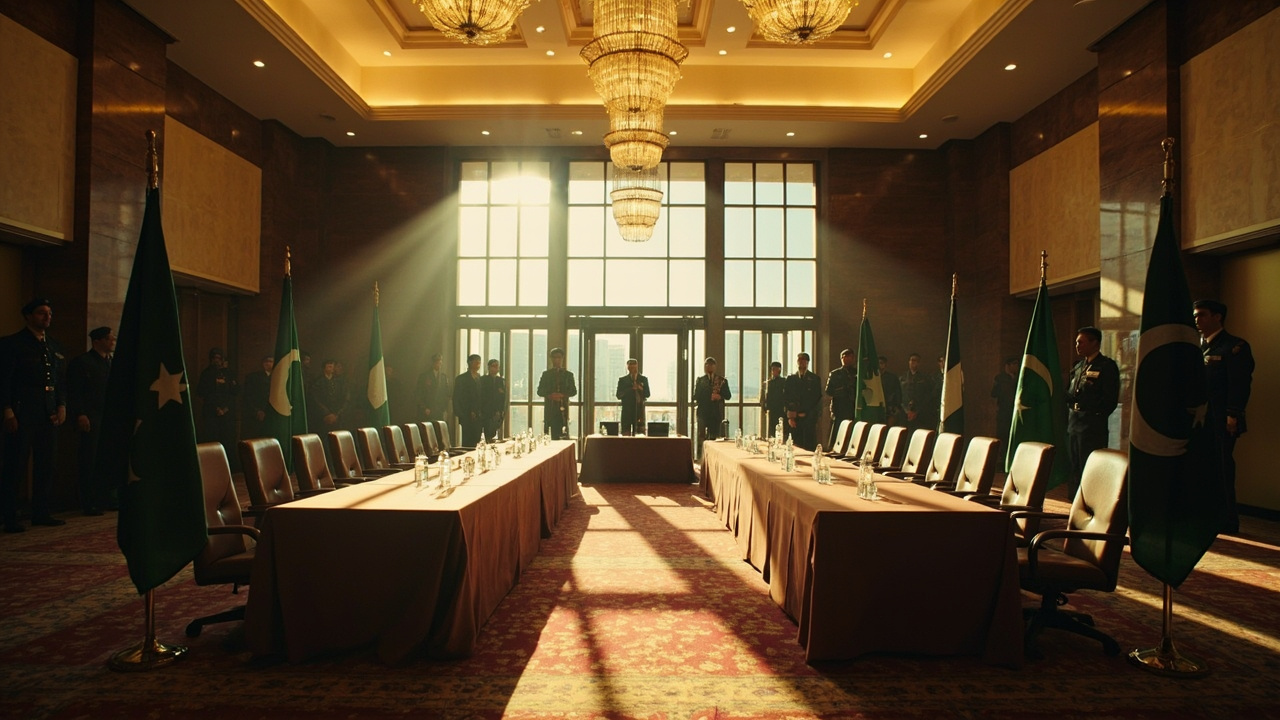
The format of the talks — if they can be called talks — remains proximity negotiations. The two delegations occupy separate suites on different floors of the same hotel. Pakistani intermediaries shuttle between them, carrying positions in sealed envelopes. The parties do not sit at the same table. They do not make eye contact across an aisle. They communicate through the mediating grace of a host government that has staked its diplomatic credibility on producing an outcome neither party appears willing to provide.
This is the format of Vienna in 2015, and it worked in Vienna because the parties, however reluctantly, shared a destination. The JCPOA was possible because Barack Obama was willing to accept an Iran that enriched and Iran was willing to accept constraints on how much. Neither condition obtains in Islamabad. Trump has publicly rejected any deal that leaves Iran with enrichment capability. Iran has publicly rejected any deal that takes it away. The proximity format — designed to allow engagement without the indignity of direct contact — may instead become the mechanism through which both parties perform the act of negotiation without the substance of it.
Ghalibaf's preconditions guarantee that the opening session, scheduled for Saturday, will begin not with the exchange of positions that Pakistan brokered but with an argument about whether the session should begin at all. The Lebanese ceasefire that Ghalibaf demands — a full implementation of the terms negotiated in February, including Hezbollah's withdrawal from positions south of the Litani River and the disbursement of European reconstruction funds — has not been achieved. Iran's frozen assets, estimated at between $6 billion and $10 billion across banks in South Korea, Japan, and Iraq, have not been released. These are not preconditions that Washington can meet by Saturday morning. They are preconditions that Washington has no intention of meeting at all.
The Plane and the Banner
The Iranian delegation's aircraft, with its banner for the Minab schoolchildren, will sit on the tarmac at Islamabad International for as long as the talks continue. It is a negotiating instrument disguised as a memorial — a reminder to every camera, every journalist, every satellite feed that the war has costs that enrichment percentages cannot capture. The thirty-seven children and four teachers who died when an American precision munition struck their school in the coastal city of Minab on February 14 have become, in the grammar of Iranian statecraft, both argument and accusation. [5]
Vance, for his part, arrived without a banner. He arrived with Kushner, Witkoff, and a delegation whose size has not been officially disclosed but which Pakistani officials estimate at forty to fifty people, including Secret Service, signals intelligence staff, and a medical team. He arrived with a ten-point plan that the other side has already rejected. He arrived into a city that had been emptied for his safety, to a hotel where the other delegation was already installed, to begin talks that the other delegation has said cannot begin.
The mainstream media — Reuters, AP, the networks — are calling this a historic opening. [1] The highest-level American-Iranian contact since the Islamic Revolution of 1979. An unprecedented diplomatic moment. And they are right about the contact, right about the level, right about the precedent. What they are less willing to say is what is visible from the tarmac, from Ghalibaf's X post, from the empty tables in the conference room: the architects of this negotiation arrived in Islamabad to find their architecture already crumbling.
The enrichment gap between 60 percent and 3.67 percent is not a gap that proximity negotiations can close. Lebanon cannot be settled in a hotel suite in Pakistan. Hormuz will not open because two delegations are in the same building. The talks are theater, and both sides know it — but it is theater that neither side can refuse to perform, because the alternative to performing it is admitting that the war has no diplomatic exit, that the ceasefire is a ceasefire in name only, and that the next phase of this conflict will not be negotiated but imposed.
The Rangers are at their posts. The cable runs are in place. The sealed envelopes are ready. And on the tarmac, a plane with thirty-seven names on its fuselage waits to take a delegation home from talks that have not yet started, and may never truly start at all.
-- YOSEF STERN, Islamabad