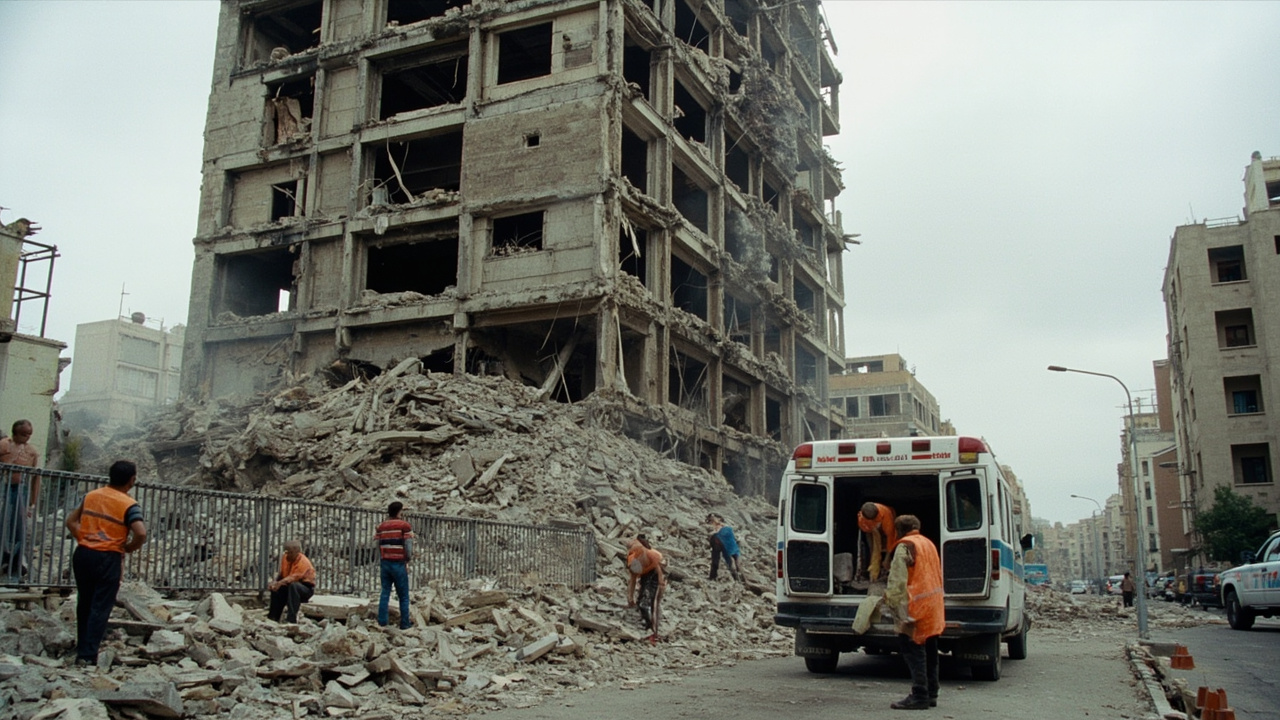
Three days after Operation Eternal Darkness killed 303 people across Lebanon in ten minutes, Israel and Lebanon are preparing to sit at the same table for the first time since 1948. The State Department confirmed Saturday that ambassador-level contacts between the two countries have been established in Washington, with the first formal session expected next week [1]. It will be the first direct diplomatic exchange between Israel and Lebanon since both nations came into existence.
As this paper reported Thursday, the revised death toll from April 8 reached 303 — forty-nine bodies beyond the initial count. And as we wrote the same day, Netanyahu's instruction to open direct talks with Lebanon was extraordinary by any historical measure. What has become clearer since is the sequence. The massacre created the talks. The talks did not prevent the massacre. That ordering is the story.
The Lebanese Health Ministry's demographic breakdown of the 303 dead arrived Friday: 110 of the victims were women, children, and elderly [2][3]. The Israeli Defence Forces' operational summary for Operation Eternal Darkness described the strikes as targeting "Hezbollah military infrastructure" — fifty fighter jets carrying 160 munitions against more than 100 targets [1]. The gap between "military infrastructure" and 110 women, children, and elderly is not an accounting error. It is the operational reality of bombing residential neighborhoods without evacuation warnings.
The Diplomatic Architecture
The Washington framework is more concrete than Netanyahu's initial Thursday announcement suggested. According to AP, the State Department will host ambassador-level delegations from both countries in a structured format — not the proximity talks that characterized the 2022 maritime border agreement, where American intermediaries shuttled between rooms, but face-to-face negotiations [4]. Israeli officials have named two preconditions: the disarming of Hezbollah and the establishment of formal diplomatic relations. Lebanon has not publicly responded to either.
The preconditions are worth examining in daylight. Disarming Hezbollah is not a demand that Lebanon's government can fulfill even in theory. Hezbollah maintains a military apparatus larger than the Lebanese Armed Forces, holds seats in parliament, and controls the southern third of the country [4]. Asking the Lebanese government to disarm Hezbollah is equivalent to asking a tenant to evict the landlord. The second precondition — formal diplomatic relations — would require Lebanon to repeal legislation that criminalizes contact with Israeli citizens, a law that has been in place since 1948.
Neither precondition is achievable in the short term. Both were stated publicly, which means they function less as negotiating positions and more as markers — establishing what Israel will demand, so that any eventual compromise can be framed as a concession.
What 1948 Means
The absence of Israeli-Lebanese diplomatic contact since 1948 is not a technicality. It is a defining fact of the modern Middle East. The two countries have fought wars — 1978, 1982, 2006 — without ever speaking directly. The 1983 May 17 Agreement, brokered under American pressure during the Israeli occupation of Beirut, was signed but never ratified by Lebanon's parliament and collapsed within a year [5]. The 2022 maritime border agreement, which delineated gas exploration rights in the Mediterranean, was conducted entirely through US mediators. Israeli and Lebanese officials never sat in the same room.
The last time something resembling direct communication existed between the two states was during the 1949 Armistice Agreements, conducted under UN auspices at Ras en Naqoura. Seventy-seven years ago.
Now the State Department is offering a room in Washington, and both sides have said yes. The question is what made this possible. The mainstream framing — that the ceasefire created diplomatic space for a historic opening — is technically accurate and almost entirely misleading. What created the space was not the ceasefire. What created the space was April 8.
The Massacre as Leverage
On X, the sequencing is the entire argument. "This follows Operation Eternal Darkness on April 8 that hit 100 targets in 10 minutes and killed at least 303," wrote one account tracking the diplomatic timeline [6]. The implication is not subtle: the talks are a direct consequence of the killing. Israel demonstrated what it could do to Lebanon without constraint — the ceasefire explicitly excluded Lebanon from its protections — and then offered an alternative.
The diplomatic grammar is familiar from other conflicts, but the scale is unusual. Three hundred and three dead in a single day is the deadliest toll of the current war [2]. The total since March 2 has reached 1,888, according to the Health Ministry's cumulative figures [3]. The strikes on April 8 alone accounted for sixteen percent of all deaths in forty days of war.
Hezbollah's response has been calibrated. After pausing rocket fire under the ceasefire framework — a pause coordinated with Tehran's negotiating posture — it resumed with approximately 30 rockets into northern Israel following the April 8 strikes [1]. The number was a fraction of its pre-ceasefire capacity. The restraint signaled willingness to return to the pause. The resumption signaled a price for testing it.
Britain's One Word
British Prime Minister Keir Starmer called the April 8 strikes "wrong" during a press conference — a single adjective attached to no policy consequence, no sanctions review, no arms shipment pause [7]. The French foreign ministry issued a statement calling for the protection of civilians. The EU's foreign policy chief expressed "deep concern." The diplomatic vocabulary of disapproval was deployed in full and achieved nothing at all.
The Lebanese government, for its part, has been conspicuously silent on the talks. It was not consulted before the strikes. It was not consulted before the talks were proposed. It is being asked to negotiate the terms of its own sovereignty with a country that killed 303 of its citizens four days ago and has stated openly that there is "no ceasefire in Lebanon" [4].
The rubble on the Corniche is still being cleared. The ambassador-level contacts in Washington are being finalized. The two facts exist simultaneously. In the diplomatic logic of 2026, they are not contradictions. They are the same event viewed from different altitudes — from the street in Beirut where rescue workers are still pulling bodies, and from the conference room in Washington where name placards are being arranged for the first time in seventy-eight years.
-- YOSEF STERN, Jerusalem