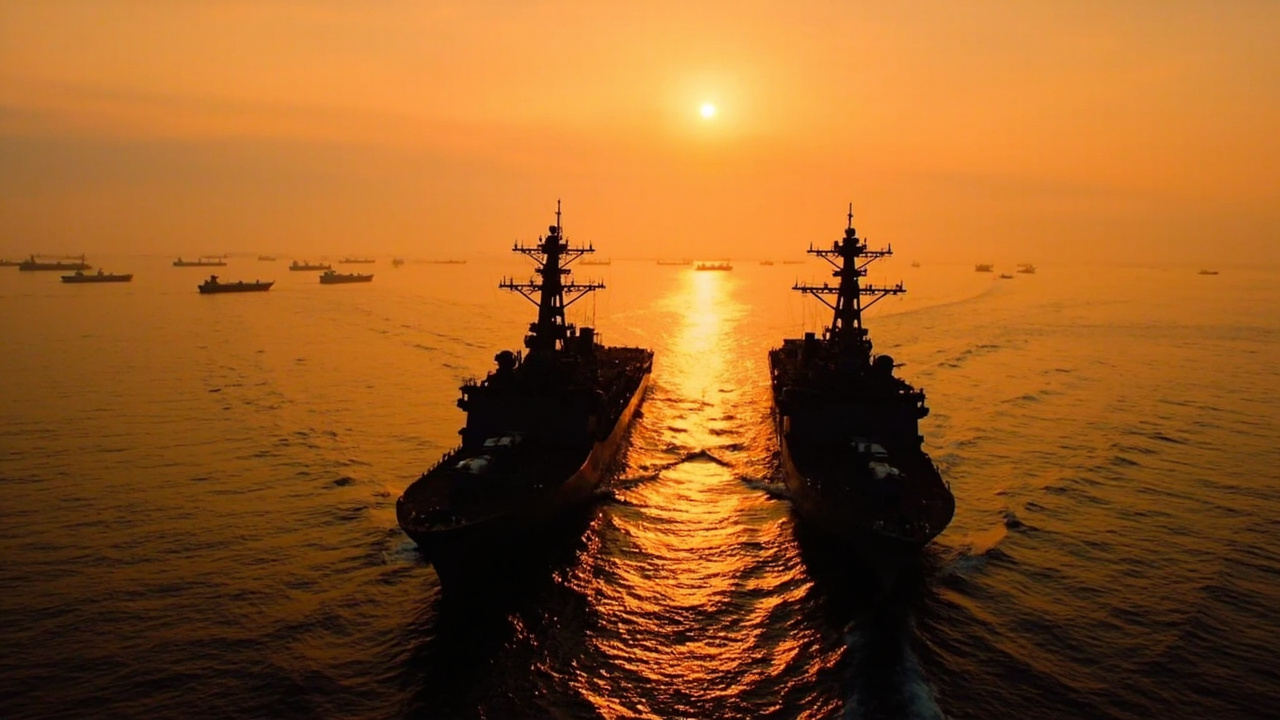
MANAMA — Two United States Navy guided-missile destroyers transited the Strait of Hormuz on Saturday, the first American warships to pass through the waterway since the war with Iran began on February 28. CENTCOM announced the operation as "setting conditions for clearing mines." Iran denied it happened. Trump said all the mine boats were already on the ocean floor. The ceasefire, such as it was, got harder to believe. [1]
As this paper reported on Friday, the $36 gap between Brent crude futures and pre-war prices is the market's real-time measure of ceasefire credibility. Saturday's events did nothing to close it.
USS Frank E. Peterson (DDG-121), part of the Abraham Lincoln Carrier Strike Group, and USS Michael Murphy (DDG-112), independently deployed, transited the strait and operated in the Arabian Gulf before returning to the Gulf of Oman, according to ship spotters and a CENTCOM press release. [2]
"Today, we began the process of establishing a new passage and we will share this safe pathway with the maritime industry soon to encourage the free flow of commerce," said Admiral Brad Cooper, CENTCOM commander. [2]
The language was notable for what it conceded. A "new passage" implies the old one remains dangerous. Sharing a "safe pathway" implies the rest of the strait is not safe. CENTCOM is not declaring the Strait of Hormuz open. It is declaring that two warships survived the crossing.
Iran's Double Denial
Iran's response came in two parts, both unusual.
First, Iranian state television broadcast a denial from a military official that any transit had occurred at all. This was a face-saving measure — Iran has repeatedly claimed operational control over the strait, and acknowledging an American transit would undermine that claim. [3]
Second, the Islamic Revolutionary Guard Corps Navy issued a statement threatening to "deal severely with any military vessels transiting the Strait of Hormuz," asserting "full authority to manage the Strait of Hormuz intelligently." [4]
The contradiction was plain. Iran simultaneously said no ships had crossed and threatened to punish any ships that did.
The Mine Problem
The operational reality is more complicated than any of the principals are admitting. Iran laid mines in the Strait of Hormuz after the war began, using the Maham 3 (a moored mine with active sensors) and the Maham 7 (a seabed mine that activates when a target passes within range). Both are manufactured domestically. [4]
According to CBS News, citing U.S. intelligence assessments, at least a dozen underwater mines were placed in the waterway. But "at least a dozen" is an intelligence floor, not a census. The actual number is unknown. Iran itself may not know precisely where all the mines are — a common problem with mine warfare, which is notoriously easier to initiate than to reverse. [4]
Trump's Truth Social post claimed the operation was "a favor to Countries all over the World, including China, Japan, and France," and asserted that "all 28" of Iran's mine-laying boats had been sunk. This figure does not match CENTCOM's own earlier statement of 16 minelayers destroyed on March 10, nor subsequent reporting that Iran retains significant small-boat capacity. [5]
The Navy decommissioned its four Avenger-class minesweepers from Bahrain in late 2025. Their replacements — Independence-class littoral combat ships with modular mine countermeasure packages — have struggled operationally. Two Japan-based Avenger-class ships, USS Pioneer and USS Chief, were dispatched this week toward the region and were last reported in Singapore. [6]
The gap between political declaration and mine-clearing capacity is the story. Destroyers can transit a strait. They cannot clear it. That requires minesweepers, divers, underwater drones, and weeks of methodical survey work in waters where a single missed mine can close the waterway again.
What the Market Sees
Between March 30 and April 5, Lloyd's List Intelligence tracked 76 transits through the strait — the busiest week since the conflict began, but still a fraction of pre-war traffic. On the day of Trump's deadline to reopen the strait, there were 15 transits. An estimated 500 to 700 vessels over 10,000 deadweight tons remain trapped in the Persian Gulf. [6]
Insurance premiums for Hormuz transits remain at war-risk levels. Until insurers reduce those premiums, the commercial fleet will not return in volume. And insurers will not reduce premiums until the mines are verifiably cleared — not politically declared cleared.
The ceasefire is not keeping the strait open. Two destroyers passing through does not mean the strait is open. The $36 gap knows the difference.
-- DARA OSEI, Manama