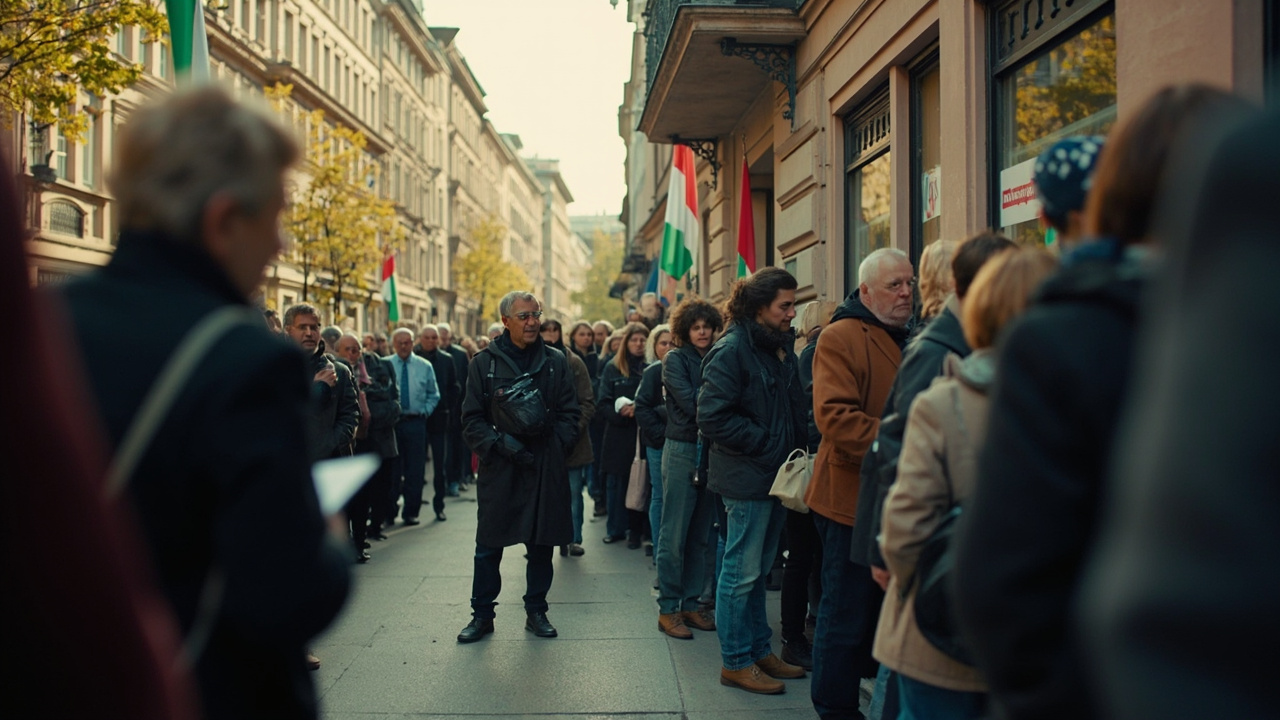
BUDAPEST — Polls opened across Hungary at 6:00 a.m. on Sunday, and for the first time in sixteen years, the outcome is genuinely uncertain — or rather, the outcome is certain everywhere except inside the Fidesz media ecosystem, where Viktor Orban is still winning.
As this paper noted on Saturday, the gap between independent polls and government-friendly surveys has become the election's defining feature. Median, Hungary's most accurate pollster — it correctly predicted Orban's landslide in 2022 — projects Peter Magyar's Tisza party winning between 138 and 142 seats in the 199-member parliament. That is a two-thirds supermajority, the same constitutional weapon Orban used to reshape Hungary's judiciary, media, and electoral system after 2010. [1]
The Nezopont Institute, which has financial ties to the government, projects Fidesz holding 109 seats and remaining in power. McLaughlin & Associates, the MAGA-friendly American firm that has polled in Hungary, gives Orban a ten-point lead. [2]
Someone is profoundly wrong, and by Sunday evening, the arithmetic will be public.
The Architecture of the Contest
Hungary's electoral system, redesigned by Fidesz in 2011, rewards organizational depth. Of the 199 seats, 106 are elected in single-member constituencies — first-past-the-post — and 93 from national party lists distributed proportionally, with a five percent threshold. Fidesz gerrymandered the constituencies, nearly halved the total number of seats, and made it easier for the approximately 250,000 ethnic Hungarians living in neighboring countries — overwhelmingly pro-Fidesz — to vote by mail. [3]
The consequence is structural: analysts estimate Tisza needs a six-point margin in the popular vote simply to secure a parliamentary majority. A two-thirds supermajority requires an even wider gap. Independent polling averages put Tisza at roughly 50 percent of decided voters and Fidesz at 37 percent — enough, if accurate, for a landslide. [4]
The critical variable is turnout. Fidesz's base is older, rural, and disciplined. Tisza's base is younger, urban, and enthusiastic but untested. If turnout reaches the projected 75 to 80 percent — which would be a record — the volume of new voters almost certainly breaks for Magyar. If it falls below 70 percent, Fidesz's organizational machinery, honed over sixteen years of managing elections it designed, could narrow the gap.
Magyar's Campaign
Peter Magyar, 45, is the most improbable challenger Orban has faced. A former Fidesz insider who trained as a lawyer, served as a Hungarian diplomat in Brussels, and married the party's justice minister, Magyar burst into opposition politics in February 2024 after exposing a presidential pardon scandal involving a man convicted in a child sexual abuse case. [5]
He founded Tisza — an acronym for Tisztelet es Szabadsag, Respect and Freedom, and also the name of Hungary's second-longest river — and won 30 percent of the vote in the June 2024 European elections. Since then, he has toured Hungary relentlessly, visiting hundreds of cities, towns, and villages, broadcasting every rally live on Facebook, and focusing on issues that Orban's media apparatus prefers to ignore: inflation, the collapsing healthcare system, chronic underinvestment in public transport, and what Magyar calls "endemic governmental corruption."
His final rally on Saturday drew thousands to University Square in Debrecen, traditionally a Fidesz stronghold and Hungary's second-largest city. "This election will enter Hungarian history books as the day of resurrection," Magyar told supporters, as they waved national flags and chanted "Europa! Europa!" [6]
The religious metaphor was deliberate. Sunday is Easter in the Western calendar. The Orthodox Easter is also being observed. Magyar is reaching for a narrative of renewal that transcends partisan politics.
Orban's Final Stand
Orban, 62, closed his campaign on Budapest's Castle Hill, sounding the alarm on war, migration, and the specter of foreign interference. "We are in an age of danger," he told supporters, framing the election as a choice between Hungarian sovereignty and submission to Brussels. [6]
The war-and-peace framing has been central to Fidesz's strategy. Orban has painted Magyar as a puppet of the European Union — an agent sent from Brussels to drag Hungary into the conflict in Ukraine and drain its finances. Tisza has denied this, but the accusation resonates with Orban's older, rural base, which has been fed a steady diet of state media messaging for over a decade.
Trump's endorsement, delivered via Truth Social earlier in the week, was meant to bolster Orban's credentials. It may have had the opposite effect. Magyar's supporters seized on it as evidence that Orban answers to Washington, not Budapest — a neat inversion of the sovereignty narrative Fidesz has cultivated.
What the EU Is Watching
Budapest's relationship with Brussels is one of the most fraught in the Union. The European Commission has frozen billions in cohesion funds over judicial independence and corruption concerns. If Magyar wins and secures a supermajority, he can amend the constitution and pass the institutional reforms required to unlock those funds — a potential windfall that could, by some estimates, add several percentage points to Hungarian GDP growth.
If Orban wins, the standoff continues, and Hungary's drift toward Moscow and Beijing accelerates. Orban is the EU leader closest to Vladimir Putin, has blocked multiple rounds of Ukraine sanctions, and has served as the European populist movement's intellectual godfather. A Fidesz victory would embolden Marine Le Pen, the AfD, and their analogues across the continent. A Fidesz defeat would be the most significant reversal for European illiberalism since the movement began its ascent. [7]
The frozen EU funds alone represent a transformative sum. The European Commission has withheld approximately €22 billion in cohesion and recovery funds — roughly 12% of Hungary's annual GDP — pending reforms to judicial independence, anti-corruption enforcement, and media pluralism. A Tisza supermajority would give Magyar the constitutional authority to dismantle the structures Orban built to capture those institutions: the stacked Constitutional Court, the media council packed with Fidesz loyalists, the prosecution service that has never brought a corruption case against a senior party figure. The reforms required to unlock the funds are, in effect, the reforms required to restore democratic governance. Brussels has made one contingent on the other. [7]
For the broader European democratic landscape, the stakes extend well beyond Budapest. Freedom House downgraded Hungary from "free" to "partly free" in 2019 — the first EU member state to receive that designation. V-Dem's democracy index has tracked a steady decline since 2010. A Magyar victory and subsequent constitutional reform would test whether democratic backsliding within the EU is reversible, or whether the institutional damage Orban inflicted is permanent regardless of who holds power. Poland's experience after its 2023 election — where the Tusk government has struggled to undo PiS-era judicial appointments despite a parliamentary majority — suggests that winning an election is the beginning of the reconstruction, not the end.
OSCE election observers are deployed across Hungary, monitoring a process that the organization has previously described as "free but not fair." The concern is not ballot-stuffing — Hungary's electoral infrastructure is generally sound — but the structural advantages Fidesz has built into the system: media dominance, constituency boundaries, and state resources deployed for partisan ends. [3]
The Unknowable
The honest assessment is that nobody knows what will happen. The divergence between independent and government-friendly polls is so extreme that one of the two sides has fundamentally misjudged the Hungarian electorate. Either Tisza is headed for a historic supermajority, or Hungary's independent polling industry has collectively lost its bearings.
The results will begin arriving Sunday evening. Hungary counts quickly. By midnight, the shape of the next government should be clear. What happens after that — whether Orban accepts defeat, whether the transition is peaceful, whether the constitutional reforms actually materialize — is a story for tomorrow's paper.
Today, 7.8 million Hungarians decide.
-- HENDRIK VAN DER BERG, Budapest