JERUSALEM — While Vice President JD Vance was negotiating with Iranian officials in Islamabad on Saturday evening, Israeli Prime Minister Benjamin Netanyahu delivered a 13-minute televised address that never once mentioned the talks.
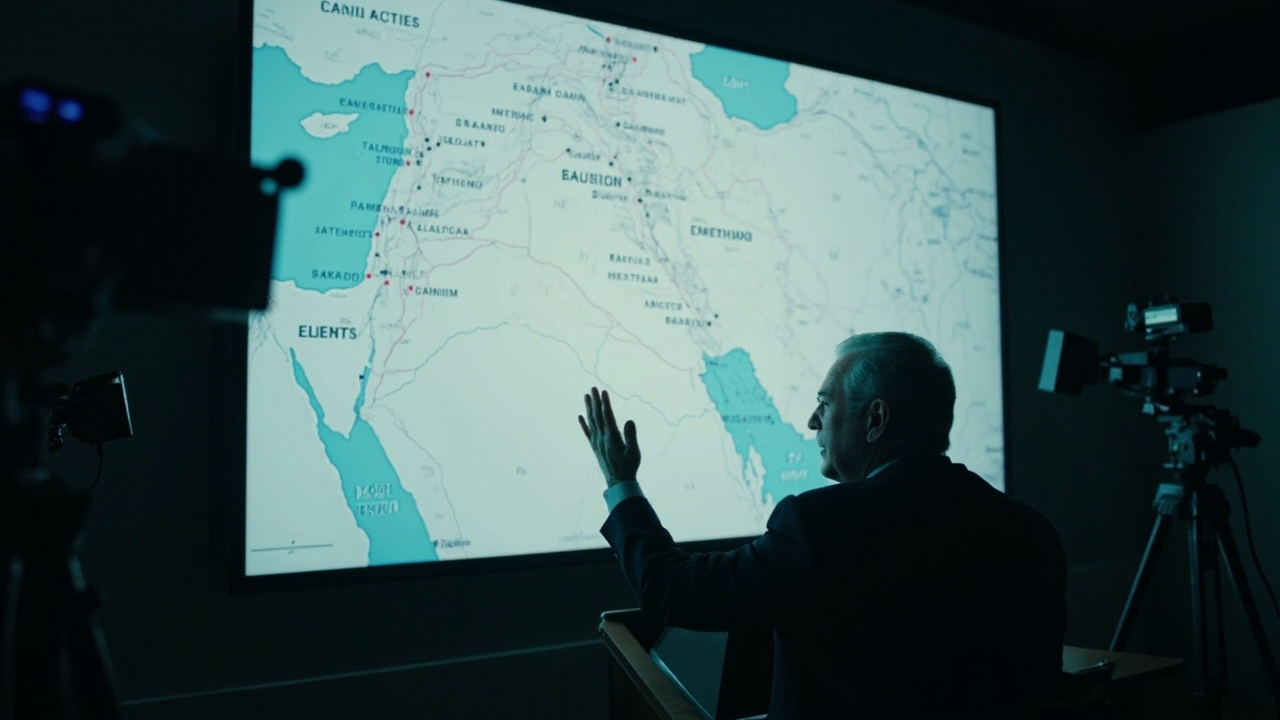
Standing before a map of the Middle East — a map that, observers quickly noted, showed the occupied West Bank subsumed within the state of Israel — Netanyahu described how six countries "wanted to strangle us" and declared: "We strangled them. And we have more to do." [1]
The timing was not coincidental. The speech was pre-recorded and released while the Islamabad negotiations were still underway. Its message was directed not at Tehran but at Washington, Brussels, and the Israeli public: whatever Vance negotiates, Israel considers the military campaign a success and intends to continue.
As this paper reported on Friday, the ceasefire framework being discussed in Islamabad explicitly excluded Lebanon. Netanyahu's speech confirmed why: Israel has no intention of stopping operations against Hezbollah, regardless of what Washington and Tehran agree.
The Speech
Netanyahu claimed that the joint U.S.-Israeli campaign had "succeeded in crushing the nuclear programme, and crushing the missile programme." He described Iran's leadership as weakened and "seeking a ceasefire" — framing Tehran's willingness to negotiate not as diplomacy but as capitulation. [2]
"They wanted to strangle us, and now we are strangling them," he said. "They threatened us with annihilation, and now they are fighting for survival."
The rhetoric was not new. Netanyahu has used similar language throughout the conflict. What was new was the staging. The map behind him — Israel highlighted in blue, the occupied West Bank incorporated without distinction — constituted a visual statement that commentators immediately identified as a de facto annexation declaration. [3]
Itay Epshtain, a policy analyst, posted on X that Netanyahu "appears on television in a pre-recorded address, with all the staged choreography one associates with authoritarian regimes, speaking of Iran ad nauseam. Yet the map behind him tells the real story. Israel, as far as this government is concerned, has completed the annexation." [3]
Lebanon
The most consequential section of the speech concerned Lebanon. Netanyahu said Beirut had "reached out several times to begin direct peace talks" and that he had approved such discussions, but with two conditions: the dismantling of Hezbollah's weapons and "a real peace agreement that will last for generations." [2]
These conditions are, in practical terms, preconditions for surrender. Hezbollah will not disarm voluntarily. A peace agreement predicated on disarmament requires either military defeat or international enforcement that does not exist.
Meanwhile, Israel's operations in Lebanon have continued without interruption through the ceasefire period. The Lebanese health ministry reports that since March 2, Israel has killed at least 1,953 people in Lebanon, including 248 women, 165 children, and 85 medical and emergency workers. An estimated 1.2 million people have been displaced. [4]
Israel carried out its largest air attack on Lebanon since March 2 earlier this week, targeting what it described as more than 200 Hezbollah positions. The strikes came while the ceasefire between the U.S. and Iran was nominally in effect — illustrating the gap between the ceasefire's text (which covers U.S.-Iran hostilities) and Lebanon's reality (which the ceasefire does not address). [4]
The Map
The map deserves separate attention. Netanyahu has a documented history of using maps as rhetorical props — at the United Nations in 2023, he displayed a "New Middle East" map that erased Palestine entirely. Saturday's version was more subtle but equally deliberate. [3]
The map showed Israel, Gaza, and neighboring states. The West Bank was not demarcated as a separate territory. It was simply part of Israel, colored in the same blue.
This came days after Israeli media reported that the cabinet had secretly approved a record number of new settlements in the occupied West Bank. The map was not an error. It was a policy statement rendered in cartography.
The Timing Problem
Netanyahu's speech created a diplomatic problem that will outlast the weekend. Iran's delegation in Islamabad included demands that any permanent agreement cover Lebanon — that a ceasefire between the U.S. and Iran must extend to Israeli operations against Hezbollah. The United States rejected this linkage. Netanyahu's speech made the rejection explicit: Israel will continue in Lebanon regardless of any deal.
For Tehran, this confirms that a deal with Washington does not buy peace. It buys a pause on one front while another continues. For Vance, negotiating in Islamabad, the speech complicated an already impossible position. He could not promise Iran that a deal would stop the killing in Lebanon because his most important ally was publicly promising to continue it.
The map, the speech, the timing — all pointed in the same direction. Netanyahu was not speaking to the room in Islamabad. He was speaking past it, to an audience that does not negotiate and does not compromise.
-- YOSEF STERN, Jerusalem