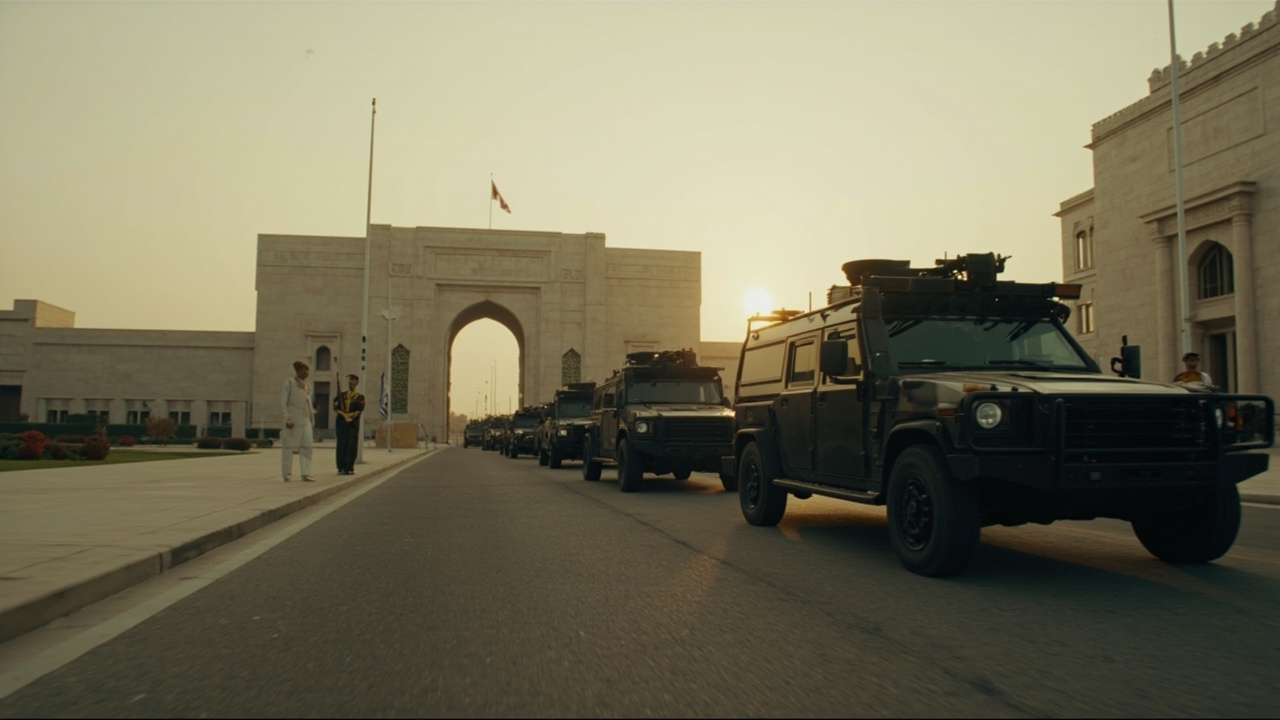
ISLAMABAD — The composition of the American delegation that arrived on Air Force Two Saturday told a story before anyone sat down. Vice President JD Vance, special envoy Steve Witkoff, and Jared Kushner — the president's son-in-law — stepped off at Nur Khan Airbase in Rawalpindi and were received by Pakistan's Deputy Prime Minister Ishaq Dar, Army Chief General Syed Asim Munir, and Interior Minister Mohsin Naqvi. [1]
As Friday's dispatch from this paper noted, the architecture of the talks was already strained. What the delegation roster confirmed is that the Trump administration opted for personal diplomacy over institutional negotiation. No State Department principals. No arms control specialists. No one from the National Security Council's nonproliferation directorate. This is a deal team, not a policy team.
Vance leads. He warned Iran before departure not to "play" the United States, telling reporters that "if they're going to try to play us, then they're going to find the negotiating team is not that receptive." He reportedly spoke to Trump a dozen times throughout the day as talks stretched into the evening. [1]
Witkoff is the connective tissue. The real estate investor turned special envoy has shuttled between capitals since March, carrying messages when neither side would speak directly. His presence in Islamabad is less about policy expertise than about proximity to the president. When Trump posts on Truth Social that a deal is close or far, Witkoff's briefings are often the source.
Then there is Kushner. His portfolio in the first Trump administration was the Abraham Accords — a transaction-based approach to Middle East diplomacy that prioritized bilateral deals over multilateral process. His return to the table signals that Washington views these talks less as nuclear nonproliferation negotiations and more as a grand bargain: sanctions for enrichment, Hormuz for reconstruction, regional architecture for normalization.
The contrast with the Iranian side is instructive. Tehran sent seventy delegates — political, military, economic, and legal teams — led by Parliament Speaker Ghalibaf and Foreign Minister Araghchi. The American side brought dealmakers. The Iranian side brought a government. Whether that asymmetry is a strength or weakness depends entirely on what each side believes it is negotiating.
This is the first visit by a U.S. vice president to Pakistan since Joe Biden came in 2011. The symbolic weight is not lost on Islamabad, which has positioned itself as the indispensable mediator. Prime Minister Shehbaz Sharif called the talks a "make-or-break moment" in a televised address Friday. [1]
-- SAMUEL CRANE, Washington