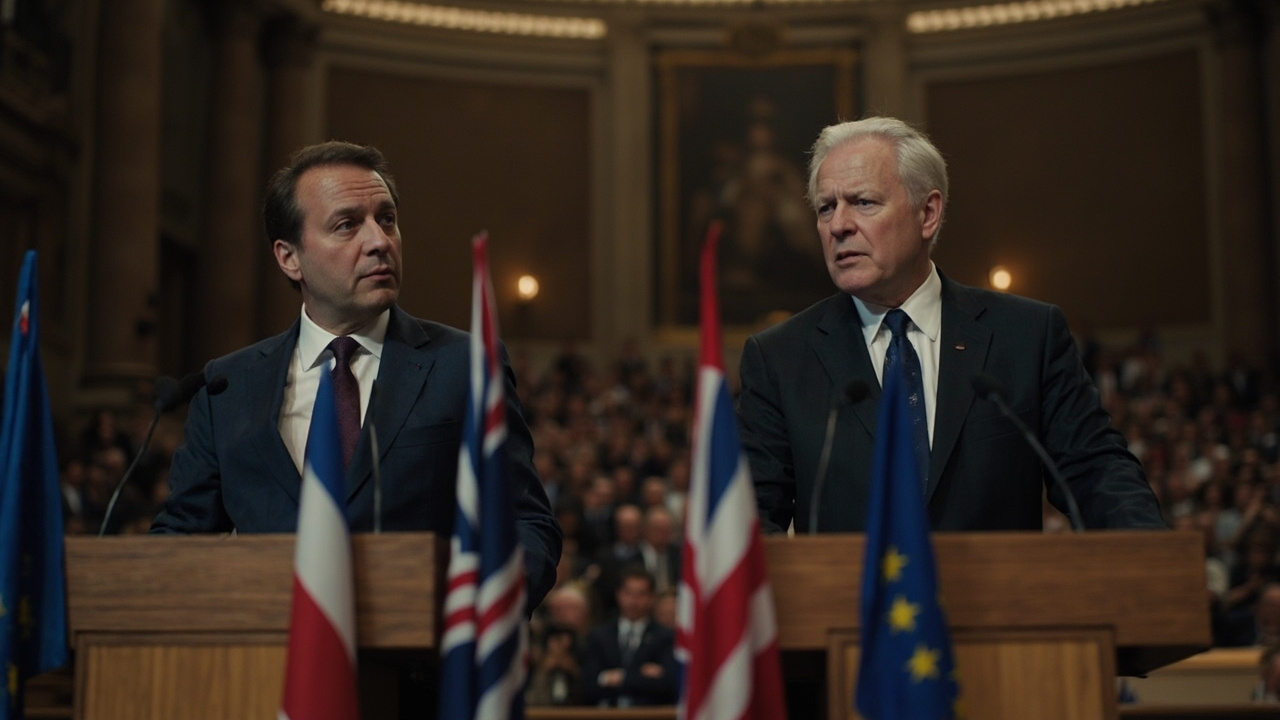
On Friday, April 18, Emmanuel Macron and Keir Starmer will co-chair a Paris conference to build what their governments are calling a "strictly defensive multinational naval mission" to restore freedom of navigation through the Strait of Hormuz. More than 40 nations have been invited. [1]
This paper's report yesterday on the Franco-British push for a European breakaway from Washington's Hormuz doctrine identified the structural tension: the US is blockading ships passing through the strait, and Europe now proposes to escort them through. Those are not complementary policies. They are opposing ones.
The Elysée confirmed that Macron will chair the conference from Paris. The British co-chair is a statement: for the first time since Brexit, London and Paris are constructing a significant joint security initiative without either a NATO mandate or American blessing. [2]
The mission's framing matters enormously. The word "defensive" is doing heavy diplomatic lifting. A purely defensive escort mission can claim to be compatible with international law and the UN Convention on the Law of the Sea. The US blockade, by contrast, has no UN authorization and relies entirely on American power-projection. European governments know that joining the US operation — however tacitly — would expose them to legal and economic liability in the event of a shipping incident. Hence the emphasis on independence. [1]
What the conference will actually produce is less certain. The Guardian notes that Britain's surface fleet has been stripped to a historically low state — the Royal Navy currently has fewer operational frigates than it did during the Falklands. [2] A British co-chair who cannot provide warships is a political gesture more than a military commitment. France is in somewhat better shape, with a functional carrier strike group and more destroyer capacity, but not enough to sustain a high-tempo escort mission against potential Iranian countermeasures while the US operates simultaneously in the same waters.
The 15-nation core appears to include France, Germany, the UK, Spain, Italy, and several non-European maritime powers from Asia and the Gulf. [1] Several invitees declined to publicly confirm attendance ahead of Friday — a measure of how diplomatically charged the conference is. To join it is to implicitly criticize the American operation. To decline is to acquiesce to it.
The legal architecture is the most consequential variable. The European approach appears to be constructing the mission under a UNCLOS freedom-of-navigation framework, explicitly rejecting any belligerent characterization. This is in direct contrast to the US, which has invoked broad national security authority and explicitly treated the blockade as an enforcement mechanism. [2]
What has emerged, in the space of six weeks, is a formal split within the Western alliance over the fundamental question of who controls the world's most important maritime chokepoint. The US says it does, by right of power. Europe says no one does, by right of law.
The conference on Friday will not resolve that argument. It will, however, force every nation that attends to take a visible position on it. That is Macron's actual objective — not a naval mission, but a diplomatic alignment that establishes Europe as an independent actor in whatever postwar settlement follows. [1]
Britain's role is the most ambiguous. Starmer's government has been attempting to maintain close ties with both Washington and Brussels simultaneously — a position that Friday's conference will make considerably harder to sustain. Whitehall sources cited by the Guardian note the tension explicitly: the US has not been consulted on the conference, and Washington is not pleased. [2]
The countries of the Global South, which bear the actual fuel costs of a closed strait, are watching Friday's conference more carefully than many European commentators have noticed. For them, the question is not transatlantic politics but practical access to energy. An independent European escort corridor, if it materialized and if it worked, would provide an alternative to dependence on either American permission or Iranian tolerance. That possibility is what makes the Paris conference something more than a symbolic exercise — and what makes Washington's silence on it so pointed.
-- CHARLES ASHFORD, London