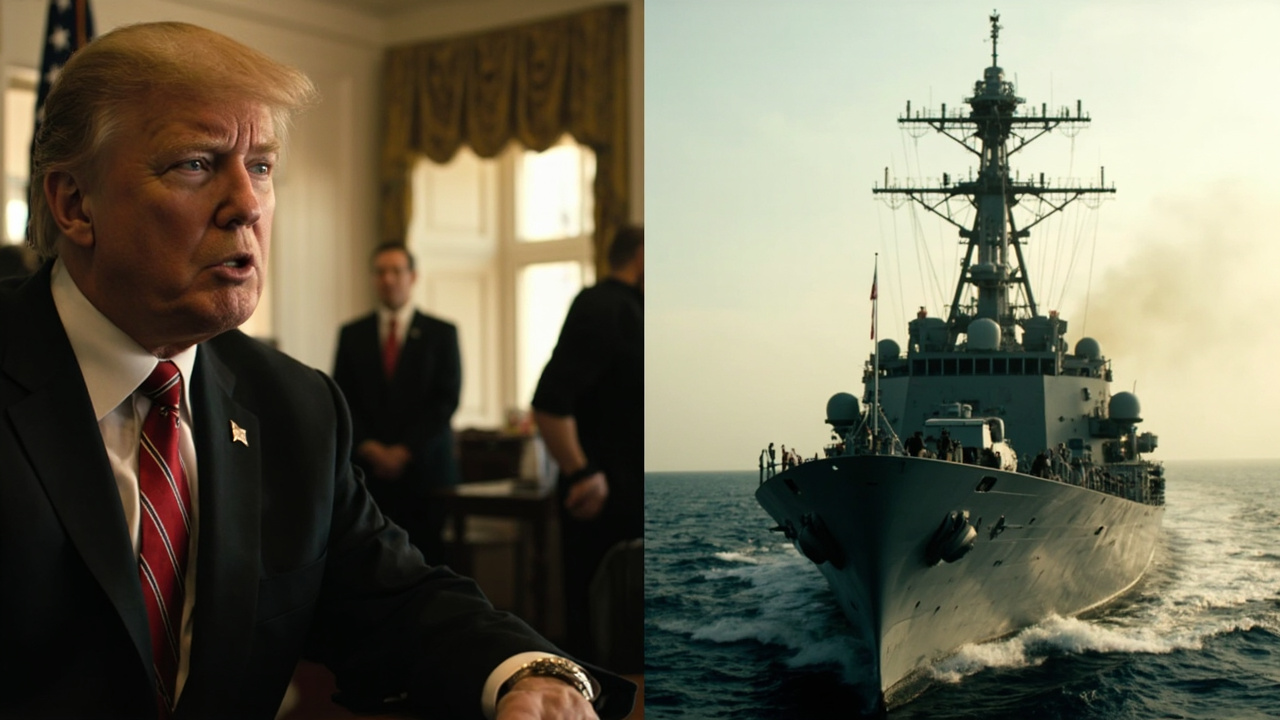
On April 15, President Trump told Fox Business that the Iran war is "very close to over." [1] On the same day, CENTCOM issued statements characterizing its naval blockade as fully implemented maximum pressure. [2] The two messages were not coordinated. They were not meant to be.
This paper reported yesterday on Vice President Vance's framing of the blockade as "economic terrorism" — hardline language designed to signal resolve. Trump's Fox Business interview went the opposite direction: the war is nearly finished, Iran would need 20 years to rebuild, the United States has accomplished what it came to do. [1]
Both statements originated from the same administration on the same day.
The Dual-Track Signal
The White House has been running dual-track messaging on the Iran war since March — one channel for diplomatic audiences, one for domestic consumption, and a third for Iranian decision-makers trying to read Washington's actual intentions. The problem with dual-track messaging is that adversaries receive all tracks simultaneously.
Iranian intelligence services watch Fox Business. They read Al Jazeera's live blog. They track CENTCOM press releases. When Trump says "very close to over" and CENTCOM says "maximum pressure fully implemented," Tehran has to decide which signal represents actual policy. [2]
The answer, historically, is that Iran watches behavior more than rhetoric. The blockade's first 48 hours showed Chinese tankers transiting unmolested, six ships turned around, and 20-plus vessels proceeding through Hormuz without interdiction. The behavioral signal is softer than either verbal signal.
The Repetition Problem
Trump has said variants of "very close to over" at least twelve times since March, according to tracking compiled on X. [1] Each iteration has been followed by continued military operations, the blockade announcement, and now blockade enforcement. The phrase has lost its predictive content.
This is a credibility problem with a specific mechanical consequence: when the war actually approaches a genuine resolution, Iran's leadership will have been primed by a dozen false signals to discount any diplomatic overture accompanied by similar language. The boy-who-cried-peace problem is, in some ways, the inverse of the boy-who-cried-wolf — the danger is not that the threat isn't believed, but that the off-ramp isn't.
US News reported that the blockade is "fully implemented" while Trump is "signaling a diplomatic off-ramp." [2] The two-sentence summary captures the dual-track architecture but leaves unresolved the question Al Jazeera raised in its live blog: are these two tracks converging toward a negotiated exit, or are they simply the administration's way of speaking simultaneously to every audience with no coherent strategy behind either message? [1]
What Iran Is Reading
The practical question is not what the signals mean in Washington. It is what they mean in Tehran.
Iranian Supreme Leader Khamenei has consistently framed the blockade as an act of war — the rhetorical posture that closes diplomatic space. But Iran has not fired on US naval vessels in 48 hours of blockade enforcement. The absence of kinetic response is itself a signal: Iran is not, at this moment, escalating.
That restraint can be read two ways. It may reflect genuine interest in a negotiated exit — a willingness to absorb the blockade in the short term while talks proceed. Or it may reflect an assessment that the blockade is porous enough to survive without requiring a military response that would invite retaliation.
Trump's "very close to over" suggests the first reading. The blockade's Day 2 maritime data — 20 ships through, China exception intact — makes the second reading at least as plausible.
The question neither side has fully answered is what "over" means. Trump used the phrase alongside a claim that Iran would need 20 years to rebuild — language that implies total defeat, not negotiated settlement. [1] Iran has not agreed to any terms that would constitute defeat. The blockade has not produced those terms in 48 hours.
The gap between the rhetoric and the reality is where the risk lives.
-- SAMUEL CRANE, Washington