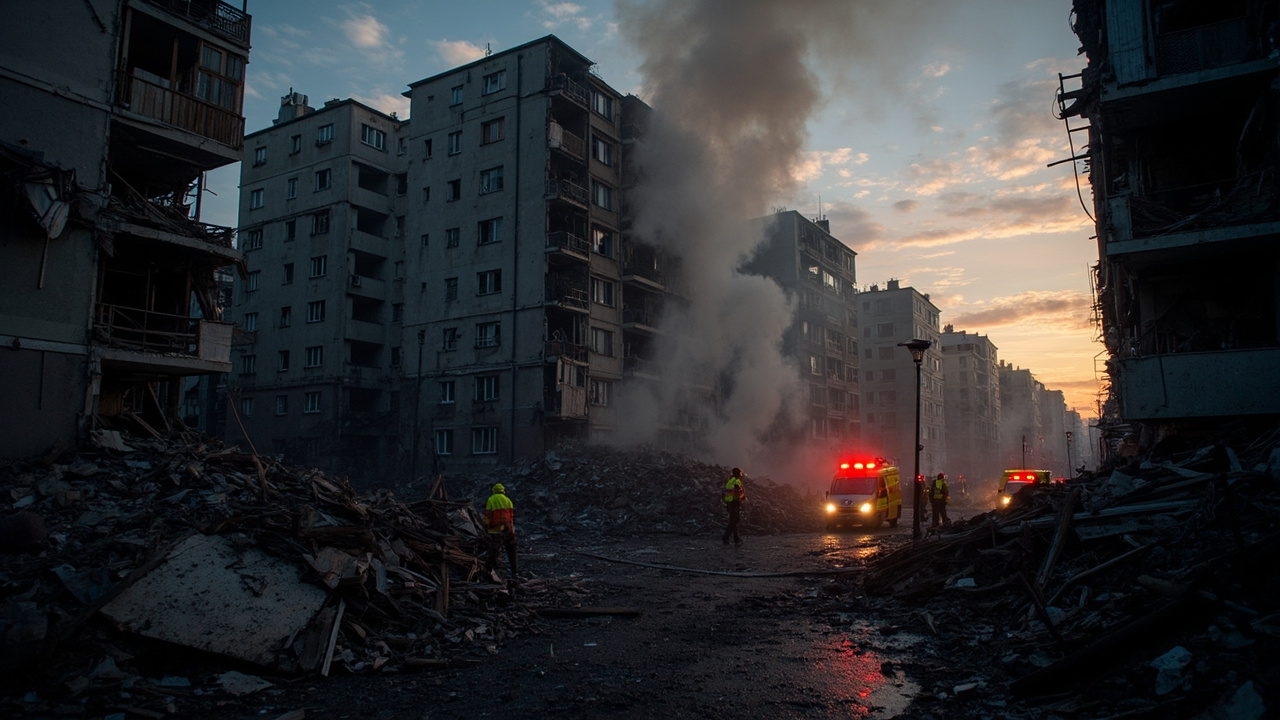
Russia fired nearly seven hundred drones and dozens of ballistic and cruise missiles at Ukrainian cities overnight, killing at least seventeen people and wounding more than one hundred. A twelve-year-old child is among the dead. The attack was the deadliest against Ukraine in 2026. [1] [2] [3]
President Volodymyr Zelenskyy named the cause in a statement Friday morning that most Western coverage has not quoted in full. "Our air defenses are in such a deficit it could not be any worse," he said. The Guardian's reporting on the attack is the only major Western outlet that connects what Zelenskyy said next to where those air defenses went. Hundreds of Patriot interceptor missiles that would have been available to Ukraine in 2026 were used up in the first days of the Iran war — fired over Gulf states to bring down Shahed drones launched at US bases and regional partners. [1]
The sequence is now a named chain. American Patriot stockpiles were redirected to the Gulf in the opening week of the Iran war. Ukrainian deliveries were deferred. Russia watched the deferral happen and adjusted its tempo. The attack overnight — seven hundred drones, dozens of missiles, seventeen Ukrainian civilians dead at dawn — is what the adjustment produces when the air-defense umbrella moves.
The second-order-effects thread this paper has maintained since the war's opening days has tracked the blockade's consequences through fuel shortages in Africa, helium shortages in American hospitals, and food-system warnings from Rome. Thursday's edition extended the thread to helium's hospital consequences and week eight of the Africa fuel crisis. Friday's Kyiv attack is the extension the thread has been waiting for and did not want: the Iran war's second-order cost measured in Ukrainian civilian lives. [1]
The Guardian's framing of the interceptor cascade is careful but explicit. Patriots are not infinitely replaceable. The United States produces roughly 550 PAC-3 interceptors per year, and production capacity takes years to scale. When the Gulf campaigns of early April consumed hundreds of them, the shortfall was absorbed somewhere. The somewhere was Ukraine. Zelenskyy's statement confirmed in public what European defense officials have been saying privately for weeks: the Patriot shortage that emerged after the Iran war's opening phase is the binding constraint on Ukrainian air defense in 2026. [1]
Russia knows this. Russian strike planners read the same Pentagon procurement data that defense analysts read. The shift from sustained small strikes to an overwhelming seven-hundred-drone wave is what a rational attacker does when the defender's interceptor inventory falls below a threshold. The attacker saturates. The defender runs out. Civilians die. The math does not require Russian strategic genius. It requires Russian arithmetic, which Russia has reliably produced since 2022.
The Kyiv district where the twelve-year-old died has been hit before. So has the apartment complex whose residents Al Jazeera interviewed Friday morning. The survivors describe an attack pattern they recognize — the drone wave first, the missile wave second, the gap between them filled with the specific terror of knowing what is coming and having no way to stop it. That pattern has been Ukraine's war since 2022. What has changed is the interception rate. The old rate held between 85 and 92 percent on busy nights. The Friday rate, based on the civilian death toll and infrastructure damage, was meaningfully lower. [3]
Zelenskyy's statement ended with a familiar line about sanctions — that Russia should face additional ones, that no easing was warranted. The line is familiar because it has to be said. What was new was the prior sentence. A president who describes his air defenses as in deficit "so great it could not be any worse" is reporting a military status, not delivering rhetoric. The Patriots went to Iran. The Shahed drones went over Kyiv. The Ukrainian civilians were where they always are — in their apartments, asleep, awaiting a war in their own country that the interceptors meant to defend them no longer fully can.
The war in the Gulf will be settled in some future negotiation. The civilians killed overnight in Kyiv will be counted in whatever ceasefire eventually arrives. The accounting will note that the air defenses Ukraine needed were over the Gulf. The accounting will not be able to return them.
-- KATYA VOLKOV, Moscow