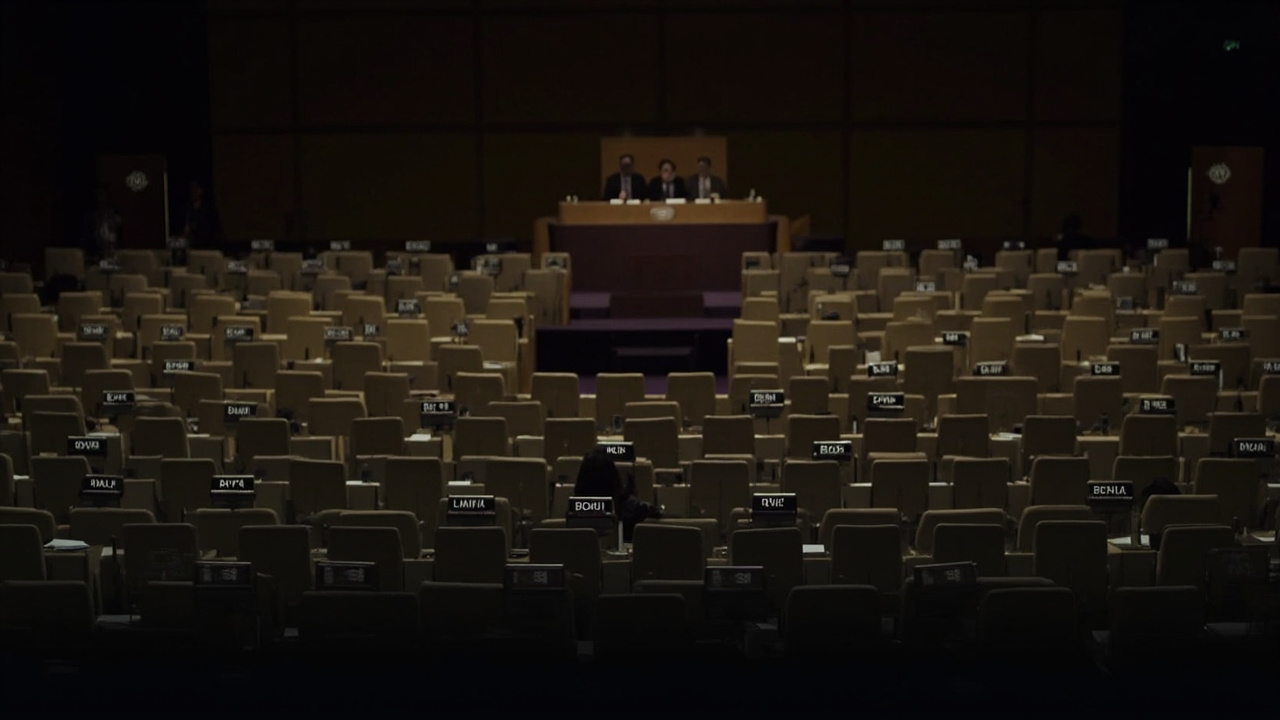
The G20 finance ministers and central bank governors met in Washington on Thursday and Friday and produced no joint statement. Disagreement over the Middle East war is the stated reason. [1] South Africa, which held the G20 presidency last year, was not in the room; the Bloomberg account confirms Finance Minister Enoch Godongwana was not accredited by the United States — the chair of this year's summit. [2] The forum has slipped from collective action to a negotiation about who is allowed to speak.
Japan's finance minister Satsuki Katayama told reporters the absence of a communique "may be a message to the US side," a formulation unusual for the Japanese finance ministry. [3] The message is that a chair cannot simultaneously be a subject. Washington sanctioned one fellow member over the war; excluded another over an ICJ case; threatened a third with secondary measures over oil purchases. The rest of the table watched.
The IMF and World Bank Spring Meetings conclude Saturday. The formal communique deficit will be papered over by a chair's summary or a staff-level statement. The substantive deficit is harder to repair. A G20 without a joint statement is not a G20; it is twenty letters on separate letterheads. The architecture built in 2008 to coordinate a financial crisis has encountered a geopolitical crisis it cannot coordinate because the coordinator is itself the fault line. The paper has long argued that the war's consequences run beyond the strait. Friday in Washington proved that the institutions built for peacetime commerce do not survive a wartime chair.
-- THEO KAPLAN, San Francisco