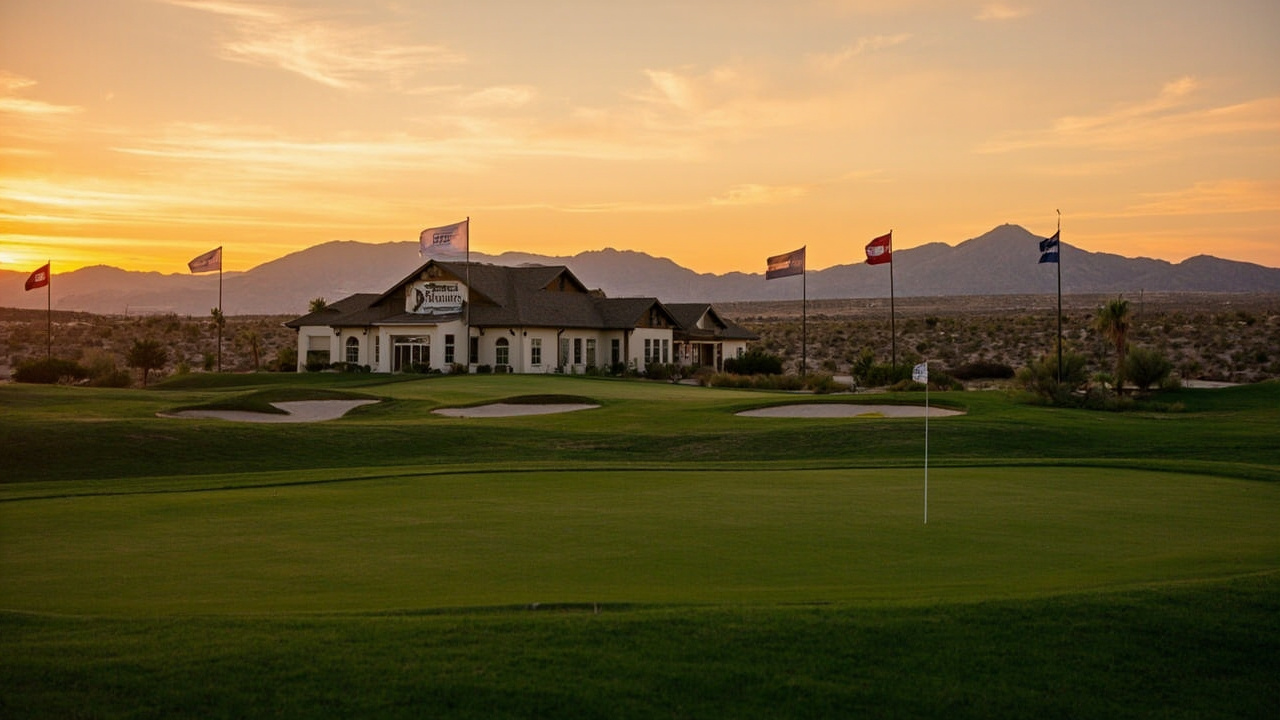
The Aramco Championship at Shadow Creek ended two Sundays ago. Lauren Coughlin won. [1] The purse was $4 million. The field included Nelly Korda, Charley Hull, Lydia Ko, Patty Tavatanakit, and Minjee Lee; it did not include Nasa Hataoka, Lexi Thompson, or Stacy Lewis, each of whom had declined to play. The event — the first sanctioned American tournament staged by Saudi Arabia's Public Investment Fund through its Golf Saudi arm — is now two weeks in the rear-view of a season that will move to Bradenton, Florida, next. What it was, and what it was a door to, is worth writing down before the calendar turns.
Shadow Creek, the Tom Fazio design Steve Wynn built in the desert north of the Las Vegas Strip in 1990, previously hosted the T-Mobile Match Play and a rotating slate of silly-season exhibitions. It is a course that trades on its opacity — a reservations-only enclave where hosting a sanctioned professional event is the rarest thing that happens to it. That the LPGA and Ladies European Tour co-sanctioned the event with Golf Saudi as title sponsor is not a calendar anomaly. It is a completed transaction. [2]
The PGA Tour has spent three years attempting — and not yet completing — the merger with PIF-owned LIV Golf first announced in June 2023. Multiple deadlines have come and gone. The Trump administration's re-engagement with the Saudi sports portfolio after the November 2024 election produced a new round of framework conversations, then another delay. [3] The language the PGA Tour uses is exacting: framework agreement, investment structure, competitive discussions. The language the LPGA used in early 2025, negotiating the same sovereign wealth fund, was shorter: yes.
The case against the door is the case the critics made during tournament week. Stacy Lewis, on a March 25 SiriusXM podcast, described the event as "PIF money buying legitimacy we give them by showing up." [4] Rose Zhang said the purse was not an argument she wanted to have with herself. The impression of a schism did not survive the Wednesday pro-am. Fourteen of the world's top 20 teed it up.
The case for the door is narrower and harder to dismiss. The LPGA's total 2025 purse was $131 million; the PGA Tour's was $505 million. [5] A $4 million event is 3 percent of the women's tour's annual prize pool. Adding Aramco moved the LPGA average to its highest number in history. Karrie Webb made the argument on her podcast in February: if the PGA Tour will not take sovereign-wealth money cleanly and the LPGA cannot grow the purse gap without it, the choice to play has a revenue-share dimension men's golf's critique is designed not to see. [6]
The LPGA's yes is an argument that women's professional sports have a different revenue math — sovereign-wealth money hits a tour with lower existing scale harder and cleaner than it does a tour with $500 million in annual purses. Aramco at Shadow Creek is not the end of that argument. It is the first data point.
The Aramco Championship will return to Shadow Creek in April 2027 with a purse the tour will not publicly confirm but is understood to be larger. [7] The argument stops being about whether the LPGA said yes, because it did, and starts being about what the purse looks like three years from now. The T-Mobile Match Play's empty slot on the Shadow Creek calendar is the answer Las Vegas printed first.
-- AMARA OKONKWO, Lagos