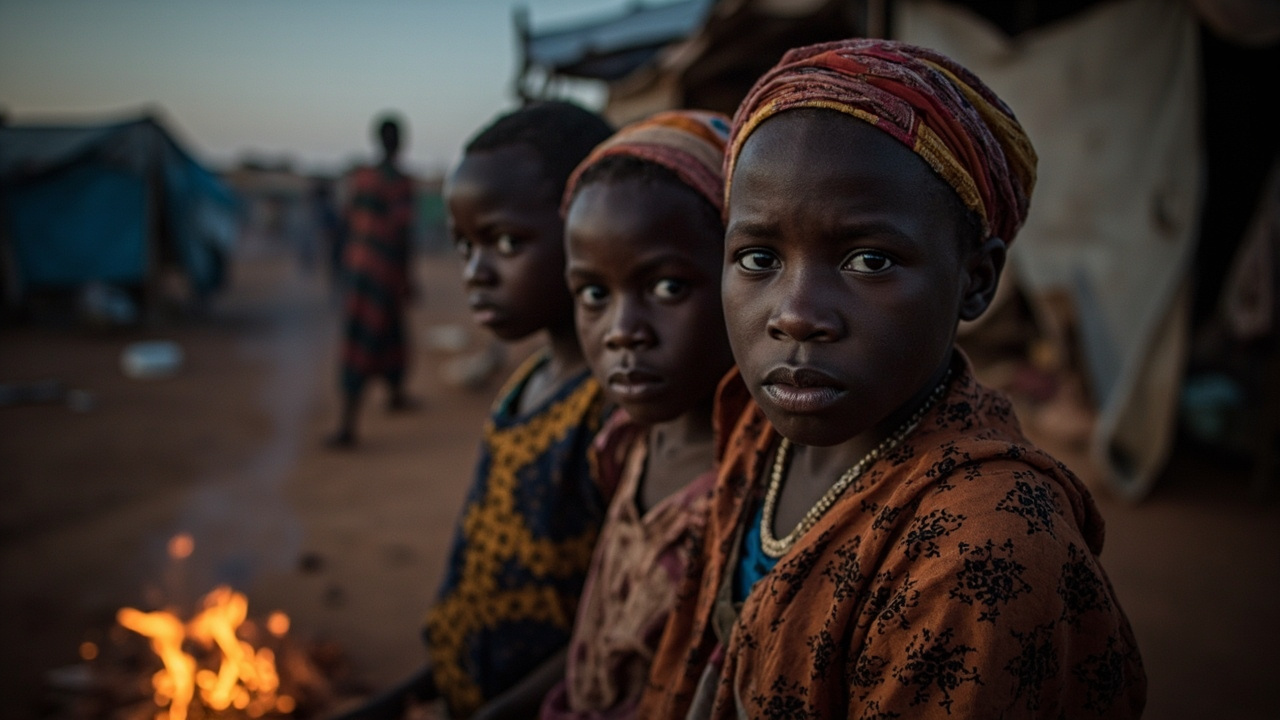
Sudan's war began on the morning of April 15, 2023, when the Sudanese Armed Forces and the Rapid Support Forces opened on each other at the presidential compound in Khartoum and the two generals who had agreed to share the country could no longer agree on how. Three years have passed in the literal counting. The war, which has devoured cities and crops and the organised memory of a people, entered its fourth year on Wednesday.
The anniversary was observed, as anniversaries of the forgotten are, with the language of the United Nations and the punctuality of human-rights organisations whose letters arrive on time because their suffering does not. [1] Secretary-General António Guterres called for the flow of weapons into Sudan to stop. [2] That flow has come, across three years, from the United Arab Emirates to the Rapid Support Forces and from Iran and Russia to the Sudanese Armed Forces, and from shadow-corporation supply chains that feed both sides. More than 14 million people have been displaced. [3] More than 30 million need assistance. More than 22 million face acute hunger. El-Fasher has held against the siege; Omdurman has been retaken; Darfur has been emptied again, as it was emptied in 2003 when the word genocide was, for a season, in use.
One writes of Sudan the way one writes of a cousin in a letter no one will open. What is missing is the secondary event — the sustained international attention that, when a war of this scale runs this long, is the architecture by which pressure is applied to the warring parties. That architecture has not assembled. The UN Security Council has met, the African Union has condemned, the foreign ministers of a half-dozen countries have issued statements, and none have produced the thing statements assemble into when the world is looking: a ceasefire with monitors, a sanctions regime the combatants feel, a humanitarian corridor underwritten by the United States, the European Union, and China jointly. [4]
The asymmetry can be named arithmetically. In April 2026, American newspapers — the New York Times, the Washington Post, the Wall Street Journal, the Los Angeles Times, the Boston Globe, and the AP domestic service — published approximately forty American-bylined stories on the Iran war for each one on the Sudan war. [5] This paper has done better and has not done enough. The ratio is neither conspiracy nor coincidence. It is what emerges when a war happens in a country whose diaspora is small in the United States, whose geopolitical significance is indirect, whose imagery does not reliably generate the clicks that generate the assignments. The ratio has consequences. The weapons continue to flow to combatants whose conduct does not attract the scrutiny organised attention produces. [6]
What remains is the register. One writes of Sudan in the only voice honest to it — a voice that does not pretend the cameras are there when they are not, that does not inflate the Guterres statement into a diplomatic event, that does not sentimentalise the figure of fourteen million into a metric one has grown accustomed to. El-Fasher has held. Khartoum is half a city. The Darfur roads are emptied of everyone a vehicle can empty them of. The fourth year has begun. The men in the fatigues in Port Sudan and the Khartoum suburbs will make their April decisions with the confidence that the weekend papers will, again, be preoccupied by something closer to home. [7]
The anniversary window closes this weekend. The war will continue past it.
-- LUCIA VEGA, São Paulo