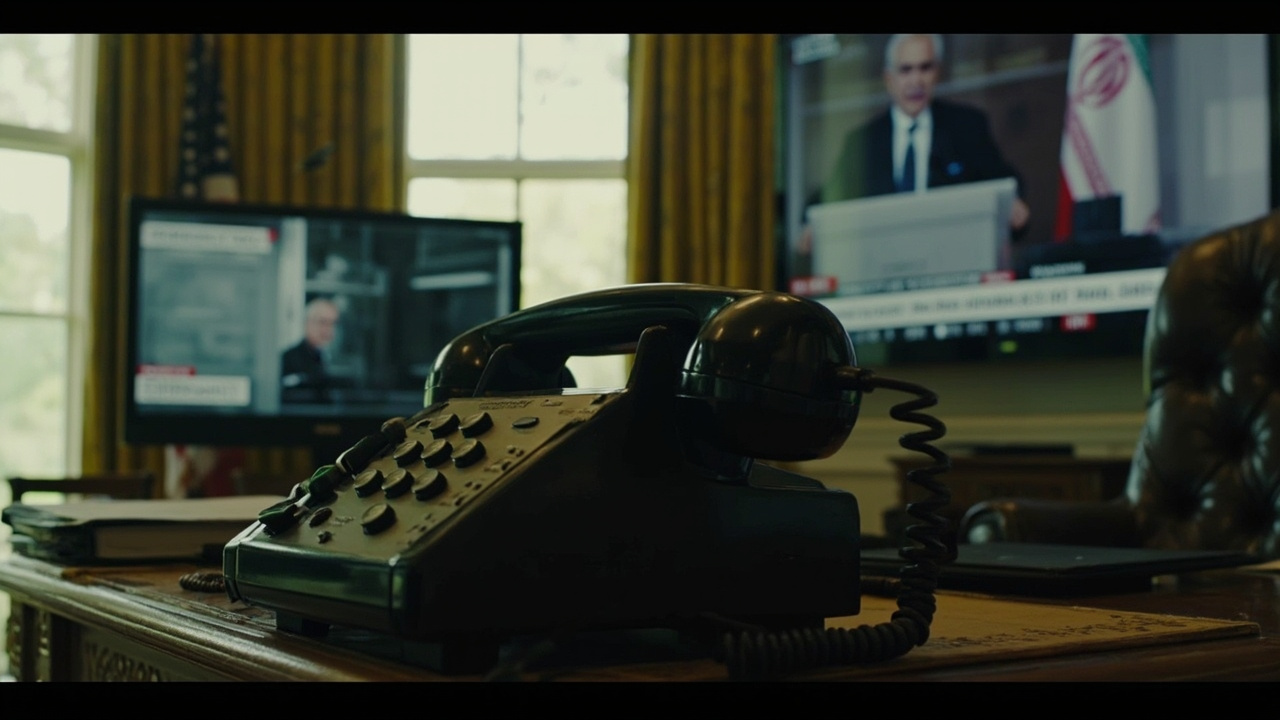
At roughly noon Eastern on Friday, President Trump told Reuters by phone that Iran had "agreed to everything" and that the United States would "go in with Iran, at a nice leisurely pace, and go down and start excavating with big machinery" to recover Tehran's enriched uranium stockpile and bring it back to the United States. [1][2] He said in the same call that Iran had agreed to permanently suspend enrichment. [3] By 5:40 p.m. Eastern — six hours later — Iran's foreign ministry spokesman Esmaeil Baqaei had delivered a rebuttal on Iranian state television. "Iran's enriched uranium is not going to be transferred anywhere," Baqaei said. "Transferring uranium to the United States has not been an option for us." [4][5] He added that the enriched stockpile was "as sacred to us as the soil of Iran." [6]
That is the fifth public revision of the stated aims of the Iran war in sixty days. It is the first where the counterparty rebutted the revision in real time on the record.
The sequence, timed
The Reuters interview went on the wire at approximately 11:47 a.m. Eastern. [1] Trump's quotes were reproduced within 30 minutes across AP, Times of Israel, Middle East Eye, and Al Jazeera. [2][3] By 2:00 p.m. Eastern Iranian state TV had aired a live remark from Baqaei; by 3:00 p.m. Tasnim News had published his full rebuttal in Farsi; by 4:30 p.m. English translations were circulating via Iran International and Drop Site News. [6][7] The Jerusalem Post had Baqaei's "not going to be transferred anywhere" line on the record by early evening. [5] Six hours — generous — from claim to counterparty denial.
The Guardian's analysis piece by early Friday evening compared the boast to George W. Bush's "Mission Accomplished" speech. [8] The Los Angeles Times led with "Outlines of a deal emerge with major concessions to Iran — a development that, if true, would mark a dramatic reversal." [9] The subordinate clause — if true — was doing the work. By the time the LA Times piece went to web, Baqaei's denial was in the Reuters feed.
What Trump said, what Iran agreed to
The specific claim Trump made to Reuters and in a concurrent Bloomberg phone call was that Iran had agreed to (1) permanently suspend uranium enrichment, (2) transfer its enriched uranium stockpile to the United States, and (3) sign a written peace deal that was "mostly complete." [1][10] Iran's public response addressed each piece. On enrichment, Baqaei did not explicitly deny a suspension but framed the country's nuclear rights as "inalienable" and "not a topic that will be discussed." [4] On transfer, the denial was total: "under no circumstance," "not going anywhere," "as sacred as Iranian soil." [5][6] On the written deal, the foreign ministry noted that no text had been provided to them for review.
The three claims and the three rebuttals are not symmetric. The enrichment suspension could have been negotiated; the transfer had never been on Iran's table at any round of the Islamabad Process; the written deal had no document. Trump's phone call produced one claim that was negotiable, one that was fabricated at the point of announcement, and one that did not exist as a text. The pattern is familiar from the war's previous aims-revisions — each successive stated objective has been narrower than the one before, but the broader public framing has continued to describe the war as expanding its ambitions.
The five revisions, compressed
The war's stated aims have now been revised five times in sixty days. Revision one, in late February, was elimination of Iran's nuclear weapons program. Revision two, in early March, was the decapitation of the IRGC leadership, producing the Tangsiri strike. Revision three, in late March after the strait's closure, was the reopening of the Strait of Hormuz. Revision four, in mid-April after the Pakistan mediation stalled, was a comprehensive ceasefire leading to permanent sanctions relief. Revision five, on Friday, was the retrieval and transfer of Iran's enriched uranium to the United States under the framework of a peace deal.
The paper's position, set on March 26 and carried through subsequent editions, has been that the aims-revision pattern is the war's structural feature rather than its rhetorical noise. Each revision has arrived after the previous aim became operationally unattainable, and each has been followed by the administration describing the new aim as the original intention. Friday's revision follows the shape. The uranium-transfer claim arrived on the first afternoon the strait's reopening was no longer a gainable objective — because it had, in Araghchi's own language, reopened. A new aim was needed to carry the war's stated forward momentum. The uranium-transfer claim supplied it.
What is different on Friday is that the counterparty did not wait two weeks to clarify the record, as it had in previous cycles. Baqaei's denial arrived same-day, on state television, in English translation, with a specific quote calibrated for circulation on Western media. The Iran-side media operation has learned that the delay between an American aim-revision and a counterparty rebuttal is the period during which the revision gets absorbed into the public record as fact. On Friday, that window was closed.
What Reuters printed, and what it did not
The Reuters filing is worth reading for what it did not quote. The "leisurely pace" line became the lead; the "agreed to everything" line became the hook; the "big machinery" line supplied the imagery. The filing did not quote any Iranian official, any US official other than Trump, any IAEA inspector, or any Gulf-state mediator. It was a single-source filing on a claim that, on its own terms, required a second source. By evening, the second source — Baqaei, on state television — had made clear that the first source's account was not shared.
Most major American outlets had by late Friday evening caught up. The NBC live blog led with the Baqaei denial alongside Trump's claim; the AP had both; the NYT's live feed noted the denial in a rolling update. [11] The outliers were the outlets that had gone first and hardest on the surrender framing. None of them issued corrections; they updated. The record of what Friday afternoon's newspapers said — the 3 p.m. headlines, the evening news cues — will show the claim carried three hours more than the denial did. That is the operating value of speed in aim-revision management.
The structural point
The structural point beneath the timing is what the paper's April 17 FISA coverage and April 16 War Powers coverage both named: the war's architecture has drifted further from the branches of government nominally authorizing it. Congress could not vote its War Powers resolution to passage. The Senate patched Section 702 by unanimous consent rather than legislate it. The president is conducting belligerency policy by phone interview with Reuters. The counterparty rebuts by state TV. The negotiating process, which Pakistan was formally coordinating, has four capitals and no date.
In an architecture like that, the fifth aim-revision is not a rhetorical choice. It is the instrument by which the war is conducted at all. If the president cannot obtain a vote from Congress to authorize continued combat, and if the secretary of defense is under six impeachment articles, and if the foreign ministry of the adversary has learned to rebut in six hours, the phone call to Reuters is what remains as the forum for setting aims. It is fragile. It is fast. It is Iran-rebuttable. And as of Friday evening, with the uranium's sanctity declared on the record, it has a new objective Trump's next call to Reuters will have to explain why it did not achieve.
-- SAMUEL CRANE, Washington