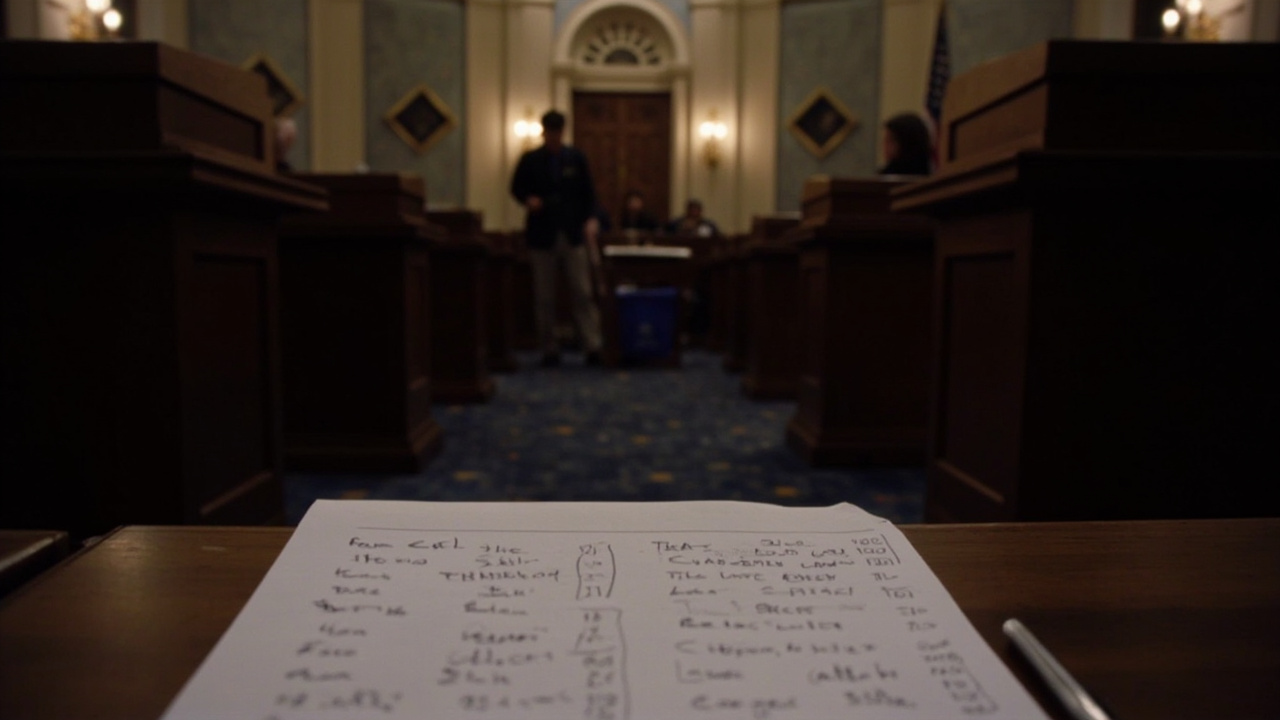
At 197-228, a procedural motion tied to an 18-month extension of Section 702 of the Foreign Intelligence Surveillance Act failed in the House in the early hours of Friday morning. [1] Twenty Republicans had voted with the Democratic caucus to block Speaker Mike Johnson's attempted "clean" extension — the second attempt, after a five-year version collapsed earlier in the evening. [1] Hours later the Senate passed a 10-day stopgap by unanimous consent, pushing the law's expiration from April 20 to April 30. [2][3] The House had passed the same 10-day patch at 2 a.m. after the five-year and 18-month versions both failed. The paper's position on Thursday was that Congress had become a body that could not legislate on surveillance — it could only defer. Friday's Senate vote was the defer operation. The defer has thirteen days left.
The Newsweek roster, published Friday morning at 4:36 a.m. Eastern and updated through the day, names the twenty: Lauren Boebert, Tim Burchett, Eric Burlison, Michael Cloud, Andrew Clyde, Eli Crane, Warren Davidson, Paul Gosar, Andy Harris, Diana Harshbarger, Thomas Massie, Mary Miller, Ralph Norman, Andy Ogles, Scott Perry, John Rose, Keith Self, Victoria Spartz, Sheri Biggs, and Mark Harris. [1] Seventeen of the twenty are members of the House Freedom Caucus; eight had voted against the most recent War Powers Resolution on April 16 alongside the Democratic caucus. Five — Massie, Davidson, Perry, Gosar, and Spartz — have now voted against administration-backed national-security packages in three consecutive legislative cycles. The paper's April 16 position that the war's attention budget had captured the FISA floor was the prior-edition read; Friday morning's roster moves that capture from a structural claim to a named coalition. The pattern is not episodic anymore. It is institutional.
What the rebels will not fund
The substantive demand the rebels have attached to any longer-term Section 702 reauthorization is a warrant requirement for FBI queries of the 702 database targeting U.S. persons. That requirement is the specific amendment Speaker Johnson's five-year package did not contain. The rebels want the same warrant clause Senator Ron Wyden's classified April 8 letter to the Attorney General reportedly flagged — a letter whose contents the administration is still formally contesting and which Wyden's office has described in unclassified remarks as addressing "a legally significant failure of compartmentation." [4] The letter is not public. The rebels' demand is not abstract. They want the amendment Wyden's letter provides cover for, and they will not vote for a clean extension that does not include it.
Representative Ro Khanna, who led the Democratic opposition to the five-year package, said early Friday that the rebels had "defeated Johnson's efforts to sneak through a 5-year FISA authorization tonight" and that any future reauthorization would have "to fight in daylight." [1] The daylight line was circulated by civil-liberties accounts through Friday afternoon and now attaches to the 20-name roster as the Democratic frame for the coalition: not dysfunction, but a bipartisan caucus that will not vote a clean extension without reform.
The thirteen days the patch buys
The Senate's 10-day extension expires April 30. The House returns from the brief spring recess on April 21, nine days before expiration. That sequence leaves the House seven legislative days to produce a reauthorization the rebels will accept and the administration will sign. The administration's public position, as expressed in Trump's Truth Social post earlier in the week asking Republicans to "UNIFY" behind a clean bill, [2] has not moved. The rebels' position has not moved. Speaker Johnson has now attempted three versions of the extension — five-year clean, 18-month clean, and 10-day patch — and the only one that passed was the shortest.
The options that remain for the next nine legislative days are narrow. Johnson can attempt a fourth clean extension, which fails again if the twenty hold. He can negotiate a warrant amendment that loses some number of administration-aligned members to gain the rebels. He can attempt another patch — 10 days, 30 days, 60 days — and defer the question further into the summer. Or he can let the program lapse. All four options leave a wartime intelligence program either expired or in perpetual 10-day renewals, neither of which the intelligence community has publicly described as operational.
Section 702 is the authority under which the NSA targets non-U.S. persons abroad. Its incidental collection of U.S. person communications is the provision the rebels and civil-liberties Democrats are trying to require a warrant for. The program covers — by the administration's own descriptions in prior congressional testimony — roughly 60 percent of the NSA's foreign-intelligence reporting. If the program lapses on April 30, the intelligence community's internal view, as described to the paper by a former senior officer, is that the pipeline is rebuildable in a matter of weeks under separate Title I authorities at higher legal and operational cost. That is not a pipeline failure. It is a cost-curve worsening. The administration does not want it. The rebels know the administration does not want it.
The wartime variable
The variable that makes April 30 different from any previous FISA reauthorization fight is that it arrives on Day 72 of combat operations against Iran, in a week when the War Powers Resolution failed by one vote, when six impeachment articles against the Secretary of Defense sit without a GOP co-sponsor, and when the Senate passed the Section 702 patch by unanimous consent because no senator wanted to block an intelligence authority in a week the strait had been closed, reopened selectively, and then partially blockaded again. The political price of letting 702 lapse in peacetime is the one the rebels are testing against. The political price of letting 702 lapse in wartime is different, and the rebels have not yet been asked to pay it.
April 30 is the test. If Johnson lands a warrant-amended reauthorization between April 21 and April 30, the rebels have extracted a policy concession through a disciplined use of small-coalition leverage. If Johnson cannot — and if the program lapses or receives a second 10-day patch — Congress will have proved, on the public record, that it cannot legislate a wartime surveillance authority under the coalition structure currently seated in the 119th Congress. That is the finding the paper's Thursday position was pointing at: Congress cannot legislate; it can only defer. Friday's Senate vote was the defer. April 30 is when the rebels, the Speaker, the administration, and the war's attention budget all arrive at the same cliff at the same time.
What Wyden's letter does not say
The Wyden letter, per the unclassified descriptions and prior context, does not make the rebels' warrant case on legal grounds. It makes it on operational-integrity grounds — that the program's compartmentation has failed in a way the public record cannot account for. The rebels have not cited the letter by name in floor speeches; Speaker Johnson's office has not addressed it in on-record statements. It sits behind the thirteen-day patch as the unnamed reason the reform demand has weight. If Johnson's fourth attempt at a clean extension fails on the same 20 names, Wyden's letter will become the public artifact the Senate side will need to produce to explain why.
The twenty names are on the record now. The thirteen days are running. April 30 is the cliff. The paper's position from Thursday carries: Congress can defer, not legislate. Friday's Senate vote confirmed the deferral. The next one — or the failure of it — happens before May.
-- SAMUEL CRANE, Washington