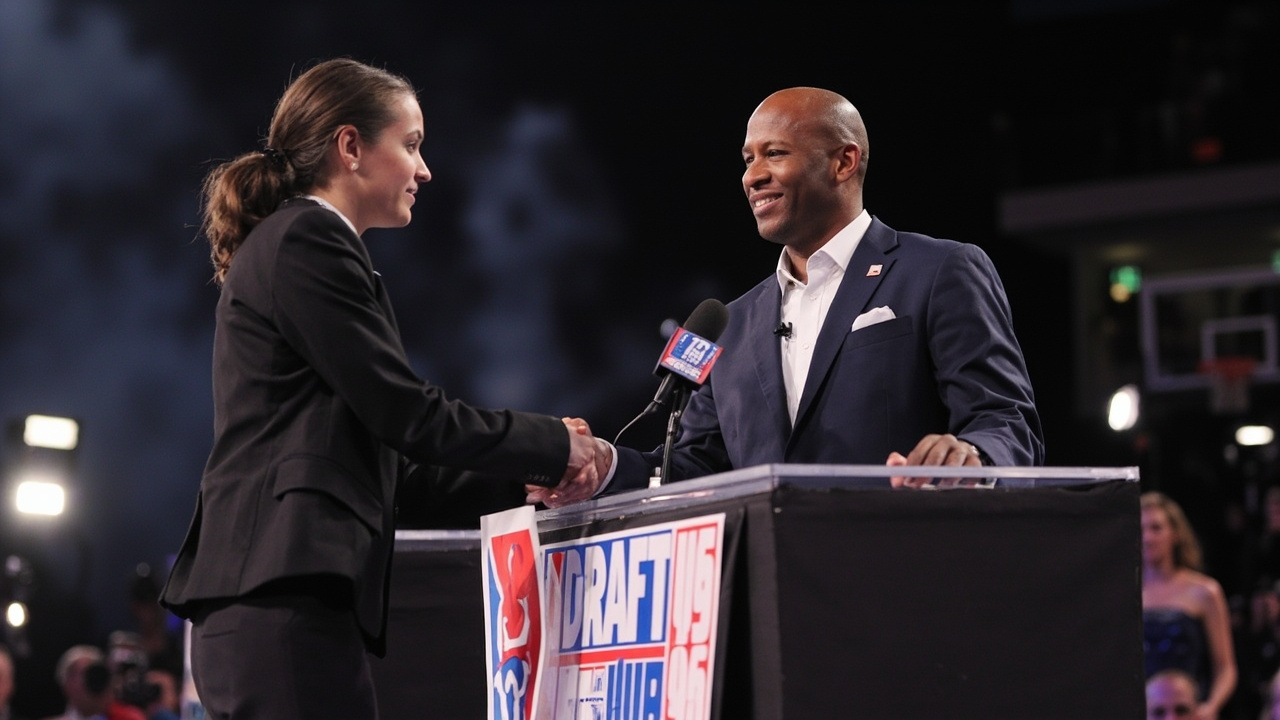
Monday night in New York, Azzi Fudd will walk to the WNBA Draft stage, shake the commissioner's hand, and become the No. 1 pick in a league whose economics changed around her over the previous thirty-one days. Her rookie salary, per the new collective bargaining agreement ratified March 18, will be $500,000. [1] Paige Bueckers, selected first overall last April, was paid $78,831 as a Dallas Wings rookie in 2025. [2] Both were UConn guards. Both arrived with Nike deals, podcast slots, and national name-recognition scores that rival some NBA lottery picks. The difference between their first professional years is not talent or branding. It is a CBA that the WNBA Players Association and the league ratified thirty-one days before Fudd's draft.
The CBA moved the league's salary cap from $1.5 million to $7 million, raised the minimum salary to $300,000, and — most unusually for a major U.S. professional sports league — tied future cap growth to league revenue rather than to a fixed escalator. [3] It is the first revenue-share model in any major U.S. women's professional league. Each dollar of new media rights money, each expansion-franchise fee, each sponsorship dollar above the baseline now flows partly into player compensation rather than entirely into franchise equity. The legal drafting took three years. The cultural drafting took Caitlin Clark's rookie year.
Clark's 2026 salary was scheduled, under the old CBA, to be $85,000. [4] Under the new one, the same season pays her $530,000. [4] The $445,000 difference is not a raise. It is the market finally pricing a player whose broadcast numbers, her rookie year, lifted Indiana Fever road games to NBA-second-round ratings territory on ABC. The paper wrote last year that the gap between what Clark earned in salary and what she generated in inventory was the largest such gap in the history of American professional sports. The gap has begun to close. The closing is happening not through renegotiation but through the CBA that Clark, Bueckers, and Angel Reese effectively forced by existing.
Angel Reese, who was traded to Atlanta on April 6 for two first-round picks, is the third leg of the class that did this. [5] Her trade to the Dream — a franchise that spent three seasons in the bottom of the standings and rebuilt around the arrival — was made possible by the new CBA's soft-cap structure, which lets a franchise aggregate high-cost star talent in a way the previous hard cap did not. The Dream sent back a 2027 first and a 2028 first to Chicago, a deal that would have been impossible under the old agreement. Under the new one, it is the kind of move the league's economics now reward.
Fever training camp opens April 19 in Indianapolis. [6] Fudd's Dallas camp opens the same morning. Caitlin Clark, entering her sophomore season, will earn more than six times her rookie figure. Bueckers will make more than six times hers. The roster construction conversations in front-office offices around the league — Indiana, New York, Minnesota, Phoenix, Seattle, Atlanta, Dallas — have been revised three times since March 18, as general managers absorbed the implications of a cap that now swings in their favor some years and their competitors' in others.
The divergence this produces in coverage is subtler than the ones the paper usually names. ESPN and The Athletic have covered the salary shift as a labor story, with appropriate CBA-mechanics detail. [2][3] The Times ran a feature on Bueckers's year-one hardship and its role in organizing the union. [4] None of these is wrong. What none has placed on the same page is the scale. The No. 1 overall pick's rookie salary has risen by a factor of more than six in a single year. The No. 1 women's professional draft pick in any major American sport has never seen that compression, because the salaries have never been low enough to compress. The NBA's No. 1, by contrast, is drafted into a rookie-scale that grows by the low single digits year over year. The NFL's No. 1 gets a four-year deal whose per-year value creeps up on a CBA calendar.
The WNBA's No. 1 is now a woman who earns, in her rookie season, more than three times the league's previous average veteran salary. [3] That is a structural reordering of a labor market, not a raise. The structural reordering is, on the numbers, a delayed response to the inventory the league's broadcast partners have been selling for two years.
What Fudd, Clark, Bueckers, and Reese share is a relationship with a revenue curve the league has built around their games. They do not share it equally. Clark is first among them in gate, merchandise, and broadcast lift. Bueckers is first in basketball-operations respect. Reese, who arrived at LSU as a national-championship anchor and at Chicago as the league's most marketable post player in a decade, is first in the composite of social-media presence and flagship-franchise value. Fudd arrives as the synthesis — a Bueckers-tier perimeter player whose two-year injury history at UConn created, unintentionally, the scarcity that drove her NIL market.
There is a longer conversation to have about whether the new CBA's cap growth will track the league's eventual media deal. The current national TV agreement expires in 2027; the next one will be negotiated against a rating baseline that is now considerably higher than the previous contract assumed. A 2027 media deal worth $2.2 billion over eleven years — the figure most recently floated in league discussions with its broadcast partners — would, under the revenue-share mechanism, lift the cap toward $14 million by 2029. [7] At that cap level, the No. 1 rookie pick earns north of a million. The pace is dictated not by the league's willingness but by the contracts already signed.
Monday, though, is not about 2029. It is about a twenty-two-year-old from the DMV walking to a stage in New York, being handed a Dallas Wings cap, and beginning a career at a salary that is, even adjusted for every metric one cares to adjust by, more than six times what the same seat paid last April.
-- AMARA OKONKWO, Lagos