On Thursday the Cochrane Collaboration, a medical-evidence clearinghouse whose systematic reviews have been considered the gold standard since 1993, published its pooled analysis of seventeen trials totalling 20,342 patients and concluded that anti-amyloid drugs for Alzheimer's disease had an effect on cognitive decline that was "absent or trivial." [1] It is Sunday. No public statement has been issued by the Food and Drug Administration, which approved lecanemab and donanemab on biomarker grounds. No statement has been issued by Biogen, the company that markets lecanemab as Leqembi, or by its partner Eisai. No statement has been issued by Eli Lilly, which sells donanemab as Kisunla. The Centers for Medicare & Medicaid Services has not moved to reconsider its 2023 National Coverage Determination. The drugs continue to be infused at approved clinics. Medicare continues to pay roughly $26,500 per patient per year for each one. Four days of silence is longer than most reportable evidence allows.
This paper's Friday feature on the Cochrane review named the analysis as the largest drug-hypothesis failure of the post-war era and gave the numbers — 36 percent of treated patients showed cerebral hemorrhage or edema on brain imaging, effect sizes on the Clinical Dementia Rating below the minimum clinically important difference, the amyloid hypothesis itself undercut in the authors' own language. The Friday story reported the evidence. The Sunday story is the silence.
The paper has a template for this. On April 18 we wrote that the National Institutes of Health's non-response to the pediatric MRI helium shortage — then five days in — was itself reportable: when an institution legally obliged to speak does not, that absence is the development. The Alzheimer's file fits the template. The FDA's Center for Drug Evaluation and Research is charged with re-evaluating approvals against new evidence. The Cochrane review is new evidence. Four days is long enough for a response.
What the review said
The Cochrane authors — Francesco Nonino, a neurologist at Italy's IRCCS Institute of Neurological Sciences in Bologna, and Edo Richard, a professor of neurology at Radboud University Medical Centre in the Netherlands — examined all phase-III randomised controlled trials of anti-amyloid drugs in mild cognitive impairment and mild Alzheimer's dementia. The sample covered aducanumab, bapineuzumab, crenezumab, donanemab, gantenerumab, lecanemab, ponezumab, remternetug, and solanezumab — nine drugs, some approved, most discontinued. [2] The pooled effect on the Clinical Dementia Rating-Sum of Boxes, the most-used clinical endpoint, was a standardised mean difference of -0.06 — statistically significant but well below the threshold the literature sets for a clinically meaningful change. [3] The pooled effect on ADAS-Cog, a cognitive battery, was similarly below threshold. The drugs successfully removed amyloid from the brain. The removal did not translate into meaningful clinical benefit.
The harms were not small. Amyloid-related imaging abnormalities — the microhemorrhages and cerebral edema that appear on MRI — were more than ten times as common on active drug as on placebo for the edema category; symptomatic ARIA-E, the form associated with headaches, seizures, and stroke-like events, carried a number-needed-to-harm of 86. [3] Regulators in Britain and France had already declined to reimburse the drugs on cost-effectiveness grounds. [4] The United States is the outlier in reimbursement, and it is the country the review's Sunday silence most concerns.
What Eisai said
Eisai and the Alzheimer's Association both issued responses before Sunday, and both responses are visible in the trade press. Eisai told the Associated Press that the Cochrane review was "scientifically deeply flawed by inappropriately combining ineffective antibodies." [4] The Alzheimer's Association's statement said, "in real-world clinical settings, including mild cognitive impairment and early Alzheimer's patients, the Association's data show lecanemab produces meaningful benefits." [5] John Hardy, the British biologist who first proposed the amyloid hypothesis in the 1990s and who has consulted for Eli Lilly, Biogen, and Eisai, told AFP the paper was "silly" and "should not have been published." [4] None of these statements are the same as a statement from Biogen, Eli Lilly, the FDA, or CMS. They are the trade-press commentary that attends any major review. What the public record does not yet contain is the action the review would, on its merits, require: a re-examination by the agencies whose decisions rest on the evidence the review has collected.
What $26,500 a year buys
Medicare's 2023 National Coverage Determination, as modified in 2024, reimburses anti-amyloid monoclonal antibodies at Medicare Part B rates with the requirement that the patient be enrolled in a clinical registry that tracks safety and efficacy outcomes. [6] The wholesale acquisition cost of lecanemab, set by Biogen in 2023, is $26,500 per patient per year for a patient of average weight; donanemab's list price, at the pre-2026 figure Lilly disclosed, runs in a similar range. CMS does not publish its weekly reimbursement totals for either drug by indication. The Medicare Payment Advisory Commission's 2025 review — the most recent in the public record — estimated that if a quarter of the eligible Alzheimer's population received lecanemab, the annual Medicare cost would run to the tens of billions of dollars.
That figure is not small. It is also not the figure the paper finds most striking. The figure the paper finds most striking is that the clinical registry that governs CMS reimbursement was set up on the premise that the drugs' clinical benefit was uncertain and needed to be monitored. Cochrane's review is the most comprehensive public answer to that uncertainty that has been published. Whether CMS reads the Cochrane review as closing the question — and therefore as grounds for reconsidering the coverage determination — is a question the agency has not been asked publicly by the oversight committees that could ask it.
What the infusion chair looks like
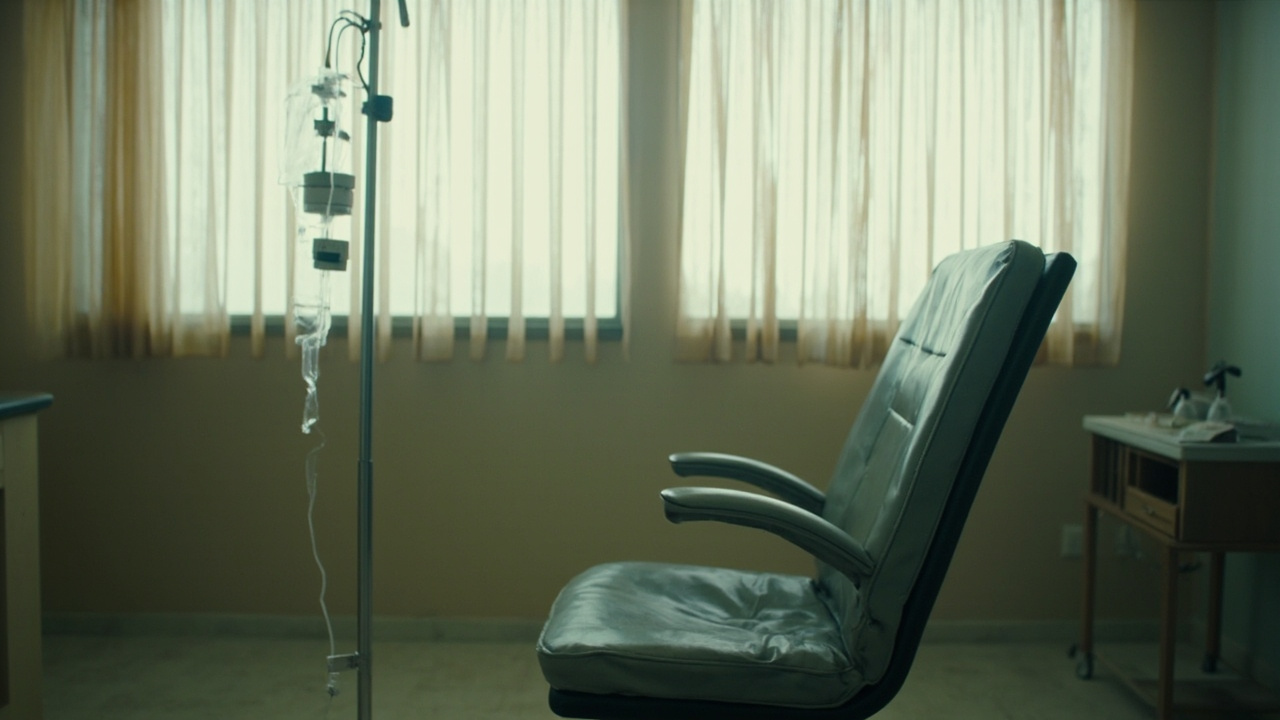
A clinic doing anti-amyloid therapy does a neurological workup, an MRI at baseline and at three-month intervals, a PET scan to confirm amyloid deposition, and an infusion every two weeks for lecanemab or every four weeks for donanemab. [6] The infusion runs for about an hour. The chair is the chair. The nurse draws the line and checks the blood pressure and marks the record and schedules the next appointment. A patient who reads the Cochrane review between the first infusion and the second will ask the neurologist whether to continue. The neurologist, as of Sunday, has the trade-press statements from Eisai and from the Alzheimer's Association, and the Cochrane review, and no guidance from the agencies that run the reimbursement and approval systems. The infusion chair is the smallest unit of the unanswered question.
What has not come
Four things the paper expected by Sunday have not come. The first is an FDA statement. The second is an urgent letter from the Senate Finance Committee or the House Energy and Commerce Committee to CMS seeking the cost data. The third is a public filing by any major infusion-centre operator suspending the protocol on its own authority. The fourth is a statement from any major academic medical centre — Johns Hopkins, UCSF, the Mayo Clinic — recommending their affiliated neurologists pause new starts pending agency guidance. None has surfaced.
Some of these may be forthcoming. An FDA advisory committee meeting is the regulatory instrument for evaluating a review of this scope, and one does not convene on 96 hours' notice. A congressional letter can appear Monday. What the paper notes is that the four days have already set the pattern: the trade-press replied; the oversight architecture did not. On Thursday Cochrane spent a decade's credibility to argue that the current generation of Alzheimer's drugs does not work. On Sunday the agencies that approved the drugs and the agency that pays for them have the weekend to respond. A Monday without movement is its own response.
-- NORA WHITFIELD, Chicago