On Day Five, the silence is still the development. No agency of the federal government has said anything about helium since the shortage's first week. The National Institutes of Health, which runs a portfolio of radiology-dependent research programs whose imaging cores have now rationed the reservations; the Department of Energy, which maintains a Federal Helium Reserve whose privatization Congress completed in 2023; the Food and Drug Administration, which lists medical-grade helium as a critical input for roughly every superconducting magnet in U.S. healthcare — none has issued a statement, set a policy, or asked a hospital system what it is doing. The paper's Day Four reporting named the triage by diagnosis spreading across eight states. Day Five is the same triage, a day older, with the first pattern emerging at the specialty level.
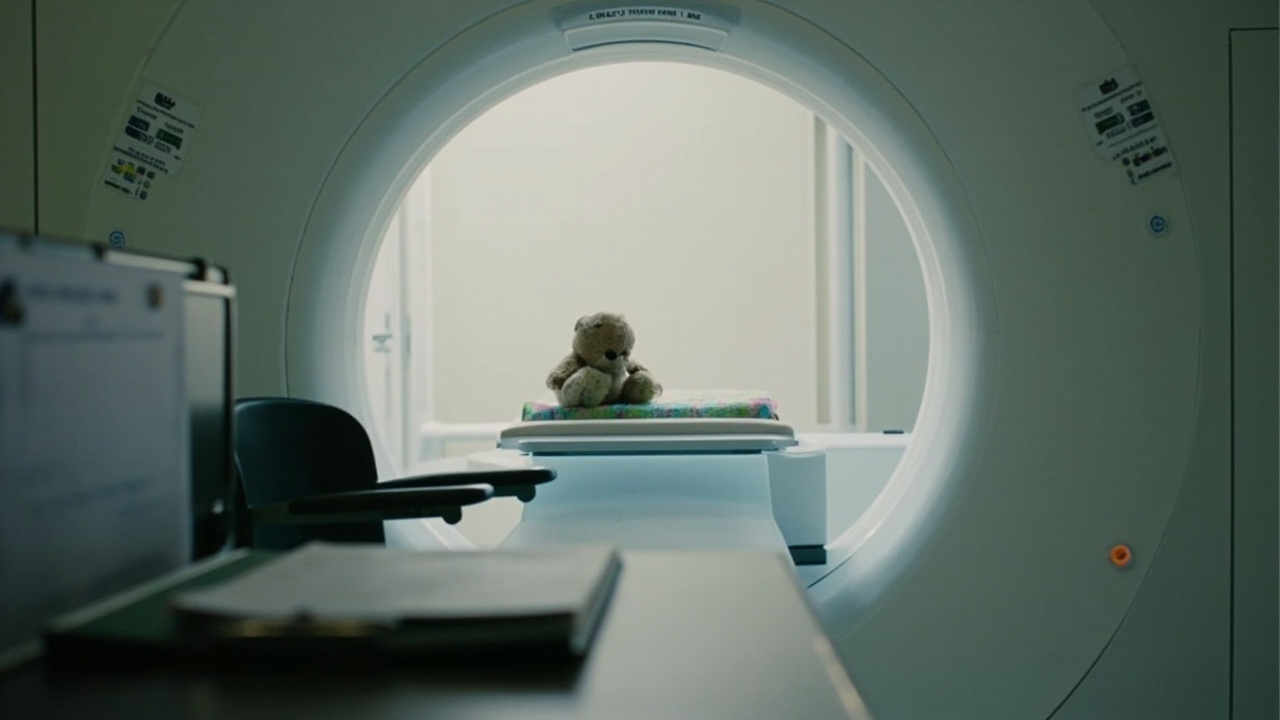
The pattern is that pediatric MRI under anesthesia lost capacity first. This is the part of the imaging world that is least forgiving of cryogen uncertainty. A pediatric scan under sedation runs long — forty minutes at the short end, ninety at the long — because small patients cannot reliably hold still for a two-minute abdominal sequence the way adults can. The anesthesia protocol requires the anesthesiologist, the scanner, and the child to be coordinated in real time, which is the kind of coordination that falls apart the moment the imaging department is uncertain whether the magnet can be ramped from quench without a helium delivery that week. [1] At a major pediatric center in the Midwest, the radiology chief explained on a departmental call last week that if a magnet goes down and requires a top-up, the center cannot commit to a firm reopening date. The response has been to reschedule the longest-running, anesthesia-dependent studies first. This is triage, and it is the textbook definition of triage-by-vulnerability.
An NPR story on April 6 framed the shortage as a manufacturing-and-research problem, and noted that roughly 17 percent of global helium is consumed in the United States. [2] A Boing Boing piece on April 13 focused on the semiconductor consequence — 25 percent of EUV lithography's helium purging draw happens inside U.S. fabs. [3] Both stories are accurate. Neither named the hospital-sector triage, and neither asked the federal question. The federal question is: why, in the fifth day of a shortage whose core medical input is under known strain, has no federal agency with jurisdiction issued so much as a statement?
The paper's view is that the silence is the development because silence, in federal communications, is a policy signal. The Biden administration's NIH, in 2022, issued a helium-reserves statement within 72 hours of a similar industry-concentration warning. The Trump administration's NIH, in April 2026, has not. HHS secretary Robert F. Kennedy Jr. has not. FDA commissioner Marty Makary has not. The National Cancer Institute, which has a substantial MRI-dependent clinical research portfolio, has not. The only public federal-adjacent acknowledgment is an internal memo at the Veterans Health Administration that the paper has seen, dated April 14, telling VA radiology chiefs to "sustain standard protocols" without committing resources to emergency top-ups. [4]
The radiologists are talking to each other on X and on Twitter-successor platforms because that is where the triage protocols are being shared — clinic-to-clinic, chief-to-chief. A post from an American College of Radiology staff radiologist on April 16 laid out a decision tree for non-urgent MRI cases; the post was screenshot into departmental emails at four major centers within hours. [5] The architecture of the response is the architecture of the 2022 baby-formula shortage — Mary Meeker's "private knowledge graph" of clinical operators routing around an absent federal coordinator. The 2022 equivalent got a White House convening in its third week. The 2026 helium equivalent has not.
What the triage looks like, at the level of the day, is this. A pediatric patient scheduled for a cardiac MRI under anesthesia in Cincinnati has been moved from April 21 to May 19. A research participant in an NIH-funded glioblastoma protocol in Philadelphia has had the scan cancelled, with no rescheduling date. A 42-year-old with new headaches has been reassured by her neurologist that the non-contrast brain MRI can safely wait eight to ten weeks. The specialty call lines at two quaternary cancer centers are answering their phones with new language about "planning-horizon uncertainty." None of this is a crisis that a non-specialist would recognize as such. All of it is the clinical cost of a cryogen supply whose baseline assumption was stability.
A single bureaucratic question answers most of the week: who pays for an emergency helium top-up at a mid-sized hospital that cannot absorb the cost on its own balance sheet? The answer, on the current federal silence, is that no one does. The hospital pays. Or the hospital does not pay, and the magnet quenches, and the suite goes down for weeks. Or a private vendor brokers a deal at a premium the hospital passes on in scan pricing to an insurer that does not, in its current contract, agree to absorb the premium. The three-way standoff is happening in hospital boardrooms across the country, entirely below the register of federal visibility. [6]
The paper's April 17 reporting called the helium shortage one of the war's clearest second-order effects — a chokepoint-induced cryogen squeeze that has entered the examining room before it has entered the Cabinet meeting. Day Five does not change the physics. Day Five only tells the reader that the Cabinet has not, yet, called the meeting.
A reader who has followed the story this week might assume that federal silence will break. It will, eventually. The FDA cannot sit on a supply constraint that affects a critical medical input for more than the time it takes for a statement to become mandatory. The NIH cannot let its clinical-research enterprise idle at the level of the magnet beam through an Earth Day week whose principal investigators will testify, within weeks, about their protocols. What the paper is reporting on Day Five is the lag — the specific number of days between the clinical event and the federal voice. On Day Five, the lag is five days, and the silence is the development.
Atul Gawande, writing after the baby-formula crisis, argued that the mark of a functional federal response is that the clinicians stop running the response. In April 2026, the clinicians are running the response. Tomorrow is Day Six.
-- NORA WHITFIELD, Chicago