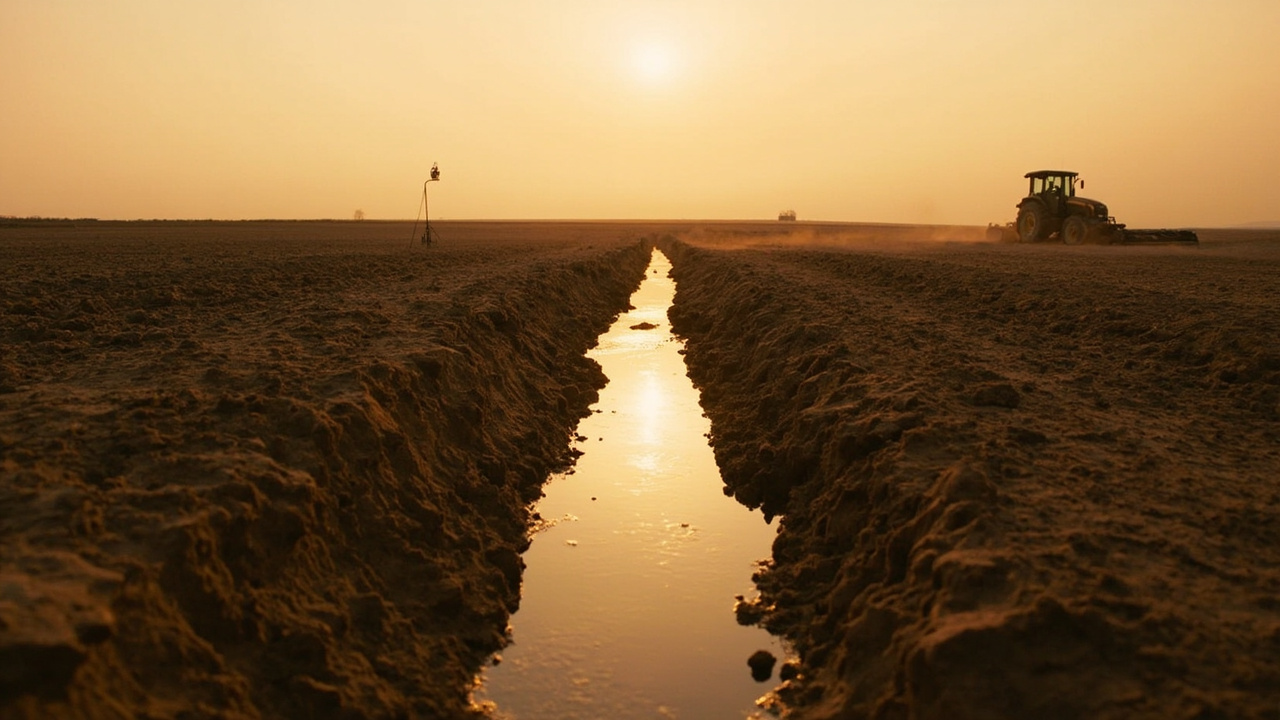
The Palmer Drought Severity Index, a measurement that takes in rainfall, temperature, and soil moisture and reports a single number for a given region, posted its highest reading for March 2026 since the index began to be calculated in 1895. [1] The U.S. Drought Monitor, which maps drought intensity in five bands across the lower forty-eight, put sixty-one percent of that territory in moderate-to-exceptional drought as of mid-April — the highest mid-April reading since the monitor was established in 2000. [2] Last month was the third-driest month ever recorded in the continental United States. The only two months that beat it are July and August 1934. Those months were the Dust Bowl. [1]
The American drought is now being measured against the comparisons that historians use, not against the seasonal context weather services use.
This matters before Earth Day on Tuesday not because the word "drought" is a climate abstraction but because three physical systems have been running a compound signal for six weeks. The first is precipitation. March 2026 was, nationally, the third driest month in the 131-year record; the second-driest and driest, July and August 1934, produced the dust storms that buried farms from Oklahoma to the Dakotas. [1] The second is heat. Fourteen states set March heat records; the Palmer Index captures the combined effect of warmth and dryness, and the Climate Prediction Center's April 7 outlook said drought degraded by three categories in parts of southeastern Colorado between March 10 and April 7. [3] The third is the vapor pressure deficit — the amount of water the atmosphere will pull from plants and soil before it is saturated — which sat at 77 percent above normal as of mid-April. Vapor pressure deficit is the number that explains why a week of no rain in April 2026 takes more water out of a wheat field than a week of no rain in April 1990 did. [1]
What the Palmer Index measures
The Palmer, developed by a Weather Bureau climatologist named Wayne Palmer in 1965, is a running balance between water supplied by rainfall and water removed by evapotranspiration. The number moves positive when conditions are wetter than normal and negative when drier. A reading of -4 is considered extreme drought; the March 2026 national value sat well past that. [4] The index has two disadvantages that professional hydrologists will describe at length: it weights soil moisture heavily, which slows its response in winter; and it uses Thornthwaite's method for estimating evapotranspiration, which climate scientists argue underestimates the atmospheric thirstiness of a warming world. Both disadvantages push the index toward conservatism. The fact that the Palmer — and not the more aggressive flash-drought indicators climate scientists prefer — is the record that has been broken is the signal. The conservative instrument has reached its modern extreme.
Where the water is not
The Western Snowpack is the second instrument. The National Integrated Drought Information System's April 9 update found that 90 percent of Western continental U.S. snow stations measured below-median snow-water-equivalent; 78 percent were below the 20th percentile. [5] California's River Basins had their driest March on record. Colorado River streamflow forecasts indicate new record lows for the April 1 projection — the projection that governs 2026 releases from Lake Powell to Lake Mead and therefore the water-rights calculations of every lower-basin state. [5] The Washington Department of Ecology declared a state snowpack emergency on April 8. The difference between a bad water year in the West and an emergency water year is where you find the headline. On April 8 the headline was Washington's declaration; on April 22 it will be the federal crop progress report that uses the same data.
Eastern drought matters too, and less attention has been paid to it. Drought.gov's April 14 Southeast status update said 96.83 percent of the Southeast was in D1-or-worse drought and 81.75 percent was in D2-or-worse. [6] North Carolina was at 100 percent coverage, Virginia at 99.95 percent, South Carolina at 99.34 percent. These are numbers that on their own would constitute the story. They are being overwhelmed by the Western and national headline because the Southeast has already been dry for three years and its crops are different.
Why Earth Day reads this as Dust Bowl
Seth Borenstein's April 18 AP piece — the dateline that will appear in every Sunday paper in the country — named the comparison directly. The only two months drier than March 2026 were the Dust Bowl months of July and August 1934. [1] The Dust Bowl, the agricultural catastrophe between 1931 and 1940 that drove the Great Plains migration to California, was produced by a combination of a long-running drought, aggressive plowing of native grass for wheat, wind erosion that consumed topsoil, and the absence of federal conservation policy. The physical drought of 2026 approaches the intensity of the historic one. The farmland of 2026 is different — terracing, no-till, and cover-cropping practices distribute risk more evenly than the open prairies of 1934 did. But the physical system is not conditioned by the agricultural practice. The Palmer Index reads soil moisture as the Palmer Index reads soil moisture.
What is already on fire
The Scarface Fire was discovered at 8:14 p.m. on April 18 in Siskiyou County, California. [7] It is the third major early-season fire this month, following the Crown Fire (Acton, April 3, 345 acres) and the Springs Fire (Moreno Valley, April 3, 4,176 acres). California has logged 500 fires across 2,000 acres through March; the five-year average for the same period is 734 fires across 13,700 acres. The number of fires is below average; the acreage per fire is rising because the fuel moisture is lower. California's spring 2026 fuel moistures, the CAL FIRE agency has said, resemble mid-summer 2022. Fire season opens in the North Coast counties before the controlled burns that reduce fuel have been completed. The structure of the season is what concerns fire managers more than the early ignitions.
What the food system has absorbed
The compound story, at the grocery-shelf level, has been the interaction between the domestic drought and the fertilizer price pass-through from Hormuz. This paper's Saturday lead named the Friday ceasefire rally as priced peace; the Hormuz-fertilizer pass-through has continued regardless, because urea and ammonia from the Gulf have not recovered 2025 shipping volumes. The companion piece to today's drought major, running in today's paper's features section, walks the supply-chain math directly — a 77 percent vapor pressure deficit and a $700-per-ton urea price, applied to a wheat and corn acreage whose expected output PBS NewsHour has already flagged as below earlier projections. [8] The compound stressor on U.S. agriculture, in the paper's reading, is what turns a climate headline into a grocery-bill one.
Consumer prices will absorb the drought slowly, through the Chicago Mercantile Exchange's summer futures curve first and through the grocery shelf months later. The U.S. Department of Agriculture publishes its first Crop Progress adjustment of the planting season on Monday evening. Analysts expect material reductions in spring wheat and corn planting expectations relative to the Prospective Plantings report issued March 31. What the drought does to the seeding decisions made this month determines the harvest that lands at the retail level in August.
What the paper has not yet said
The Palmer Index reading is a number without a policy response. No farm-state governor has called for a federal drought emergency declaration as of Sunday morning. The Biden-Treasury-era drought coordination architecture has been reorganised under the Trump administration's second term; the National Drought Resilience Partnership, which Barack Obama convened in 2013, has not been formally reconstituted. NIDIS continues to issue its biweekly status updates and its monthly outlooks. Neither the White House nor USDA has made a major public statement tying the March reading to a federal response. Whether any farm-state governor breaks that silence before Earth Day is the question the paper has not answered.
What it has answered is the comparison. Only July and August 1934 were drier than the month the country has just lived through. That sentence does not need elaboration. On the runway into Earth Day it is the sentence the rest of the paper's week will build on, because the drought is not, in any useful sense, a new story; it is the old story measured against the right benchmark for the first time since the people who lived through the first one were mostly alive to remember it.
-- DARA OSEI, London