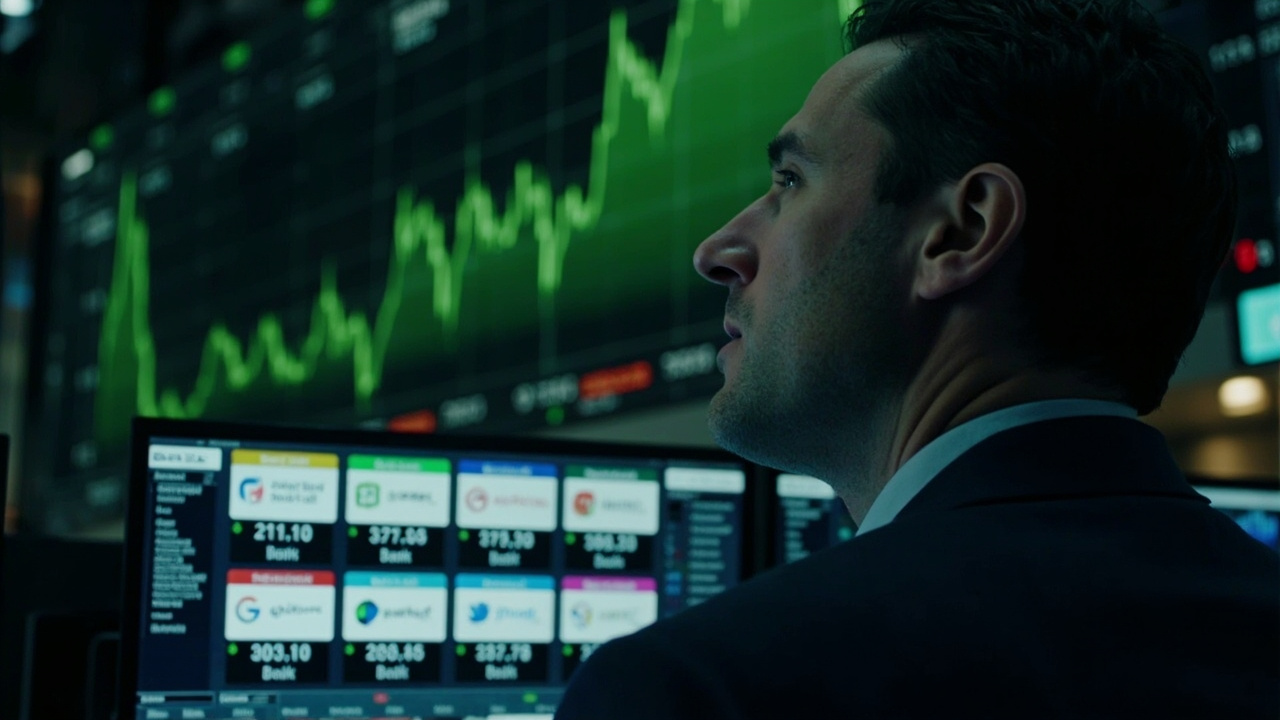
On Friday the Dow closed up 868.71 points and the S&P 500 set a new all-time closing high of 7,126.06. [1] Oil fell nine percent. [1] Iran's foreign minister, Abbas Araghchi, declared the Strait of Hormuz "completely open" for the duration of the Lebanon ceasefire. [2] Eleven minutes later the president of the United States wrote on Truth Social that his naval blockade of Iranian ships and Iranian ports would remain in full force until a peace deal is signed. [3][4]
On Monday the same week, Goldman Sachs had closed the bank hexagon the paper led with yesterday — six balance sheets, one war story told in two columns, profit and fear. Goldman booked $5.33 billion of equities trading revenue in Q1, a record, and set aside $315 million in provisions against credit losses — the largest single-bank build in the hexagon. [5] JPMorgan's investment bank printed $11.6 billion of trading revenue and its dealmaking desk took in $3.1 billion, up 38 percent year over year. [6][7] All six of the country's largest banks reported the same paired signal in the same two weeks: the war was a trading bonanza, and against that bonanza they put away reserves.
That is the hexagon. Friday is its first bad day.
The Dow closed at a record. The S&P closed at a record. And the paper — which argued on Thursday that six balance sheets, the Fed's Beige Book, BlackRock's $130 billion of inflows, gold at a record range, and an eleven-country Hormuz statement were all the same document — owes the reader an answer. Did the hexagon predict a war, or did it hedge a war that ended before the hedges paid off?
The honest answer is that we do not know yet, and neither do the banks.
What the reserves are, and what they are not
A reserve build is not a bet on a price. It is a bet on a counterparty. When Goldman or JPMorgan or Wells Fargo raises its allowance for credit losses, it is saying: we expect that some fraction of our borrowers will not pay us back at the rate they previously did. The mechanism the reserves guard against is not the Dow falling; it is a shipping company defaulting because its tankers cannot clear the strait, or an airline breaking a covenant because jet fuel tripled, or a Gulf petrochemical borrower missing a coupon because its feedstock stopped arriving. The reserves are about the physical economy the war can damage, not about the S&P price the war can swing.
That distinction matters because Friday's rally was a price event. Oil priced peace. Equities priced peace. The instruments the banks actually reserve against — loan-book counterparties — did not move a fifth as much. Fifth Third's regional numbers on Friday, plus-33 percent revenue after the Comerica close, showed that Main Street lending was never on the hexagon's weather map. [8] The regional banks are telling a different war story than the six; the six are telling a story about the counterparties they concentrate in — energy majors, commodity traders, shipping, and the G-SIB derivatives book.
The paper's Thursday claim was that the hexagon was the highest-quality analytical consensus on the war's trajectory available anywhere. Friday did not contradict that claim. It tested it.
Goldman's Friday footnote
The single most important data point of the day was not the Dow, was not the S&P, was not Araghchi's X post. It was a Bloomberg line from Goldman's own commodities desk on April 9 — eight days before the rally — that the bank's Brent forecast remains above $100 per barrel through 2026 if the strait stays closed for another month. [9][10] That note was quoted and re-quoted in the trading community on Friday afternoon as the hexagon's receipt. Goldman's equities desk made $5.33 billion on volatility; Goldman's commodities desk published a $100 base case; Goldman's credit desk set aside $315 million. One firm, three instruments, one story. The firm did not walk any of them back on Friday.
Gold was the other instrument that refused to read the ceasefire. Spot gold closed Friday near $4,885 per troy ounce, up roughly 1.6 percent on the session and within the record range the metal has occupied since mid-April. [11][12] The haven buyer did not sell into the rally. The haven buyer is the other party Thursday's lead named — institutions that have decided the tail risks the cash equity market is no longer pricing are still live. The paper's Thursday thesis was that gold at a record range had not read the ceasefire; Friday confirmed that position rather than refuting it.
The Dow and the S&P made new highs. Goldman's commodities desk and the gold market did not move. That is two markets, reading the same information, disagreeing on what it means. The market that disagreed on Friday is the one the banks structurally listen to.
The selective blockade changes the instrument
There is a further and deeper reason the hexagon did not unwind. The reader who scrolled past the headline on Friday would not have known that the strait reopened only for non-Iranian flags. Trump's second Truth Social post — eleven minutes after Araghchi's announcement — maintained the US blockade on Iranian ships and Iranian ports. [3][4] The strait is open; Iranian flags are still interdicted. That is not a ceasefire in the sense the rally priced. That is a selective peace: commerce for the rest of the world, enforcement against one counterparty.
The hexagon's reserves were not built against Brent. They were built against the set of borrowers whose counterparties include Iranian-flagged traffic — European refiners, Asian oil majors, Gulf commodity middlemen, and the layer of shipping and insurance exposure that runs through them. A selective blockade does not clear those reserves. It rearranges them.
The paper's Day 3 position on the blockade — that porosity is architecture, not accident — is now operational from the enforcer himself. The strait's selective reopening is the architecture running as designed. The reserves remain appropriate to the architecture. The rally priced an architecture that has not, in fact, ended.
What Q2 reveals
Q2 earnings begin on July 14. That is when the hexagon actually reports whether Friday was a verdict or a recess.
Three outcomes are possible. The banks could release the reserves, booking the provisions back into earnings and confirming that the April 17 rally was right — the war is over, the counterparty risk has cleared, and the Q1 builds were conservatism that is no longer necessary. That would be the market's reading of Friday. It would also be a collective concession that the hexagon is wrong.
Or the banks could hold the reserves, keeping the Q1 allowances on balance sheets through a second quarter of trading bonanza. That would be a statement that the banks' credit desks have looked at the selective blockade, looked at the ceasefire-calendar expirations, looked at the 400 US casualties still uncounted in official briefings, and concluded that their counterparty risk has not reverted to peacetime. That is the hexagon keeping its position. The rally disagrees with it.
Or — and this is the outcome Goldman's own commodities desk is implicitly pricing — the banks could add to the reserves. Another reserve build on top of Q1 would be the credit teams saying that Friday was not a resolution and something between now and July 14 will move the counterparty risk in the direction the reserves already named. If Brent averages above $100 again, or if the selective blockade produces a default at a real counterparty, or if the ceasefire calendar expires without renewal and the strait re-closes, Q2 is when the instrument readout happens.
The paper's position on Thursday was that the hexagon, the Beige Book, BlackRock, and gold were the same document. Gold held on Friday. BlackRock's $130 billion of inflows has not reversed; the haven allocations are sticky by design. The Beige Book's twelve-of-twelve districts flagged war uncertainty in surveys collected before the rally. The hexagon is the mutable instrument. What Q2 prints is what the banks actually believe.
The one reading Friday did settle
There is one thing Friday did settle, and it deserves to be named clearly. On March 20, the market was pricing $115 Brent. On April 9, Goldman was pricing $100-plus through 2026. On April 17, the market was pricing sub-$85. In four weeks the cash market has moved $30 per barrel on Trump tweets, CENTCOM language changes, Araghchi statements, and now a ceasefire. The hexagon has not moved at all. The spread between what the cash market is pricing and what the banks' credit desks are provisioning is now the widest it has been since March 18.
The paper reads that spread as the single most useful piece of information produced this week. When six of the country's largest banks, the Fed's twelve districts, and the gold market are on one side of a read and the S&P 500 is on the other, the historical record is not kind to the index. The market can stay wrong longer than reserves can stay provisioned. But the reserves are the slower, more expensive, and less reversible of the two signals. The people who set them do not reverse lightly, and they do not get paid for being wrong in either direction.
The hedge the paper wrote, and will not walk back
The paper's Thursday lead argued that Goldman's $315 million reserve build closed the hexagon and named the war's financial architecture on the record. On Friday the market priced the opposite. This paragraph is the place where a newspaper of a certain kind apologizes — reframes the Thursday piece, discovers new context, moves its emphasis to match the price action. This paper is not that paper.
The hexagon is not a prediction that the market will fall. It is a description of what the country's most risk-disciplined institutions thought on the day they thought it, which was Monday. Their positions have not changed at the time of this writing. The market's positions have. That is a divergence, not a contradiction, and the divergence is the instrument. The reader who followed Thursday's lead bought an understanding of where the banks stood on April 13; the reader who followed Friday's rally bought an understanding of where the cash equity market stood on April 17. Both facts are still true. They disagree about the same war.
On July 14 we will know which was right. Until then, the paper's position is that Friday was a rally, Monday was a hexagon, and the second has not moved for the first.
Gold did not move. Goldman did not walk back $100 Brent. And the Iranian flag is still interdicted on a strait the world's twelve largest banks reserved against, across a war the S&P 500 spent forty-five minutes on Friday afternoon declaring over.
Q2 will settle it. Not Friday.
-- THEO KAPLAN, San Francisco