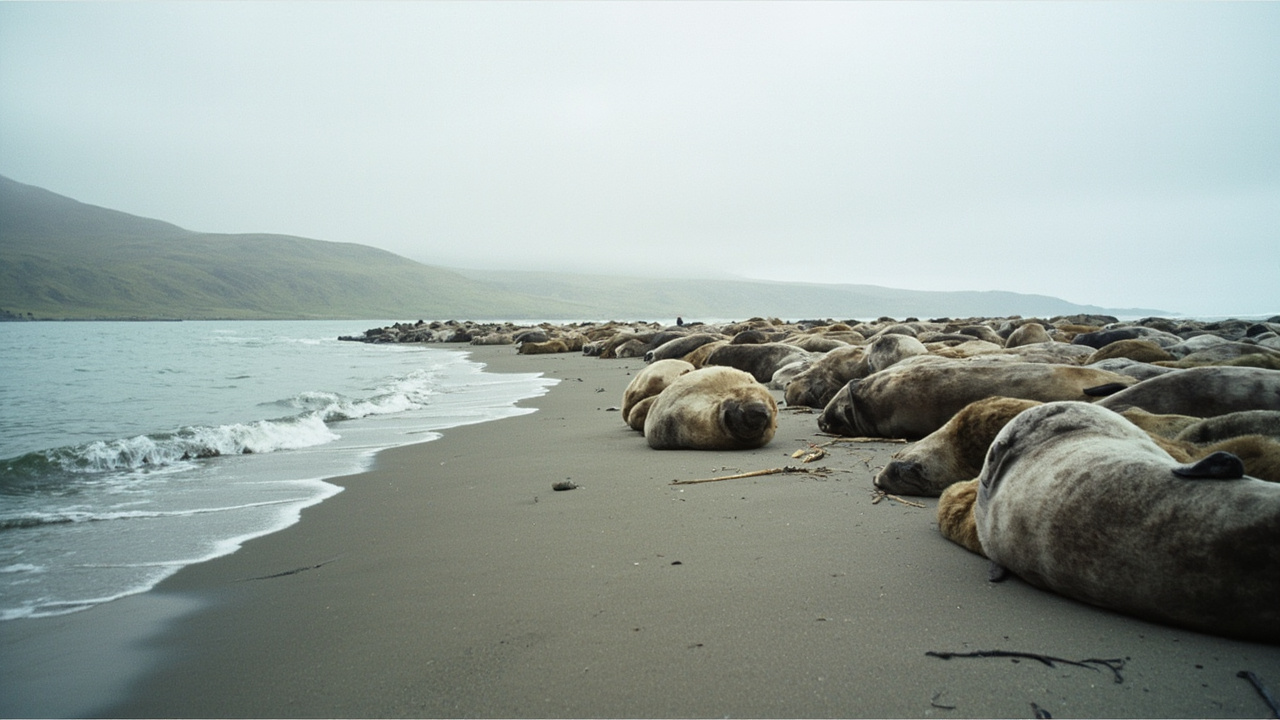
The IUCN's April 9 Red List update moved the emperor penguin from Near Threatened to Endangered and the Antarctic fur seal from Least Concern to Endangered — a two-category jump that IUCN pinniped specialists called "highly unusual." [1] In the same update, the southern elephant seal moved from Least Concern to Vulnerable. The first two listings are physical. The third is biological.
The paper's Saturday feature called this one physical event at two poles, linked through the bipolar sea-ice signal. Saturday's frame was half the story. The emperor penguin population, now about 595,000 adults, is projected to halve by the 2080s because the fast ice it needs for breeding is disappearing. [2] Antarctic fur seal numbers have fallen from 2,187,000 in 1999 to 944,000 in 2025 as warming oceans push krill to greater depths and shrink the food base. [1] Both mechanisms are climate-driven.
The southern elephant seal is different. Highly pathogenic avian influenza — H5N1 — has swept through four of the five major subpopulations since 2021. [1] At South Georgia, a 2024 survey recorded 47 percent fewer breeding females than in 2022. At some colonies, pup mortality has exceeded 90 percent in individual seasons. [3] "Penguins and seals and Antarctic animals are going to be challenged by the changes we're seeing to sea ice, and by diseases making their way there," IUCN SSC Pinniped Specialist Group co-chair Kit Kovacs told ABC News. [3] Breeding females, which spend more time ashore than males, are disproportionately exposed.
The Antarctic has had limited exposure to pathogens that established elsewhere decades ago. That inexperience is now its own mechanism. The IUCN's full 2026 Red List update arrives later this year. The question is whether conservation science treats Antarctic wildlife as a single-threat system — sea ice — or a two-vector one. Friscourt et al. 2024 already documented plasticity in fur seal diet that complicates any single-driver story. [4] The uplisting quietly names the second driver.
-- DARA OSEI, London