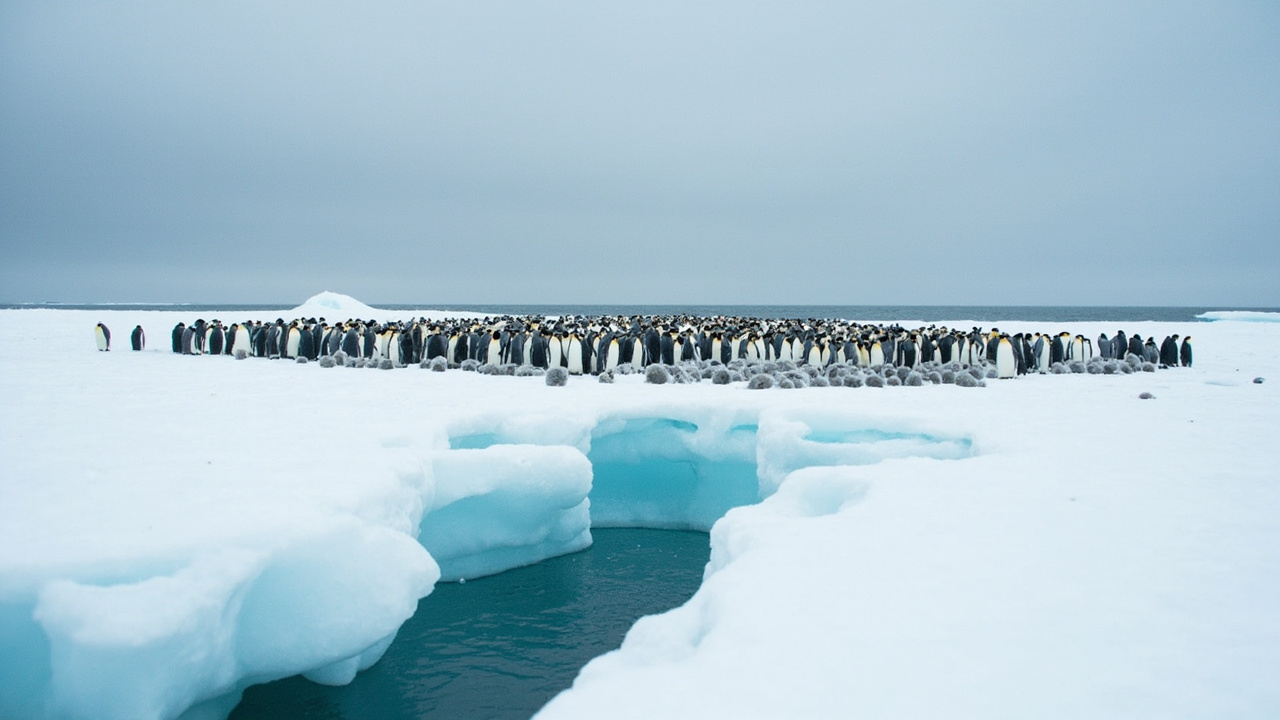
On April 9 the International Union for Conservation of Nature moved the Emperor Penguin and the Antarctic Fur Seal from Near Threatened to Endangered. [1] The uplisting put the most iconic bird of the Southern Ocean in the same conservation category as the tiger. The cause cited in the IUCN's release was not hunting, not pollution, not poaching — it was the physical phenomenon of disappearing sea ice. [1] In the Weddell Sea, where the largest emperor colonies breed, summer sea-ice extent has declined roughly 22 percent over the last fifteen years. [2] In the 2024-25 breeding season, premature sea-ice breakup killed approximately 9,000 chicks — most of them drowned when the platform beneath them fractured before their waterproof plumage had come in. [3]
The paper's April 17 reporting on the Arctic winter-maximum sea-ice record covered the other pole. It cited the National Snow and Ice Data Center's March estimate that the Arctic's annual freeze-up had returned less ice than any winter in the satellite record, a figure the paper read as climate datum and which Zack Labe and Ed Hawkins had already tied, on the day of the IUCN announcement two weeks prior, to the Emperor Penguin uplisting. The Arctic loses ice in winter maximum; the Antarctic loses ice through the breeding season. These are not two stories. They are one physical phenomenon, read from two different ends of the planet, using two different living instruments.
The emperor is a good instrument because it is a conservative one. Adults are the heaviest flying birds in the Southern Ocean, and they breed on sea ice rather than on land. The breeding cycle runs nine months. The chicks must stay on the fast ice — shore-fast sea ice that grips the coastline — long enough to molt into swimming plumage before the ice breaks up. When the ice breaks up early, the chicks end up in the water without plumage, and they drown. The margin is narrow, and the margin is shrinking. [3]
In 2022, satellite imagery showed five emperor colonies losing their fast ice in a single season and 10,000 chicks dying. [4] In 2024, the number was estimated at approximately 9,000. [3] These numbers are not Antarctic-wide; they are a subset of the colonies the British Antarctic Survey and allied groups monitor with high-resolution imagery. Whole populations — the ones at sites not covered by weekly satellite overflights — are presumed to have suffered similar losses and are currently not counted. The IUCN's projection, which a working group led by researchers at Woods Hole and the Scripps Institution co-authored, runs the species' population down 60 to 80 percent by 2100 on current warming trajectories. [2] Ninety-nine percent of breeding colonies, in the high-emissions scenario, produce no surviving chicks in most years.
It is possible to read an Endangered listing as a conservation milestone — a category earned through the paperwork of red-list assessment. That reading is true. It is also too narrow. The Emperor Penguin was moved because Antarctic sea ice is failing in a way the modeling two decades ago did not anticipate. The Arctic's winter-maximum record, the Antarctic's breeding-season breakups, and the Endangered uplisting are three data points on the same physical curve. No mainstream outlet has placed them on one page. X has, and Labe and Hawkins's threads — each linking the IUCN announcement to the NSIDC figures — are the most retweeted entries from polar-science Twitter this month. [5]
The divergence produced by the separation is small but consequential. A reader who follows environment coverage will have seen the penguin story as a creature-in-trouble notice. A reader who follows climate science will have seen the Arctic maximum as a technical datum. A reader who follows both — and who reads the two together — will have seen what Labe and Hawkins saw, which is a bipolar sea-ice signal more comprehensive than either story alone. The Weddell Sea is not the same physical system as the Bering. What the two have in common is that they are both losing their winter.
Earth Day falls on April 22, which is the Wednesday after this edition ships. The conservation community will read reports. Governments will issue statements. The IUCN's April 15 red-list assessment of soil species — 20 percent of the 1,758 species in the first global assessment judged at risk — will be cited. [6] The Cochrane-style consensus instrument for the natural world is the IUCN Red List, and it has produced, across a single spring, three uplistings that rhyme: the emperor, the fur seal, and a fifth of the soil-dwelling species humans have catalogued. Behind all three is the same physical engine, running at the pace the modeling did not predict.
The Antarctic Fur Seal has a different story than the penguin but a similar one. Industrial sealing in the 18th and 19th centuries nearly extinguished the species. Recovery through the 20th century restored populations to pre-sealing levels. The current uplisting has nothing to do with hunting and everything to do with pack-ice decline and a shift in the Southern Ocean's krill base, which supports the fur seal as well as the penguin. [1] The uplisting is not a second data point in a penguin story. It is the krill signal arriving at a different trophic level.
What the paper wants the reader to carry from this weekend is a specific spatial intuition. The Arctic's winter maximum failed. The Antarctic's breeding-season fast ice failed. A bird that needs nine months of stable ice to reproduce is on a red list because the ice is not giving it those months. A seal whose food web depends on a krill species that requires specific under-ice conditions is on the same red list because the under-ice conditions are changing. The physics is the same. The instruments are different. The reader, in between them, can see the curve.
Zack Labe, on X, called the IUCN announcement "the first of many taxa to come." The post did not need to specify which pole or which year. It was clear enough.
-- DARA OSEI, London