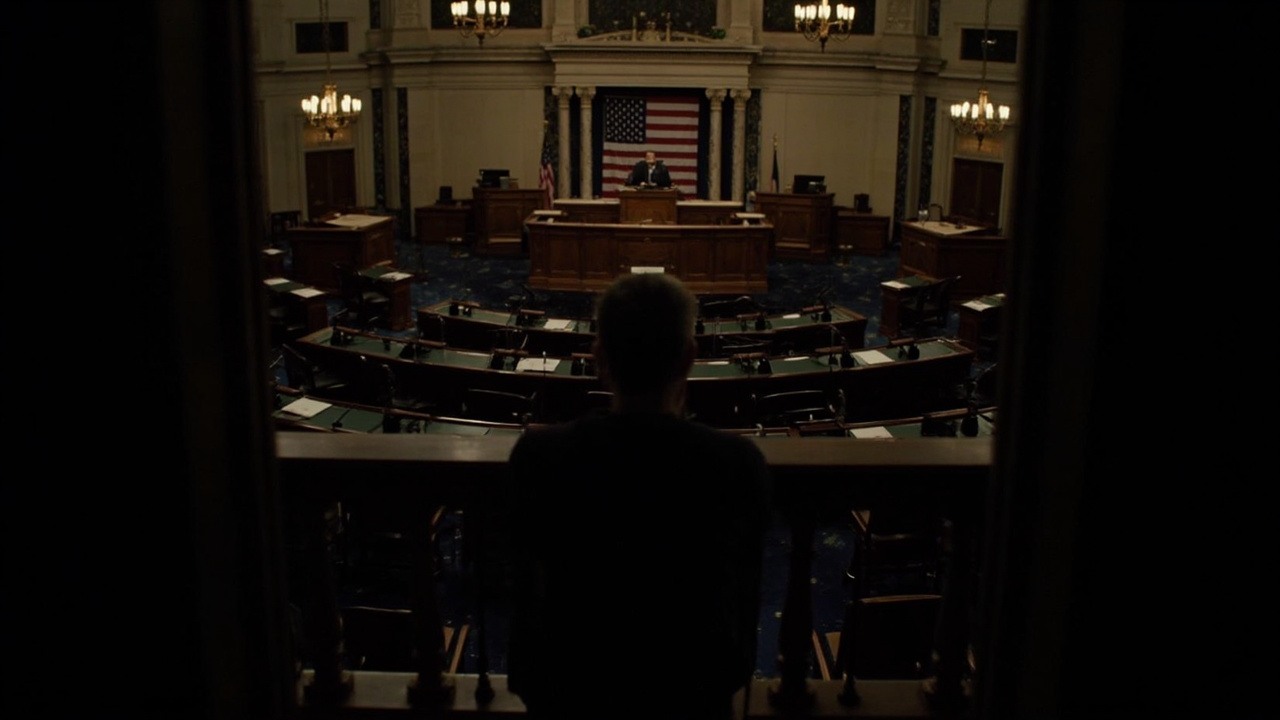
The Senate passed the ten-day extension of Section 702 of the Foreign Intelligence Surveillance Act by voice vote at 11:04 a.m. Eastern on Friday, April 17. [1] The House had passed the same patch by unanimous consent at approximately 2:30 a.m. that morning, after the five-year version collapsed on a procedural rule vote and the 18-month version collapsed with it. [2] President Trump signed the patch Friday afternoon. The law expires on April 30. As of Sunday morning, the House is in recess until Tuesday. Congress has eleven days and a list of twenty names.
The list was published at 4:36 a.m. Eastern on Friday by Newsweek. The paper carried it on Saturday. The April 18 edition named them — Boebert, Burchett, Burlison, Cloud, Clyde, Crane, Davidson, Gosar, Harris, Harshbarger, Massie, Miller, Norman, Ogles, Perry, Rose, Self, Spartz, Biggs, Mark Harris — and called them "a caucus-of-record" with a specific demand: a warrant requirement for FBI queries of the 702 database targeting U.S. persons. On Friday, the demand was the reason the five-year package failed. On Saturday, the demand did not have a public voice. Through Sunday morning, it still did not.
Mark Harris of North Carolina's 8th district released a statement through his House website Friday afternoon calling for "a warrant requirement for searches of Americans' communications" as "essential to protecting the Fourth Amendment." [3] Andy Harris of Maryland, chair of the Freedom Caucus and one of the twenty, told CBS on Thursday — a day before the vote — that a clean extension "doesn't have the votes." He has not issued a post-vote statement through Sunday. Of the remaining eighteen, none has filed a post-patch floor speech, a press release, or a Truth Social commitment to an April 30 position. The Saturday morning Freedom Caucus feed posted a photograph of the chair but did not reference the vote.
What silence means on the tenth day
Congressional silence is its own instrument. A rebellion that makes a vote requires that vote to happen; a rebellion that holds a position between votes requires public discipline that most House Republicans find expensive. The April 16 vote required twenty signatures. The April 30 vote requires twenty signatures plus whatever new position the White House, the Freedom Caucus, or the moderates have moved to in the interim. The White House has been clear: it wants a clean extension. Trump's Truth Social of Wednesday asked Republicans to "UNIFY, and vote together on the test vote to bring a clean Bill to the floor." [4] That request lost. The administration has not issued a revised request.
Speaker Mike Johnson has three remaining options and a fixed calendar. He can attempt a fourth clean extension, which fails again if the twenty hold. He can negotiate a warrant amendment, which costs some administration-aligned members to gain the rebels. He can attempt a further patch. [5] The first option has already been tried three times in seven days. The second option is what the Rebels have been asking for since March. The third option is what Congress has been doing since April 11. The option that has not been tried is letting the program lapse.
Jamie Raskin, ranking Democrat on House Judiciary, told reporters Tuesday that trusting a Trump Justice Department to follow the law without reform would be "moronic." [6] That sentence is on the Democratic record. No corresponding sentence from a Republican rebel has been entered on the record since Friday morning.
The adjacent silences
The paper has tracked two other silences on the same calendar. The first is the Hegseth impeachment, which on Saturday entered Day 5 with thirteen Democratic co-sponsors and zero Republican co-sponsors. The second is Schedule F, which on Saturday entered Day 3 of zero union filings challenging the 50,000-employee reclassification. The FISA silence is the third, and it is different in structure: the Hegseth silence is from Republican House members who might be expected to co-sponsor but have not; the Schedule F silence is from unions that might be expected to file but have not; the FISA silence is from House members who have already voted but have not spoken since.
The vote-and-then-vanish pattern has a precedent. In the 2024 FISA fight, after a warrant amendment failed 212-212 on the House floor, forty-eight members moved to silence within seventy-two hours — seven ultimately recanted their positions. The pattern, if it holds, suggests that the April 30 floor is not yet written. Any of the twenty could move. Two moves, under a razor-thin House majority, would flip the arithmetic.
Chip Roy, Ralph Norman and Morgan Griffith were three House Rules Committee members who had supported a warrant amendment in 2024 but were absent from the April 15 Rules vote, according to Punchbowl News' report. [7] Their Saturday silence is consistent with their April 15 absence. The Freedom Caucus can lose all three and still hold the block, but every additional absence marginally reduces the block's resilience.
The wartime variable
The variable the Rebels have not yet been asked to pay is the political price of letting 702 lapse on April 30 while U.S. and allied assets are still in kinetic exchange with Iran. The ceasefire with Iran expires on April 22. If the ceasefire does not hold — Saturday's IRGC fire against Indian tankers is the sharpest contrary signal to date — then the FISA vote on April 30 arrives in an environment where the Director of the CIA, the Director of the FBI, and the Director of the NSA can be expected to go on the record asking members to extend the authority. The administration has the instruments to make the political cost of a no vote higher on April 30 than it was on April 17.
What it does not have, as of Sunday morning, is an obvious count of Republican moderates who would change position under that pressure. The rebels know this. So does the Speaker. So does the Director of National Intelligence. The silence, in that sense, is not a position. It is a bid.
The Newsweek list is eleven days old. On the eleventh day, no name on that list has issued a statement committing to April 30 without the warrant clause. On the twelfth day, the House returns from recess. On the thirteenth day, the Speaker will know whether his bid or theirs holds.
-- SAMUEL CRANE, Washington