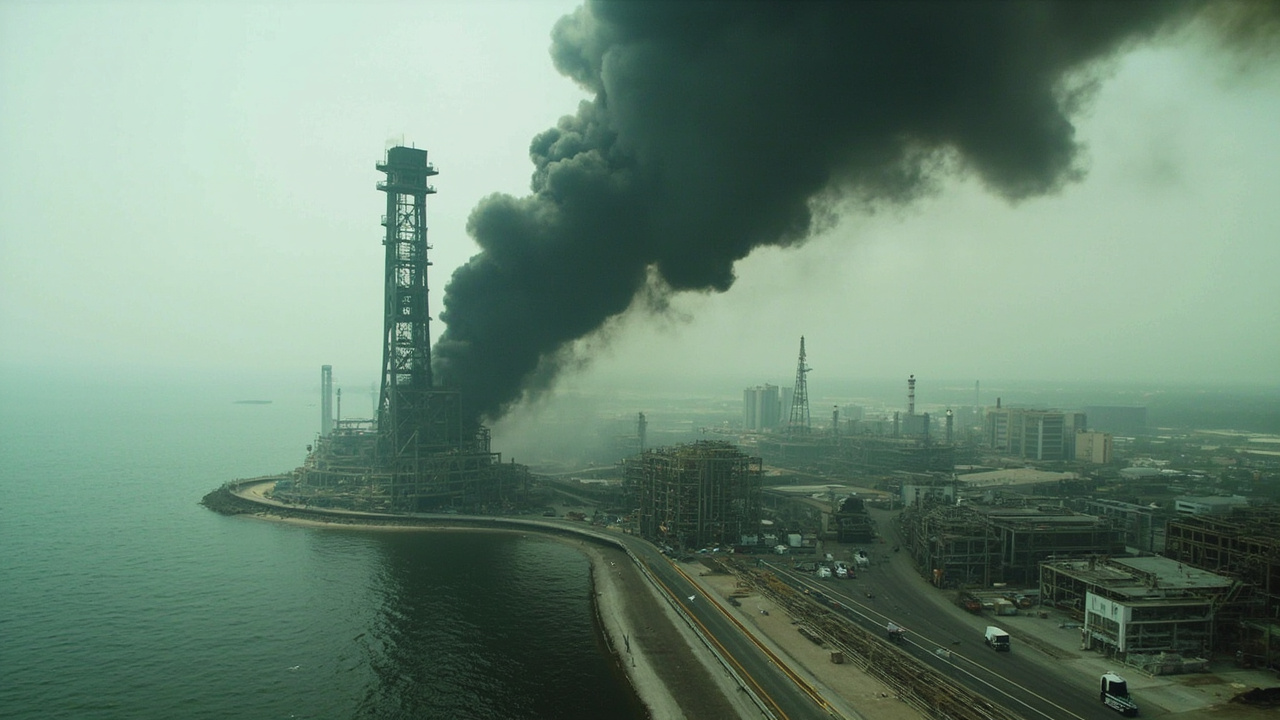
Fatih Birol, executive director of the International Energy Agency, told Neue Zürcher Zeitung Friday that restoring pre-war oil and gas output in the Middle East will take "approximately two years overall." [1] Country by country, he said, the timeline varies: "In Iraq, for example, it will take much longer than in Saudi Arabia." [1] More than eighty Gulf energy facilities have been damaged, over a third of them severely. [2]
The paper's April 18 lead argued that porosity had replaced the strait as the market's real architecture. Birol's two-year line is the upstream version of the same argument. Reopening the Strait of Hormuz does not restore supply. Facilities must be repaired. Output must be restarted. Both take time.
The numbers support the caution. The IEA's April Oil Market Report, released earlier in the week, recorded a March supply collapse of 10.1 million barrels per day — the largest supply shock in the agency's tracking history. [3] OPEC+ production fell 9.4 million barrels per day month-on-month, to 42.4 million; non-OPEC+ supply fell 770,000 barrels per day to 54.7 million. [3] Iraq took the deepest losses, its output down about 66 percent; Saudi production fell 30 percent, to 7.25 million barrels per day. [2]
Birol's line on Hormuz closure was directional. "Shipments of oil and gas that were already en route to their destinations before the war began have now arrived," he said. "But no new tankers were loaded in March. There were no new deliveries of oil, gas or fuels to Asian markets. This gap is now becoming apparent." [1] If the strait stays closed, "we must prepare for significantly higher energy prices." [1] In IEA base-case scenarios, the agency still expects regular Middle East deliveries to resume by mid-year — below pre-conflict levels. [4] In the severe scenario, demand falls 5 million barrels per day year-on-year from the second quarter onward and two billion barrels are drawn from stocks. [4]
Natural gas recovery may take longer. LNG terminals, Birol said, may need more than two years to return to normal flow. [2] That distinction matters because LNG buyers — Japan, South Korea, India — have optionality Western-hemisphere crude buyers often lack. If Qatar's export capacity is still repairing in 2027, the substitution market reshapes.
The agency also has an instrument ready. Birol said the IEA is "ready to act immediately and decisively" on a second coordinated stock release, after the March move drew 400 million barrels from member reserves. [1] "We're not there yet, but it's definitely under consideration." [1] Stock releases, he repeated at Semafor World Economy last week, are "only a painkiller." [5]
The longer thesis Birol has been laying down since early April extends the short-term arithmetic. Speaking at that Semafor event, he called the Iran crisis a structural rupture of the same order as 1973 and 2022. "We are not going back to where we were." [5] Countries will price energy security as a risk premium. "Trustworthiness and predictability will be very important in the energy trade." [5] Translated from the IEA register: buyers will pay more to avoid trading with suppliers whose export route is contested.
The market response has tracked slowly but in the right direction. Brent traded below $90 on Friday's reopening announcement, then moved back toward $94–96 on Asian open Sunday after Saturday's IRGC attacks. [4] Goldman Sachs published an estimate earlier in the week that another month of Hormuz closure would keep Brent above $100 across 2026. [2] The National reported that 50 percent of Gulf upstream fields could return to pre-war levels within two weeks — if Hormuz reopens — rising to 80 percent about a month later, before plateauing. [4]
Two weeks to half, one month to four-fifths, two years to full. The curve shape is what operators should price in. "The market is underestimating the consequences of a prolonged closure of the Strait of Hormuz," Birol said. [1] It is also underestimating the consequences of a reopening. Peace does not restart a refinery. Neither does it rebuild a pipeline, a gas separation plant, a utility feeder, a tanker berth. The IEA's Friday line puts a clock on what Saturday's kinetic events compressed into policy.
Two years is the floor. It is also the number the world's largest energy-analysis body now carries on record.
-- DARA OSEI, London