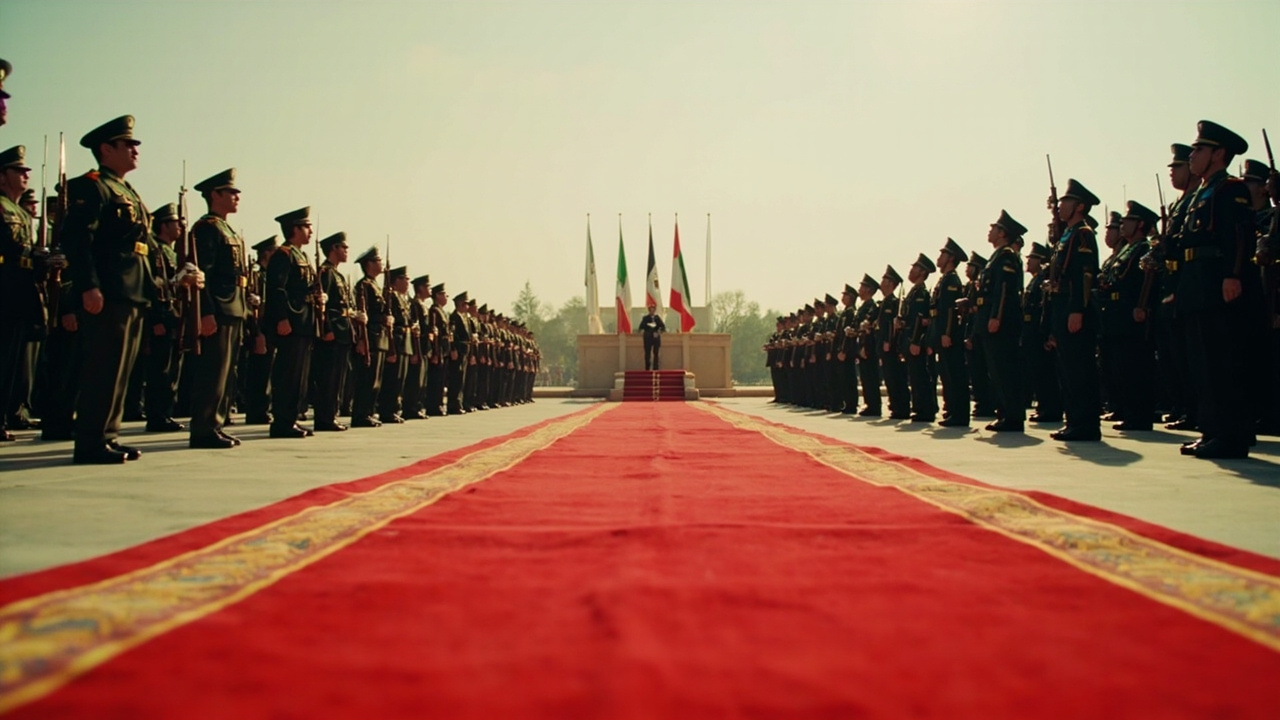
The message appeared on a Telegram channel on Saturday morning, Tehran time. It was attributed to Mojtaba Hosseini Khamenei, the cleric who became Iran's third supreme leader on March 5 and has not been photographed, filmed, or publicly seen since. [1] Read later on Iranian state television, it commemorated April 18 — Farvardin 29 in the Iranian calendar, the country's Army Day — and it contained one operational sentence: "Just as Iranian army drones strike like lightning against American and Zionist criminals, its brave Navy is ready to make enemies taste the bitterness of new defeats." [2]
Ninety kilometers south, in the same hours, Iranian Revolutionary Guard gunboats were firing on merchant vessels they had cleared to transit the Strait of Hormuz. By the time the statement was being read, the Indian-flag supertanker Sanmar Herald had taken rounds across its superstructure, the bulk carrier Jag Arnav had been attacked separately, and a third containership had been struck by unknown projectiles. The paper's Sunday account of those incidents runs as today's lead on Iran's fire against Indian tankers. The statement and the gunfire were not in sequence. They were the same event at different registers.
Mojtaba Khamenei is 56 years old. He joined the Islamic Revolutionary Guard Corps in 1987 at seventeen, served in the Iran-Iraq War under Qassem Soleimani in the Habib ibn Mazahir Battalion, and after 2009 was reported to have assumed informal command of the Basij. [3] He was elevated to the Supreme Leadership by the Assembly of Experts on March 5, seven weeks after his father, Ali Khamenei, was killed in the February 28 joint U.S.-Israeli strike on the Supreme Leader's Tehran residence. Reuters, citing Iranian sources on April 11, reported that Mojtaba had himself been wounded in the same attack and sustained "severe and disfiguring wounds." [4] The Washington Post and the Telegraph filed variations of the same report. Saturday's statement was the first public utterance attributed to him since his elevation, and no photograph accompanied it.
Iranian state media treated the silence itself as doctrine. Al Jazeera's April 1 commentary by Kayhan Valadbaygi had framed the rumored injury as irrelevant to Iranian trajectory, arguing that the post-Khamenei structure was institutional rather than personal. Saturday's message fit that frame: the author was named, the body was hidden, and the text was operational. On the English-language site of khamenei.ir, an April 9 message attributed to Mojtaba had already promised to "take the management of the Strait of Hormuz to a new phase." [5] Saturday's version was shorter, aimed at a military anniversary, and closer to an order than to a sermon.
The statement's grammar
Read alongside the IRGC's own radio traffic from Saturday, the statement's phrasing is not abstract. TankerTrackers, the shipping monitor that published the IRGC-vessel audio recording, reported that gunboats opened fire after ships had been given prior clearance to transit — a pattern that, read charitably, implies the naval command and the leadership are operating on different clocks, and read less charitably, implies they are running one clock and hiding the second. The statement's line about drones "striking like lightning" references the February 28 counterattacks on Al-Udeid and Bahrain. The line about the navy "ready to make enemies taste the bitterness of new defeats" references nothing historical. It references the next 72 hours.
The paper's April 18 account of the papal-presidential religious clash argued that ceremonial language in wartime is rarely ceremonial. The Mojtaba Saturday message fits the same test. A supreme leader who has not appeared in public for 48 days issues his first operational message on his country's Army Day. Within hours, an arm of his government executes a distinct tactical escalation against a neutral flag. The sequence is either coincidence, coordination, or the one thing that was supposed to be impossible after March 5 — operational disunity between the leadership office and the Revolutionary Guard.
What the statement does not contain
It does not mention the Islamabad talks. Iran's Deputy Foreign Minister Saeed Khatibzadeh had said on the sidelines of the Antalya Diplomacy Forum in Turkey on Saturday that Tehran was "not yet ready" to hold a new round of face-to-face talks, citing Washington's refusal to abandon "maximalist" demands. [6] The second round had been scheduled for April 20 in Islamabad. By Saturday afternoon it had no date, and the statement named no negotiating track.
It does not mention the ceasefire. The two-week truce reached on April 8 after 38 days of fighting expires on April 22 — Wednesday. The statement does not address what happens on Thursday.
It does not mention Ali Khamenei's burial. Iran's Astan Quds Razavi foundation said on Saturday that the late supreme leader's burial site in Mashhad "has not yet been finalized," seven weeks after his death. [7] The son's first message skipped the father's grave.
It does mention drones and the navy. It says both are "ready."
What follows in the 72 hours
Iran's Khatam al-Anbiya joint military command said Saturday morning that the Strait of Hormuz had been returned to "strict control" and would remain there "so long as the United States does not ensure full freedom of navigation for vessels traveling from Iran to destinations and from destinations to Iran." [8] That conditional is the operational reading of Saturday's text: the navy makes enemies taste defeat until Washington unblockades Iranian ports, and the leadership office — speaking through a Telegram channel, not a microphone — authorizes that posture.
The British Foreign Secretary on Saturday called for "full resumption of shipping" through the strait. The European Union issued no formal statement. The Modi government summoned the Iranian ambassador in New Delhi and chaired an emergency national-security meeting at dawn Sunday. The United States said it would continue to enforce a maritime blockade of Iranian ports. None of these actors has had a response from the man whose name was on Saturday's message. Mojtaba Khamenei's first public act as supreme leader has been to confirm that he exists, that he commands, and that the navy has his word. It has not confirmed whether he has a face.
In Tehran, on Saturday night, Iranian Parliament Speaker Mohammad Bagher Ghalibaf delivered the Army Day ceremonial remarks at Imam Khomeini's mausoleum — in person, visible, filmed. The signal was available and noticed. The man who commands the armed forces did not attend.
-- YOSEF STERN, Jerusalem