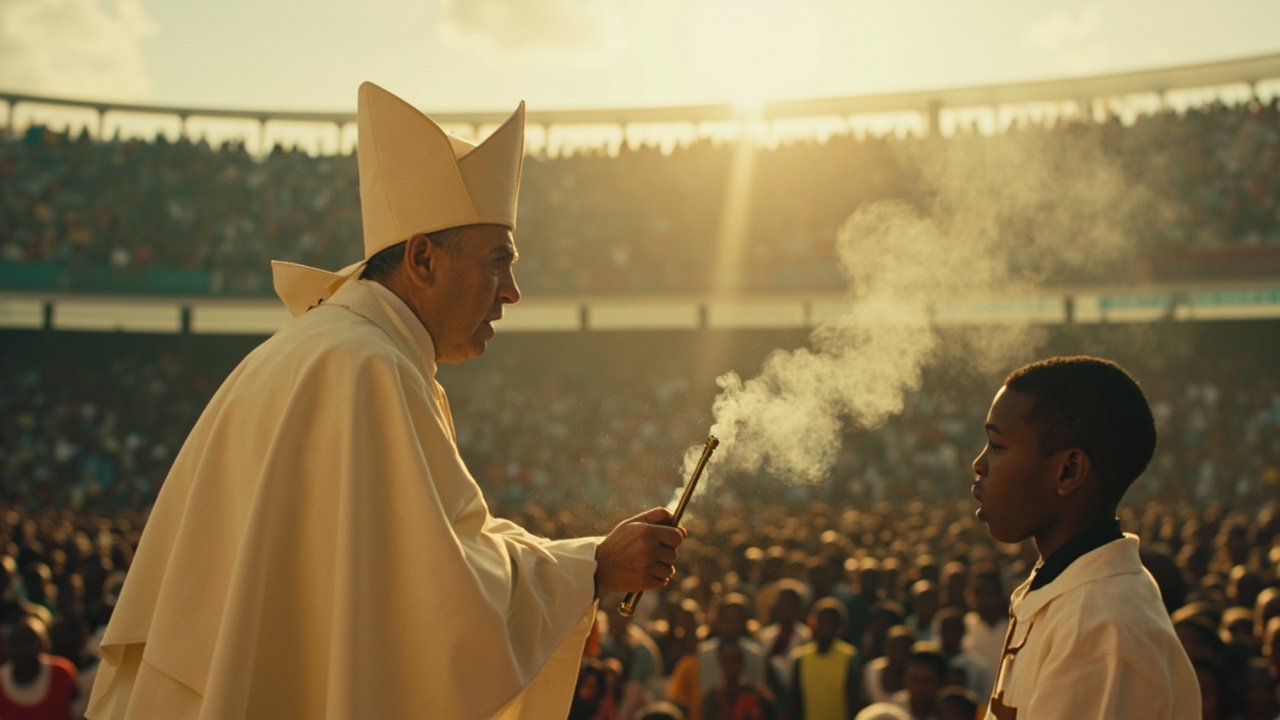
On April 14, Tuesday evening, at a Turning Point USA event on the University of Georgia campus, Vice President JD Vance addressed a contested crowd. "The Pope should be careful talking theology," he said. "God has been on the side of those who wield the sword. When the Pope says that God is never on the side of those who wield the sword, there is more than a thousand-year tradition of just war theory in the Catholic Church." [1][2] On April 16, Thursday, in St. Joseph's Cathedral in Bamenda, Cameroon — a city whose Anglophone separatist conflict has killed at least 6,500 people and displaced over 650,000 since 2016 — Pope Leo XIV delivered a homily that named "a handful of tyrants" as the agents "ravaging the world with killing and devastation." [3][4] On April 17, Friday afternoon, before a congregation of more than 120,000 at the Japoma Stadium in Douala, the pope added the sentence that gave the week its operative phrase: "Hunger is now being used as a weapon of war." [5][6]
On Saturday morning, April 18, the pope is to celebrate Mass at Yaoundé-Ville before departing for Angola. [7] This is the third act of the week, and by the register of church history it is the one that carries the weight, because it is the act in which the rebuke becomes a habit. An isolated homily is a moment; three homilies in seventy-two hours, with a rebuke of the American vice president's theology folded in between them, is a programme. The first operational conflict between the Catholic Church and a wartime American administration over who speaks for God in wartime is now underway, and the Church is the party with the longer memory.
The theology Vance is invoking, and the theology the pope is invoking
The phrase Vance appealed to on Tuesday — "a thousand-year tradition of just war theory" — is not a casual rhetorical flourish. It is a citation of Augustine, Aquinas, and the scholastic tradition that produced the jus ad bellum criteria every Catholic moral theologian has had to contend with. Vance's move was to suggest that the pope had strayed from this tradition by saying God is not on the side of those who wield the sword. The move has a problem. The just war tradition does not claim that God is on the side of those who wield the sword. It claims that a particular war, under particular conditions, may be conducted without committing sin — competent authority, just cause, right intention, proportionate means, last resort, reasonable prospect of success, discrimination between combatants and non-combatants. The tradition is a set of constraints, not a blessing.
The pope's citation — that God is never on the side of those who wield the sword — is a direct paraphrase of Matthew 26:52, where Christ tells Peter to put down his sword. The citation is not an innovation. It is catechesis. A Catholic vice president accusing the pope of theological innovation by paraphrasing the Gospel puts the vice president outside the tradition he invokes. That is not a polemical claim. It is what happened.
The deeper point, which Vance's audience at Turning Point did not notice and which the pope's audience in Douala did, is that the just war tradition in its mature form — Aquinas's, Vitoria's, Suárez's — requires a separate authority to certify that a war meets the tradition's criteria. That authority, historically, was the Church. The vice president's invocation of the tradition while implicitly rejecting the authority that maintains it is the kind of argumentative structure Hannah Arendt, in her writing on totalitarianism and legitimacy, called the appeal that dissolves its own standing. The tradition cannot be cited without the tradition's certifier; the tradition's certifier cannot be dismissed as careless without losing the tradition itself.
What the pope said, and did not say
The pope did not, in his Bamenda or Douala homilies, name Donald Trump. He did not name the United States. He did not name Iran. He did not name Israel. He did not name Cameroon's president, Paul Biya, whose 42-year rule has produced the Anglophone conflict the pope is addressing. The word "tyrants" was plural and unmodified. The homily in Bamenda pointed at a global condition: "a handful of tyrants" who spend "billions on military" while children in the same cathedral's parish districts were, weeks before, abducted from school dormitories by armed separatist and government forces. [4]
The word-choice discipline is the first thing to notice. The pope is on an eleven-day pastoral tour of four African countries. He is not making a geopolitical speech. The homilies are pastoral instruments delivered in settings where the parishioners themselves are the subjects of the violence he is describing. The generality of "tyrants" is not evasion. It is the mode of moral teaching the Church uses when the specific instance would deform the teaching. The tyrants in Bamenda are the ones the Bamenda faithful already know about; the tyrants a Douala audience perceives are the ones Douala already has language for; the tyrants a Catholic reader in the United States perceives are the ones the Catholic reader in the United States is most proximate to. The teaching travels through the ambiguity.
"Hunger is now being used as a weapon of war." This is the sentence from Friday that carries farthest. It is deliverable to Ukraine; it is deliverable to Sudan; it is deliverable to Gaza; it is deliverable to the Lebanon border cordon; it is deliverable to the parts of southern Cameroon where schools were closed for two years because armed actors ate the rice supplies of villages whose Sunday Mass the pope celebrated that morning. The pope's homily is not a statement about American policy. It is the claim that a particular practice — the weaponisation of the food supply — has crossed a line that makes the agents of the practice liable to the theological language of tyranny. That is a doctrinal claim, not a political one. The political consequences attach because the Church is a global institution whose doctrinal claims are binding, in a certain limited but not negligible sense, on 1.4 billion living souls.
What conflicts between pontiffs and American administrations have looked like before
The most useful historical comparison is John Paul II and the 2003 Iraq invasion. Pio Laghi, the Vatican's envoy, delivered a private warning to George W. Bush days before the invasion that the war did not meet the just war criteria. John Paul's own public statements before and during the invasion were less categorical than his envoy's private ones. The Vatican did not condemn the war openly; it described it, in successive statements, as a "defeat for humanity." The pope's public rebukes were subtle, the private ones sharp, the net effect a posture of disapproval that did not cross into anathema.
Leo XIV's choice is already different in register. Three homilies in seventy-two hours, the word "tyrants" deployed without modification, and the explicit framing that religion is being "manipulated for military, economic and political gain" is not the Pio Laghi template. It is closer to the language Pope John XXIII used in Pacem in Terris during the Cuban Missile Crisis, or to the language Paul VI used at the United Nations in 1965 — "Jamais plus la guerre!" The register is magisterial. A magisterial register invites a magisterial response, which the Vance Turning Point remarks were not. The Vance remarks were, in form, the kind of populist Catholic commentary that does not engage the doctrine it cites.
What the Saturday Mass will mean
The Yaoundé-Ville Mass on Saturday morning and the Angola transit in the afternoon close the Cameroon leg of the apostolic journey. The Vatican has not previewed whether the pope will add a fourth explicit statement to the Bamenda-Douala arc or whether the closing homily will return to more general pastoral themes. The precedent of the week, and the pope's stated scheduling over the Angola leg and the concluding leg in Mozambique, suggests the "tyrants" framing is now a recurring motif of the journey rather than a single homily's choice.
If Saturday's Mass does sustain the arc, the question the paper now carries — and which the April 17 thread memo now calls the religion-power-wartime thread — is whether the American bishops' conference will engage the homilies, and whether the vice president's theological stance will be addressed by a US cardinal by name. The USCCB's Friday statement on the Douala homily was brief and did not cite Vance. The American bishops have, historically, lagged the Vatican's moral pronouncements by several weeks when the relevant administration is domestic. The lag is longer than usual when the vice president in question is Catholic.
What is already true is that the American vice president has publicly argued that God has been on the side of those who wield the sword, and the pope has publicly argued that a handful of tyrants are ravaging the earth with the military budgets that produce the swords, and that the two statements are now in the same rhetorical room. The Arendtian point is that the room has been entered, not that a verdict has been delivered. The room will stay open. Saturday is when we learn if the pope intends to remain inside it.
-- ANNA WEBER, Berlin