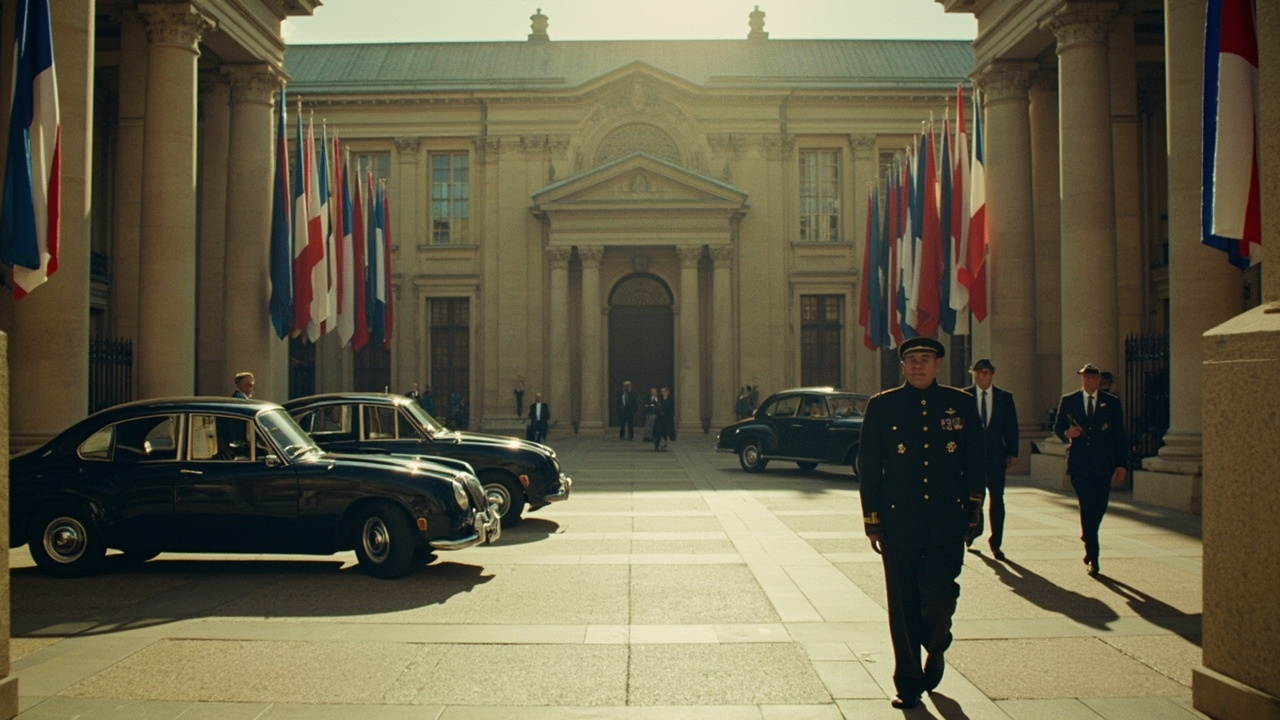
France and Britain convened 51 countries on Friday for the first full session of the Strait of Hormuz Maritime Freedom of Navigation Initiative. [1] The joint statement by President Emmanuel Macron and Prime Minister Keir Starmer confirmed that Paris and London will "jointly take forward" a "strictly defensive" coalition and that Britain will host the next leaders' meeting. [1] The United States was not in the room, on the screen, or on the distribution list.
That is the point, and it held through the weekend.
The paper's April 18 report on the Hormuz mission emerging without Washington described an architecture still on paper. Friday in Paris it became a document. Saturday's IRGC fire on Indian-flagged tankers reset its deployment clock. Starmer's formula — that British assets would arrive "as soon as conditions allow" — had been written to cover a quieter sea than the one that materialised twenty-four hours later. [2]
The military spine of the coalition is thin but specified. France has sent its nuclear-powered aircraft carrier, a helicopter carrier and several frigates to the region. [3] Britain's RFA Lyme Bay has been earmarked to deploy mine-hunting drones; HMS Dragon, the Royal Navy's only major surface deployment, is already in the eastern Mediterranean. [3] Italy, via Premier Giorgia Meloni, offered naval units. Germany, via Chancellor Friedrich Merz, offered mine-clearance and maritime intelligence capability. [3] More than a dozen of the fifty-one participants signed up to contribute assets. The rest signed up to the principle.
Merz added the line that separated him from his host. He told the room he wanted US participation: "we believe this would be desirable." [3] Macron's standing position — that belligerents cannot be part of a defensive mission — excluded Washington by design. An Élysée statement said the French would work "in good understanding with the Americans but we will not enter a coalition with the Americans, simply because we are not parties to the conflict." [4] Merz attached a second condition: Berlin would need Bundestag approval and a "secure legal basis," preferably a UN Security Council mandate. [3]
The coalition's framing went through revision by Saturday morning. The joint statement had "welcomed the announcement today that the Strait will re-open." [1] Iran's deputy foreign minister was saying the same thing at the Antalya Diplomacy Forum. [5] By Saturday afternoon the IRGC had opened fire. A military-planning conference in London "this week" — Starmer's line at the Élysée — now meets under rules that changed while it was being scheduled.
There are older templates to borrow. One French official told Reuters the mission "can involve intelligence sharing, mine-clearance capabilities, military escorts, information procedures with neighbouring countries and more." [3] That is Operation Aspides, the EU's Red Sea mission against the Houthis, with a new chart on the wall. Estonia's Kaja Kallas has floated expansion of Aspides eastward as a bureaucratic short-cut. [6] The bureaucracy is the easy part. The political question is whether a defensive mission can be launched against a state that fires on cleared neutral shipping, without being drawn into something larger than defence.
The coalition's composition answers a separate question. The prime ministers of Australia and Canada, the presidents of South Korea and Ukraine, and representatives of China and India joined by video. [3] This is not an Atlantic coalition. It is a customer coalition — every participant imports through Hormuz or exports to states that do. Trump, at the White House on Saturday, said he did not need allies' help. [3] The fifty countries in Paris appear not to need his.
What the next step looks like depends on Wednesday. If the ceasefire expires without a Round 2 forum, the London military-planners' meeting will take place in wartime, which is not what Macron scheduled. If Wednesday produces diplomacy, the mission reverts to the paperwork stage and remains a document about a mission that may never deploy.
Either way, the map has changed. NATO is not the security architecture the war produced; this coalition is. Whether it can do anything without the navy it did not invite is an open question. On Saturday, as the IRGC turned ships around, Paris and London were the two capitals drafting a response.
-- CHARLES ASHFORD, London