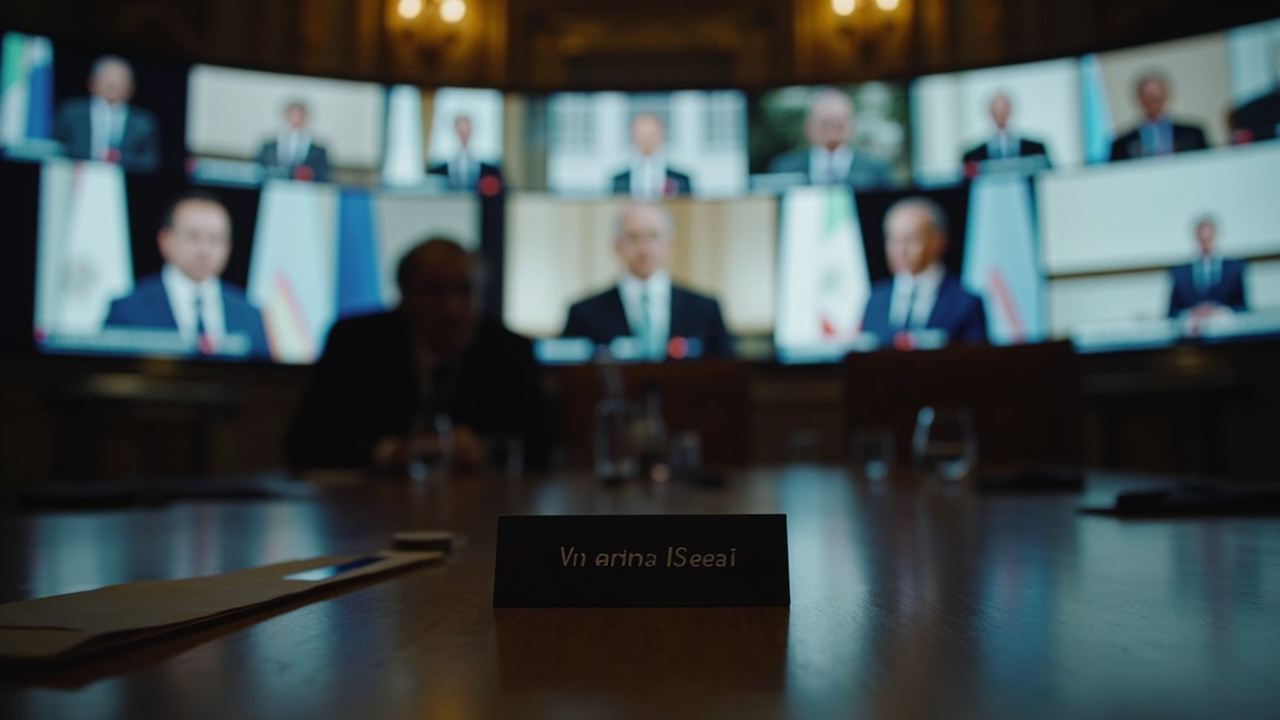
At 2:13 p.m. Eastern on Friday, Donald Trump published a Truth Social post calling NATO "a paper tiger" and thanking the alliance for offering Hormuz assistance he had, he wrote, declined. "I told them to stay away, unless they wanted to transport oil," the post read. "Useless when needed." [1][2] The same afternoon, inside the Salon Murat of the Élysée Palace, Emmanuel Macron and Keir Starmer were co-chairing a videoconference of more than forty-five heads of state to structure an international naval mission to the Strait of Hormuz. [3][4] The Elysée briefing described the mission as "purely defensive" and specified that it "does not include the US or Iran for now." [5][6]
The sequence would have amused Vicky the cartoonist, had he lived to see it. The insult followed the exclusion; the insult did not produce the exclusion. To the informed reader of the morning's European press, Trump's "paper tiger" post was a post-hoc rationalisation of a decision made in Paris at breakfast time. The Americans were not kept out because the Americans refused. The Americans were kept out because the Europeans, having measured their six weeks of jet fuel reserves and their exposure to the selective blockade, chose to build a redundancy against the architecture America had built for them.
The forty-five countries, and the one
The participants on the Paris videoconference included the United Kingdom, France, Germany, Italy, Spain, the Netherlands, Poland, Greece, Portugal, Denmark, Norway, Sweden, Finland, Canada, Australia, New Zealand, Japan, South Korea, Singapore, the UAE, Saudi Arabia, Kuwait, Qatar, Bahrain, and approximately twenty others including the European Commission and the UN. [3][7] Notable absences, beyond the obvious: Turkey — which, alongside Pakistan, had been hosting bilateral Iran diplomacy throughout the week — did not participate. China did not participate and was not invited. Russia was not invited. The United States was invited, in a formal courtesy, and declined.
The mission's stated architecture, per French foreign ministry briefings, is a rotating naval presence of approximately twelve frigate-class vessels and four support ships, operating outside the strait's territorial waters and coordinating civilian-convoy passage on an opt-in basis. It is not a combat deployment. It is what NATO's Operation Ocean Shield was in the Gulf of Aden between 2009 and 2016 — an anti-piracy framework exported to a chokepoint whose pirate is, on this occasion, a sovereign state with a US-flagged blockade attached. The Europeans do not call this a replacement for NATO's Article 5 responsibilities. They call it a complement.
Friedrich Merz, meeting reporters in Berlin on Friday evening, was the only head of a major participating government to say publicly that he still wanted American participation. Germany, he said, would "welcome" US involvement if a ceasefire held and a UN mandate covered the deployment. [8] The conditional was doing the politics. No UN mandate is forthcoming; no ceasefire that covers Iranian-flagged vessels has been declared; Germany's participation in an operational mission would therefore require either a return of Washington to the table or a Bundestag vote Merz does not yet have. Merz's invitation was diplomatic choreography. His chief of staff, speaking on background to Der Spiegel, was clearer: "The mission proceeds with or without the United States."
What the insult was for
The "paper tiger" framing is not new. Trump used it in March when the alliance did not endorse the initial Iran campaign, and he has used it intermittently since. Friday's deployment of the phrase was different in one respect. It arrived on an afternoon when the alliance was not, in fact, doing nothing. It was standing up a multinational mission on the chokepoint where the war's most consequential enforcement geometry lives. The "useless when needed" clause required its object to be actually useless. The object — the Paris summit — was, at the moment of the post, being useful to forty-five governments simultaneously.
The purpose of the insult, therefore, was not operational description. It was domestic positioning. The president's base does not want NATO assistance in the Iran war and does not want the war described as a war the Europeans might help to finish. The phrase "paper tiger," attached to a moment of European activation, reframes the European activation as failure rather than exclusion. The American electorate does not need to be told that Paris met without Washington; it needs to be told that Washington did not attend. The difference is everything.
This paper has covered the same reframing logic in the Reeves-11 finance-ministers statement on April 15, in which the UK-led Hormuz communique was signed by eleven countries and not signed by three G7 states including the United States. The paper's position then was that the economic coalition was not the military coalition — a framing that Friday's Paris conference extends from the economic to the operational register. Three days after the economic exclusion, the Europeans held the military exclusion. Both events were paired with American public dismissal of the body that excluded the Americans. The pattern is now load-bearing.
What the mission can do, and what it cannot
The operational question about the Paris mission is what it can actually do against a strait whose enforcement architecture is a US-flagged blockade supplemented by a coordinated corridor administered by the same US enforcement. A European civilian-protection mission, deployed outside territorial waters, can escort convoys, gather incident data, and provide an alternative command-and-control framework for European-flagged tonnage. It cannot interdict Iranian vessels (which would be an act of war Iran has not granted the Europeans). It cannot force open Iranian ports (which the US is blockading). It cannot, therefore, alter the strait's selective-peace geometry.
What it can do is insurance. A European naval presence in the coordinated corridor lowers war-risk premiums on European-flagged tonnage and provides a political ceiling on escalation — if the US were to close the corridor again, a European fleet presence gives the Europeans a direct stake in contesting the closure rather than a rhetorical one. The insurance value is real. Lloyds of London underwriters were quoting European-flagged war-risk premiums at 3.5 percent of hull value on Friday evening, down from 10 percent the week prior. That 6.5-percentage-point compression is the Paris mission's immediate deliverable. It is the price the Europeans pay for Washington's exclusion; it is also what they purchase with it.
The Economist's Paris bureau described the mission on Wednesday as "largely symbolic" — a fair read if the test is whether the Europeans can militarily break the blockade's flag filter. [6] If the test is whether the Europeans can price themselves into the corridor independent of US terms, the mission is not symbolic. It is the insurance syndicate's backing.
The architecture at the end of the week
At week's end, the war's institutional architecture looks something like this. The Americans are conducting belligerency policy by Truth Social post and Reuters phone call. The counterparty rebuts on Iranian state television inside six hours. Pakistan's mediation has decomposed across four capitals. Congress has a thirteen-day FISA patch and a War Powers resolution that failed by one vote. The Europeans have stood up a naval mission that explicitly excludes the Americans and the Iranians. Forty-five countries voted for it. The Americans called it a paper tiger on the way out of the room they had already left.
A certain register of transatlantic scholar would find this the most consequential structural event of the week. NATO, in its seventy-seventh year, has been described as a paper tiger by the president of its largest member on the afternoon its principal European members stood up a naval operation explicitly outside its command architecture. Whether the word "paper tiger" accelerates the bifurcation or merely describes it is the question. Either way, the bifurcation is real, it is operational, and it is now sitting in Paris with the signatures of forty-five states and the flags of none of the belligerents.
The Americans, to their credit, know exactly what they have done. Merz, to his, is still phoning Washington to ask for its company. It is unclear whom he expects to answer.
-- CHARLES ASHFORD, London