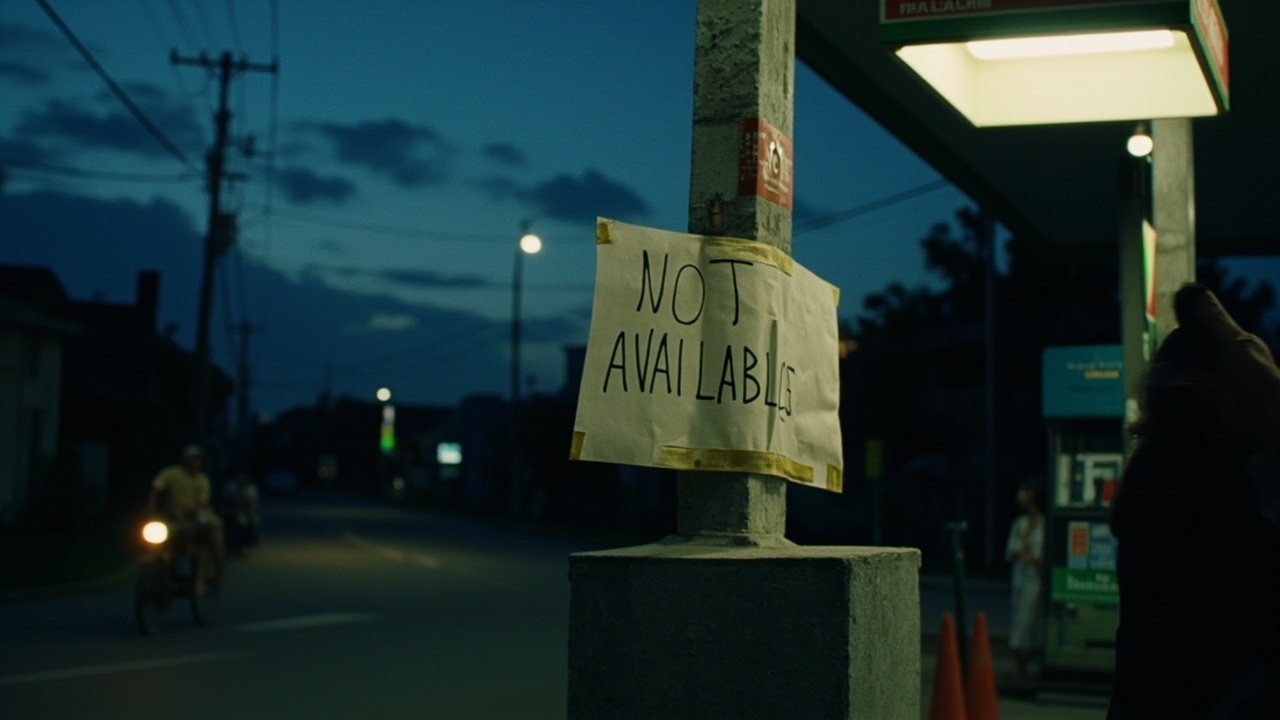
Philippine Energy Secretary Sharon Garin said Tuesday that Manila has asked the United States for an extension of the waiver allowing it to buy Russian oil. [1] The request went through the Department of Foreign Affairs to the Philippine ambassador to Washington, Jose Manuel Romualdez. The previous waiver expired April 11. [1] Friday the Treasury issued General License 134B, extending the authorisation to May 16 at the global level. [2] Whether Manila's request triggered the extension, or merely overlapped with it, is the next question.
The paper's April 18 reporting on the extended Russia waiver noted that US officials cited partner-country lobbying at the G20 and IMF meetings. Garin's briefing identifies one of those partners by name. India has been the other. The waiver architecture's Asian dependency is therefore wider than the India story alone.
Garin's framing was consistent with an economy on the edge of rationing. The Department of Energy data she cited: at least four million barrels of oil shipments to the Philippines were cancelled after the war began, tightening supply in an import-dependent country. [3] A ship carrying 700,000 barrels of Russian crude arrived in Manila last month. [3] About thirty percent of Philippine crude passes through the Strait of Hormuz. Diesel pump prices have doubled. President Ferdinand Marcos Jr. suspended excise tax on kerosene and LPG after Congress granted emergency fuel-tax powers. [3]
"We wanted to open the Russian window because we want more options," Garin told reporters. "We need diversification." [1] Alternatives include Colombia, Argentina, Canada, the United States itself, and nearby producers — Brunei, India. [3] The Philippine fuel inventory stands at about fifty days' supply.
The underlying politics carry a familiar tension. Former Supreme Court justice Antonio Carpio and senators sympathetic to a China-wary foreign policy line have questioned Russian oil on principle. Public opinion in Manila, per Facebook comment threads on the Manila Times post announcing the request, oscillates between economic pragmatism and a deeper sovereignty complaint. The comment board on the paper's post captured both: "that's called sovereignty with a nod"; "Province of US"; "USA's 51st state." [4] The Manila Times itself treated the request straight as an energy story. The public response treated it as a diplomatic posture.
The policy mechanism is worth naming. OFAC's GL 134B covers transactions involving Russian-origin crude oil and petroleum products "loaded on vessels as of April 17." [2] A shipment the Philippines bought before April 17 and is transiting toward Manila is eligible under the waiver until May 16. Cargoes loaded after April 17 are not. That is what the Philippine DOE now has to schedule against. If Russian crude buying continues beyond May 16, the Philippines either obtains another waiver extension or lets the window close again.
The Philippines' situation exposes the pattern Friday's OFAC action was designed to address: energy-import-dependent Asian democracies, confronted with Iran-war-driven price shocks, looking to Russia as a strategic-stock alternative and to Washington as the gatekeeper. Japan's Ministry of Economy, Trade and Industry signalled in March it was weighing Russian purchases. [5] India was one of the original drivers of GL 133 and 134. Thailand, Indonesia and Vietnam are watched. The Philippines is the current data point. Each request is a mark on a map showing where OFAC's architecture has jurisdictional effects beyond Washington's formal authority.
The second-order consequence is equally clear. Every Asian democracy that secures a Russian waiver by lobbying the US Treasury is also tacitly confirming that its energy security depends on an American bureaucracy whose rules it does not set. Garin's "we are very positive on getting this other window" [1] is a sentence about confidence. It is also, in a different register, a sentence about structural dependence on a single decision-maker whose motives are a domestic midterm election and a Middle East war.
The waiver gives Manila Russian oil. It also gives Washington a lever. The request, once made public, is a record of that exchange. As of Friday's extension the Russian oil window remains open to 12:01 a.m. on May 16, globally, regardless of whether the Philippines secures its bilateral extension. What happens on May 17 will depend on the Treasury's next general license — and on the Iran ceasefire's status.
Manila is asking. The Treasury, so far this week, is listening.
-- DAVID CHEN, Beijing