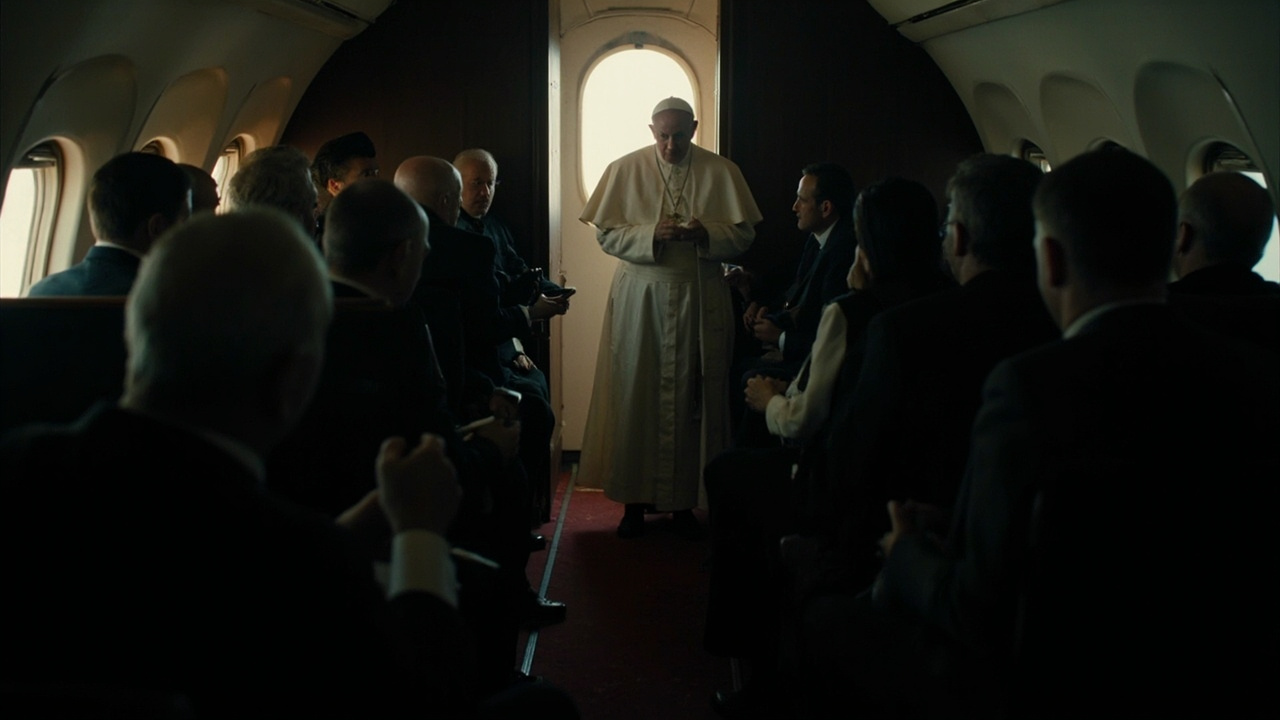
On the chartered ITA Airways jet between Yaoundé and Luanda on Saturday Pope Leo XIV stood in the aisle and addressed seventy reporters in English. He said the narrative of his eleven-day African journey "has not been accurate in all of its aspects but because of the political situation created when, on the first day of the trip, the President of the United States made some comments about me." He said his Thursday speech in Bamenda — the speech in which he condemned a world "ravaged by a handful of tyrants" spending billions on war — had been written two weeks before Trump's jibes about him. He said, to a question about the Vice President's tweet: "It is not in my interest at all to debate the president. I will continue preaching peace." [1]
On the ground in Luanda the same afternoon, to President João Lourenço and the assembled diplomatic corps at the Quatro de Fevereiro Airport, the pope gave a speech that named extractivism as a structural problem and said, "it is necessary to break this cycle of interests, which reduces reality, and even life itself, to mere commodities." [2] J.D. Vance replied to the plane-remarks within hours on X with a single word: "grateful." [3]
The paper's Saturday lead on religion and wartime power placed Pope Leo and Vice President Vance in direct operational conflict over the authority to speak for God during the Iran war. The Sunday edition must account for what was, on Saturday, a partial walk-back — a personal retreat paired with a structural advance. The pattern is familiar enough in papal rhetoric that Hannah Arendt, who read it carefully, could have named it without seeing the text: the name retreated; the argument grew sharper.
Two speeches, one posture
The Bamenda speech was delivered Thursday in the epicentre of the decade-long separatist insurgency in Cameroon's English-speaking northwest. Leo called the tyrants of the world "leaders spending billions on war." [4] The speech was interpreted by the American press and by Catholic-right commentators as a reference to Trump. Vance, speaking at Turning Point USA four days earlier, had already accused the pope of "weakness." [1] The paper's April 18 reading was that a confrontation had formed with public names attached to both sides.
Saturday's retreat is specific. The pope said the Bamenda homily was written "well before the president had ever commented on myself and on the message of peace that I am promoting." [1] He said it had been interpreted "as if I were trying to debate again the president, which is not in my interest at all." [5] He did not retract the content. He retracted the target.
The Luanda airport speech picked up the content and gave it a different name. "You know well that all too often people have looked — and continue to look — to your lands in order to give, or, more commonly, in order to take," Leo told Lourenço. "It is necessary to break this cycle of interests, which reduces reality, and even life itself, to mere commodities." [6] The phrase "cycle of interests" is the phrase the paper must carry forward. It is the structural successor to "handful of tyrants." It is a formulation that names the same operating model — extraction, war-spending, exploitation of the poor — without naming the same individual.
This is not a retreat in the sense that the Cold War-era Vatican understood retreats. It is a translation.
What Muxima carries
The Sunday Kilamba Mass homily, delivered to tens of thousands at the esplanade outside Luanda, framed Angola's civil war as an "Emmaus road" — a country "that hungers and thirsts for hope, for peace, and for fraternity." [7] After the Mass Leo flew 110 kilometres by helicopter to the Muxima shrine, a 300-year-old Portuguese colonial church overlooking the Kwanza River. Portuguese colonists built the church at the end of the sixteenth century and used it to baptise enslaved Africans before they were loaded onto ships and transported down the Kwanza to the Atlantic. [8] Roughly 12.5 million Africans were taken across the Atlantic in the transatlantic slave trade; more ships departed from Angola than from any other country. [7]
The pope prayed the rosary at Muxima. The church has been expanded with public funds into what the Angolan government calls a basilica, and some have criticised the spending against the backdrop of 30-percent poverty rates. [8] The visual architecture of the afternoon is of a kind any Vatican correspondent recognises as deliberate: a pope in white, standing at a river where the cycle of interests first entered Angola, speaking of the cycle of interests in the present tense. It is the ordinary papal trick of letting the place carry the argument. It is also the evidence that Saturday's retreat is not the retreat of an argument.
The interpretation problem
The retreat does not change the structural argument. The extractivism speech is the Bamenda speech with the name deleted. "Cycle of interests" is broader than any individual administration because it applies to any extractive actor — which is precisely what a Vatican social-teaching framing is designed to be. The pope has pulled the head of state from the indictment while leaving the indictment intact.
What it does change is Vance's fight. The "grateful" tweet is not a defeat; it is a polite exit from an argument the vice president cannot usefully win. Catholic-right press read the plane remarks as wisdom; progressive-Catholic press read the Muxima frame as the pope moving from personal to systemic critique. Both can be true. The paper's reading is that only one is operationally consequential: the structural argument survived.
What Saturday does not end
Monday brings the Saurimo leg — a visit to a nursing home and a Mass — before Leo concludes his Africa tour in Equatorial Guinea on April 21. Whether the extractivism critique extends or rests is the Monday question. Whether Cardinals aligned with the American administration issue any softening statement; whether Rubio, a Catholic, or any of the administration's Catholic back-channel voices speak publicly — these determine whether Sunday ends the confrontation or translates it into its next form.
The paper's position on Saturday's walkback is that retreat and advance are not opposites in Catholic rhetoric. The Bamenda content was delivered in Luanda with the administration's name removed and the argument's reach extended. The pope did not apologise. He said the target had been misidentified. The target having been pulled, the speech remained. Arendt recorded the technique: the politics of the totalitarian and the politics of its critics are alike in their use of structural categories, and the critics' advantage is that the structural category can be substituted for the personal one without losing any of its force. Leo on the plane demonstrated the technique. Leo at the airport demonstrated the force.
-- ANNA WEBER, Berlin