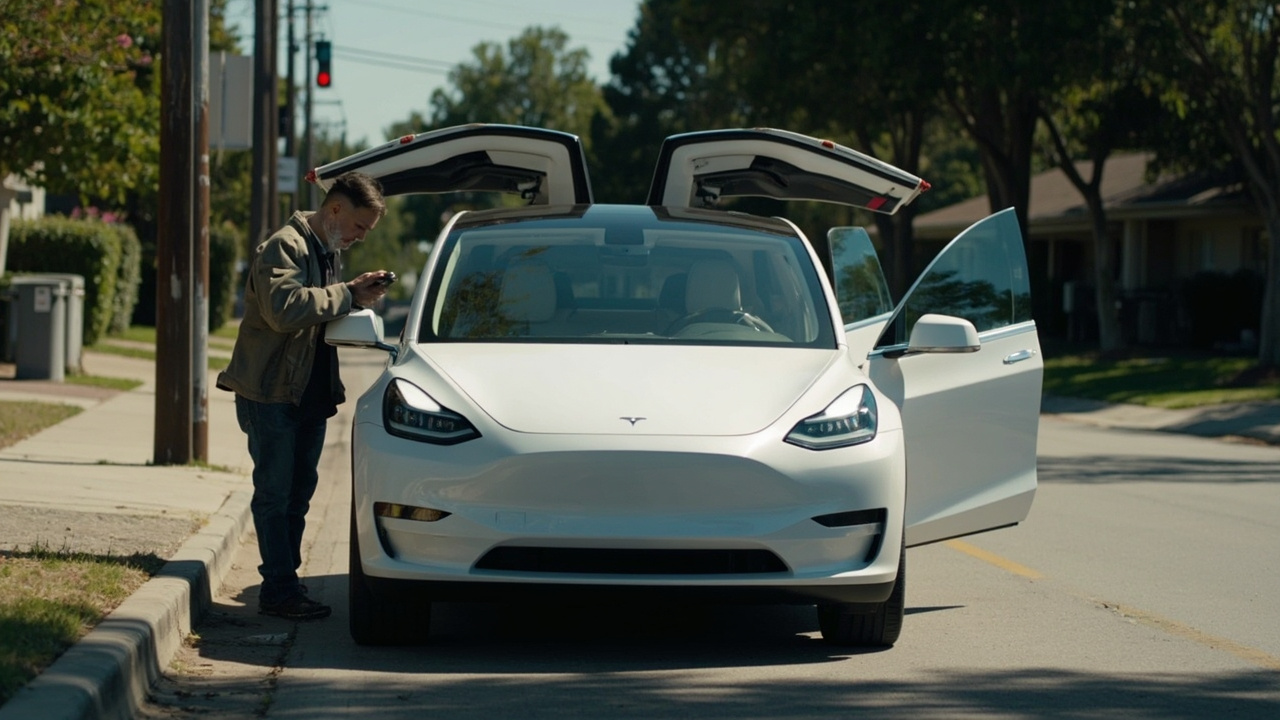
At roughly 3 p.m. Central time on Saturday Tesla's official @robotaxi account on X posted a fourteen-second video of a white Model Y with no one in the front seat, a geofence map of Houston that covered perhaps twenty-five square miles, and three words of accompanying text: "Robotaxi now rolling out in Dallas and Houston." [1] Elon Musk reposted the clip. By 5 p.m. the story was on Reuters, TechCrunch, and Electrek. By 6 p.m. Tesla's X account had a second post, for Dallas, with its own geofence covering the Highland Park area. The company did not disclose fleet size, pricing, the location of remote supervision staff, whether safety monitors would ride with the vehicles, or who the operator-of-record for liability purposes would be. [2] On Wednesday April 22 the company will hold its first-quarter earnings call.
What happened Saturday was not the launch of a robotaxi service. It was the placing of a narrative structure around an earnings call. Tesla has an inventory problem: the company produced 50,363 more vehicles in the first quarter than it delivered. [3] That is the widest production-delivery gap in at least four years, coming after a quarter in which the expiration of the $7,500 federal EV tax credit eliminated the demand the credit had supported. JPMorgan reiterated its Underweight rating with a $145 target — about sixty percent below the Friday close of $400. Energy storage deployments fell 15.4 percent year-on-year. The autos thesis is deteriorating. [4] The AI thesis — that Tesla is not really an automaker but a robotics platform whose fleet doubles as a training dataset for self-driving software that will generate revenue without the Cybercab production Wall Street has been expecting for three years — is the thesis that supports the $1.3 trillion valuation. [2] A Saturday video of an unsupervised Model Y pulling up in Houston is the narrative bridge between a Wednesday deliveries number that will not defend the valuation and a valuation that has to survive Wednesday.
The paper's Saturday lead on the Friday ceasefire rally called the week's market pricing a recess, not a verdict — banks reserved for war while equity markets priced peace. Tesla sits inside that asymmetry as an equity whose valuation was priced more as AI platform than as automaker for a year before the Friday rally made the pricing explicit. The Saturday launch presses the thesis one step further at exactly the moment the peace-priced valuation is being falsified by the Hormuz kinetic events. This is not coincidence; it is an increasingly familiar Tesla pattern. Narrative density rises as fundamental numbers soften.
What got launched
Tesla's Austin operation, which opened in June 2025, has approximately eighty vehicles today, of which four to twelve run without a human safety monitor on any given day. [2] The remaining cars still carry safety monitors in the driver's seat. All vehicles are remotely supervised by Tesla staff whose locations the company has not disclosed. Austin has logged fifteen crash incidents since launch, per Tesla's February regulatory filing. [2] The service shuts down during rain.
What rolled out on Saturday is not the scaled-up Austin. It is a footprint the size of a medium-sized American suburb in each of two new cities. The Houston geofence, roughly twenty-five square miles, covers parts of Willowbrook and Jersey Village — a zone the autonomous-vehicle tracker Robotaxi Tracker registered a single vehicle in on Sunday morning. [2] The Dallas geofence appears to centre on Highland Park; the same tracker registered one vehicle there as well, against Austin's forty-six. The word "rollout" overstates what is currently on the road.
Waymo, for comparison, has been operating publicly in Dallas and Houston since February 2026, with fully driverless vehicles — no safety monitors, no chase cars, no remote supervision requirement. [2] Waymo is now delivering 500,000 paid robotaxi rides per week across ten US cities. Whatever Tesla has in Dallas and Houston on the Sunday after the announcement, it is operating in markets a competitor has been serving publicly for two months.
What the Saturday play buys
Three things. First: a concrete expansion datapoint for Musk to cite on Wednesday's earnings call. Tesla's Q4 2025 shareholder update committed to launching robotaxi in seven cities within the first half of 2026. [4] Saturday moved the score from one-for-seven to three-for-seven. In an earnings context where the deliveries number will disappoint, the story becomes: we are executing on the expansion committed in January.
Second: options cover. The Tesla straddle for Wednesday prices an 8.19 percent move. [5] Past Tesla earnings have seen larger moves. The Saturday video provides catalyst cover for a Tuesday bounce that will soften the Wednesday number.
Third: regulatory narrative. Tesla has approval to operate robotaxi service in Texas, Nevada, and Arizona. [2] The Saturday launch, fleet-size and pricing undisclosed, becomes evidence the company can cite to federal regulators that it is operating at scale. Whether that persuades anyone who has been to the Houston geofence and counted vehicles is a different question.
The numbers Wednesday will show
The Q1 deliveries number, published April 2, was 336,681 vehicles against 387,044 produced — the 50,363 unit gap. [3] Full-year 2026 deliveries guidance was withdrawn in January. Wall Street consensus for Wednesday's revenue sits at approximately $20.1 billion, down from $21.3 billion a year earlier. Margins ex-regulatory credits are expected below ten percent.
These are the numbers the valuation does not defend. The $1.3 trillion market cap applied to $85 billion in expected revenue at a ten percent margin implies price-to-earnings multiples north of 150. [2] That is AI-platform pricing applied to a company whose auto revenue is roughly 85 percent of its business. The Wednesday call is when the market chooses: continue pricing Tesla as AI platform, or reprice as automaker. The Saturday rollout is designed to lean on the choice.
What has not come
NHTSA did not open a preliminary evaluation in the first twenty-four hours of the Dallas and Houston launches. Texas regulators did not issue a Sunday statement. The Texas law that took effect September 1, 2025 requires self-driving operators to obtain a Texas DMV permit; Tesla has that permit. California has approved the first in a series of required permits but not the full bundle; the Bay Area service still runs with human drivers. [1]
The Wednesday earnings call will be the first moment the launch is quantified. Until then, Saturday's rollout is a video. The video is a good video. The fleet is not disclosed. The pricing is not disclosed. The insurance and liability structure is not disclosed. What the market has, between Saturday and Wednesday, is the announcement; what it does not have is the operational datum that supports it. Wednesday tells us whether Tesla's narrative machine still works.
-- THEO KAPLAN, San Francisco