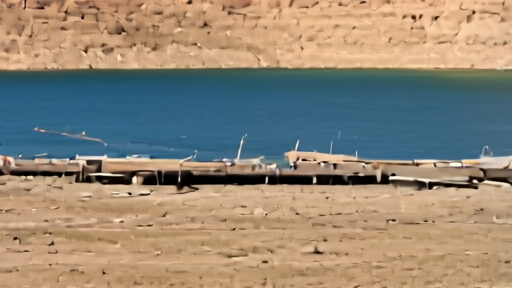
Colorado's statewide snow-water equivalent peaked at 8.55 inches on March 9, fifty-one percent of the thirty-year median and the lowest peak in the thirty-nine-year history of the SNOTEL monitoring network. [1] The peak arrived nearly a month before the usual April 8 date. As of April 9, statewide snow-water equivalent had already fallen to twenty-two percent of median — the previous low for that date, in 2012, was more than twice as high. [2] The paper's Saturday brief on the Colorado River snow drought opened the thread. Monday advances it with the primary number: the worst Colorado snowpack in recorded history is now flowing into reservoirs that were already well below full.
The basin the Colorado supplies runs through seven U.S. states, two countries, and forty million people. [3] The Bureau of Reclamation's most recent 24-Month Study, released in February, projected water-year 2026 inflow into Lake Powell at about 5.02 million acre-feet — since then, the outlook has darkened further. Updated federal modeling in April reduced the expected spring inflow into Powell to roughly 1.4 million acre-feet, or about one-fifth of normal. [4] Lake Powell sits at twenty-three percent of full capacity. Lake Mead sits at thirty-four percent. [3] The Upper Basin's peak snow-water equivalent stood at twenty-four percent of median for the season; the Lower Basin at fourteen percent. [5]
The March heat was the accelerant. State climatologists recorded daytime highs sustained at record levels across the Colorado Rockies for multiple consecutive days — the Colorado River Basin's warmest March on record, 13.7 degrees Fahrenheit above normal. [3] Statewide snowpack dropped by nearly five inches of water content during the second half of March alone; under a typical year the network would still be gaining, not losing. Ninety percent of western continental U.S. SNOTEL stations reported below-median peak snow-water equivalent. Across Colorado, 103 of 117 SNOTEL stations registered at or near the zeroth percentile; ninety-five percent at their lowest or second-lowest values on record. [1]
What this means operationally is that the 2007 Interim Guidelines and the 2019 Drought Contingency Plans, the two frameworks that have governed basin allocations for nearly two decades, face a summer with no reserve to draw from. The January forecast for spring runoff was 3.65 million acre-feet; February cut it to 2.4 million; the April modeling sits around 1.4 million. [4] Lake Powell's modeled elevation by December 2026 is 3,490 feet under the most probable scenario — the dead pool, at which hydropower generation stops, is 3,370 feet.
The February 2026 repeal of the Clean Air Act endangerment finding did not touch the Colorado River Compact, which is an interstate agreement ratified by Congress in 1922. But the compact was written against a decade that turned out to be the wettest in the basin's thousand-year reconstructed record. The Palmer reading is the current number. The compact is the frame that a year like this tests.
-- DARA OSEI, London