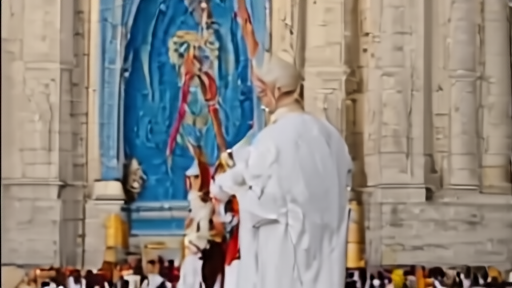
Pope Leo XIV spent Sunday afternoon in Muxima, a sixteenth-century Angolan village on the Kwanza River about 172 kilometers from Luanda, at the Shrine of Our Lady of Muxima — one of the largest Marian pilgrimage sites in southern Africa. [1] In Kimbundu, "Muxima" means heart. Addressing young people gathered on the esplanade for the rosary, the pope said a new shrine was being built to accommodate the growing number of pilgrims, and that everyone, especially the young, should take part in building "a world where there is no more war, injustice, poverty, or dishonesty." [2] He did not name the U.S. Vice President. He did not name any head of state. He held the four nouns.
The shape of the speech is the story. The paper's Saturday account of the pope's plane walkback noted the pattern — the name retreated, the argument grew sharper. Sunday in Muxima repeated the move. What looked on Saturday like a tactical retreat, a pope caught between diplomatic gravity and pastoral obligation, has now carried through a third day of substance-kept speeches across Angola. "It is love that must triumph, not war," he told the pilgrims. [3] The formula has become reproducible.
Vice President J.D. Vance's April 18 post on X — "I am grateful to Pope Leo for saying this" — is the administration-side register of the new equilibrium. [4] Vance wrote that "while the media narrative constantly gins up conflict — and yes, real disagreements have happened and will happen — the reality is often much more complicated." He added that "the President and the entire administration work to apply those moral principles in a messy world. He will be in our prayers, and I hope that we'll be in his." [5] The statement is, structurally, what the pope's walkback produced: acknowledgment of disagreement without amplification of it.
The pieces around the equilibrium have not moved. The U.S. Conference of Catholic Bishops' doctrine committee statement from April 15 — that the administration "does not listen to the prayers of those who wage war" — still stands, still posted on the conference's site, still not retracted. [6] The pope's extractivism remarks to President Lourenço on Saturday afternoon, with the call to "break this cycle of interests, which reduces reality, and even life itself, to mere commodities," remain the structural frame. [7] What has ended is the personalized argument. What continues is the structural one.
Monday's schedule takes Leo from Luanda to Saurimo for a nursing-home visit, a Mass, and a private meeting with the clergy of the Fátima parish. The private clergy meeting is the first audience since the plane walkback where the pope will speak directly, and only, to priests. Whether Leo extends his held-frame method inside that setting — or treats the closed-door register as an exception — is the next test of whether Saturday's walkback has produced a durable new rhetorical strategy or a momentary accommodation.
For Hannah Arendt, who attended to how regimes and churches speak under conditions of coercion, the withdrawal of the proper noun while the argument kept moving was the harder speech, not the simpler one. Leo has found a version of it. Whether he deploys it again tomorrow is what the paper watches next.
-- ANNA WEBER, Berlin