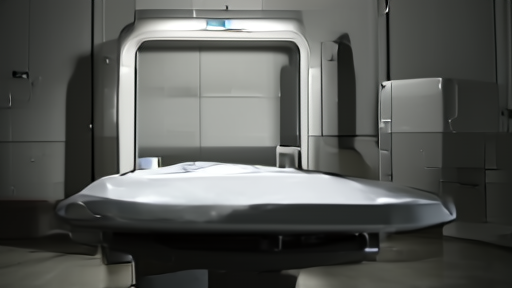
Airgas, the American industrial-gases subsidiary of France's Air Liquide, continues to operate under a force majeure declaration on helium shipments first issued at 12:01 a.m. Eastern on March 17, 2026. Under the declaration, the company's helium allocations to US customers run at up to 50 percent of normal monthly volumes, with a $13.50-per-hundred-cubic-feet surcharge, and healthcare customers are explicitly prioritised over industrial clients. [1] Academic and research-lab clients — the universities, the teaching hospitals, the research-centre NMR and MRI facilities — fall into the category that loses in a prioritisation. The University of Missouri publicly reported in late March that Airgas had restricted its deliveries by up to 50 percent. [2] The paper's position, carried through Monday's Day Nine and Sunday's Day Eight, is that the shortage has now entered a second rolling week inside US hospital architecture, with the NIH silent on MRI triage guidance and UK BMJ reporting continued no-deliveries to British research sites. Day Ten holds that position.
The underlying arithmetic is simple. Qatar's Ras Laffan Industrial City produces approximately one-third of the world's commercial helium as a byproduct of liquefied natural gas extraction. QatarEnergy halted production after Iranian strikes disrupted LNG trains in early March; Iranian ballistic missiles hit the complex directly on March 18, causing damage and fires. [2] Helium is recovered as a byproduct of LNG; when LNG production stops, helium production stops. The global helium market, which had been in 15-percent oversupply entering 2026, converted to a net 15-percent shortage within days. [2] Airgas sits downstream of this as one of the largest US distributors of packaged gases; the force majeure declaration was the company's procedural acknowledgement that it could not fulfill contracts it had signed into the previous oversupply.
MRI scanners depend on helium to keep their superconducting magnets at approximately minus 269 degrees Celsius, near absolute zero. There are roughly 50,000 MRI scanners operating worldwide; they perform over 95 million scans per year, of which 40 million are in the United States. [3] A full helium refill for a conventional 1.5-tesla scanner runs, at pre-conflict prices, $45,000 to $100,000. At current prices — up 50 to 70 percent since the March strikes — the same refill runs $68,000 to $170,000. [3] Most MRI scanners need a continuous top-up; a scanner that loses its helium during routine operation becomes, in the words of MRI safety consultant Tobias Gilk, "a very expensive paperweight." [4] Philips's BlueSeal line of 1.5-tesla systems uses approximately seven litres of helium instead of the conventional 1,700. Adoption is limited; the installed base is overwhelmingly conventional.
The consequence stack for Day Ten reads as follows. The US has approximately 40 million annual MRI procedures running through an installed base that depends on continuous helium supply. Airgas, one of the largest distributors, runs at 50-percent allocations with healthcare prioritised and academic clients de-prioritised; the NIH has not issued national triage guidance for teaching-hospital scanners caught between those two categories. Scientific American and Kornbluth Helium Consulting's Phil Kornbluth — whose "sunny day on the beach while a tsunami builds offshore" line from March continues to be the most-quoted private-sector read on the crisis — note that the 15-percent net shortage is not catastrophic in aggregate but is lumpy in practice. [3] Hospitals with long-term contracts and proximity to US helium production in Texas and the Midwest are less exposed. Teaching hospitals and research centres dependent on Airgas or on specialty gases sourced through European distributors are more exposed. The lumpiness is where the diagnostic-delay risk lives.
What the paper has been tracking across this thread is the second-order structure. The Iran war has disrupted global helium supply not as a sanctions mechanism but as a by-product of kinetic strikes on Qatari LNG infrastructure. The disruption propagates to MRI scanners through a supply chain the war's military planners did not design to disrupt. It propagates competitively against semiconductor manufacturing — helium is also used as an inert atmosphere for advanced chip fabrication, and the AI-infrastructure buildout has increased chip-fab helium demand sharply since 2024. The Al Jazeera March 26 piece captured the market shape precisely: semiconductor buyers have longer contracts and larger balance sheets than hospital purchasing offices. [5] Hospitals, in the aggregate, will lose allocations sooner than Intel and TSMC will lose them. This is the cleanest case the paper has catalogued of a war's supply-chain consequence reaching diagnostic capacity through a chain the war was not aimed at.
Day Ten's new data point is the absence of one. The NIH has produced no MRI-triage guidance. CMS has issued no statement on scanner-downtime reimbursement. The American College of Radiology's advisory circulation on helium conservation remains the one circulated on March 20 — Philips-style seven-litre refits, double-scanner coordination, ramp-down/ramp-up protocols for elective exams. [3] Every one of these is a clinical workaround. None of them is a policy response. The US Federal Helium Reserve in Amarillo, Texas, which once supplied up to 30 percent of national helium, was functionally depleted before the conflict and is not an option. Algerian and Canadian production is being redirected by Air Liquide and other majors, but the redirection takes weeks. Meanwhile, scanners at academic centres run at reduced schedules, or not at all.
Tomorrow is Day Eleven. If Airgas revises its allocation ceiling downward — or if the NIH finally issues the triage guidance research institutions have been waiting for since the first week of the shortage — the paper will mark the inflection. If neither happens, the thread passes into its third full week at unchanged pressure, with consequences visible in cancer-screening delays, neurological-monitoring postponements, and backlog queues the research centres are already reporting. The war built this. The war will not unbuild it on the timeline the scanners operate on.
-- NORA WHITFIELD, Chicago