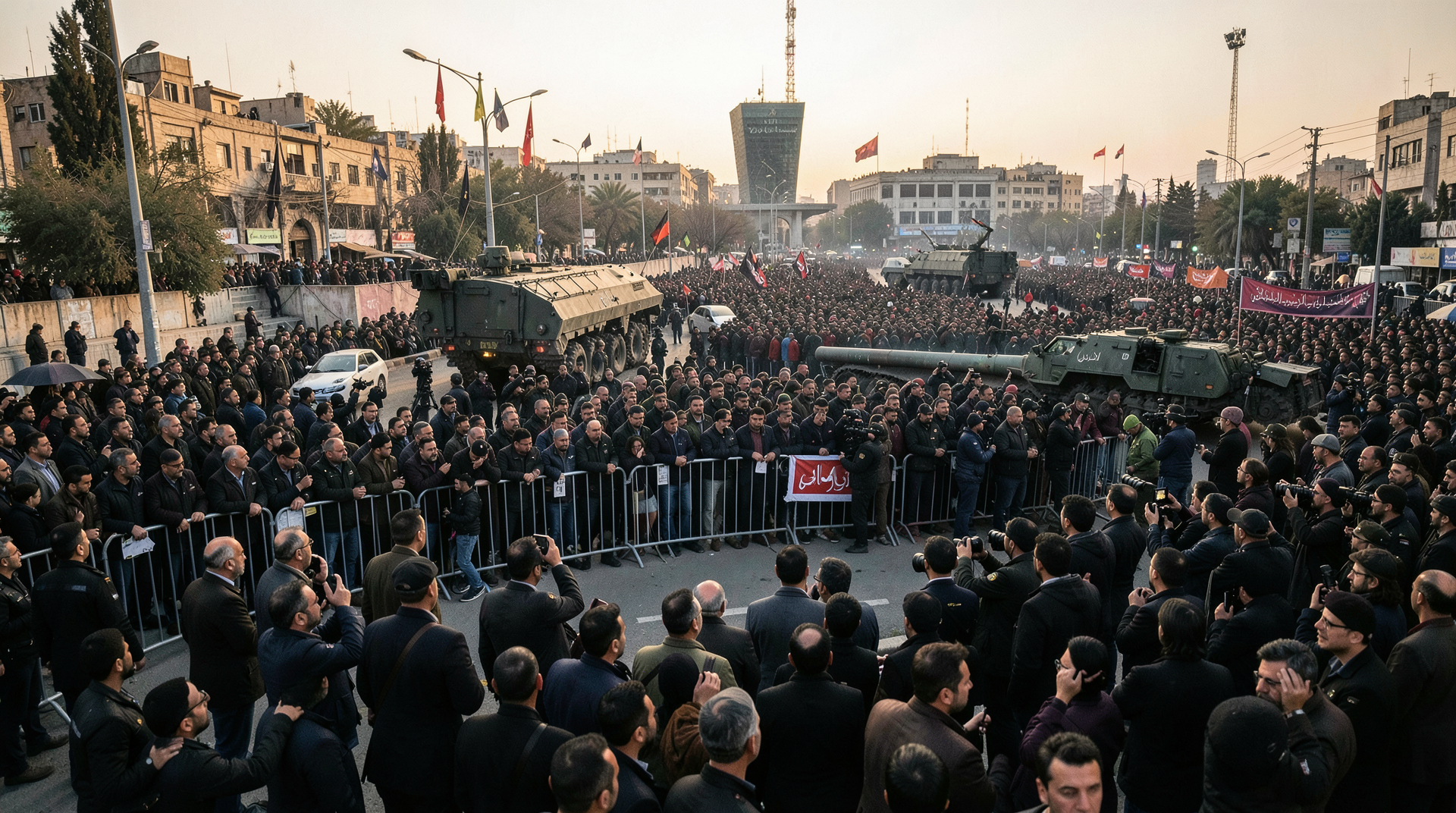
The old debate - is Iran divided or just theatrically plural - became harder to sustain Tuesday night. A Qadr missile appeared in Tehran rally imagery while three distinct political voices delivered incompatible strategic messages in public. [1][2]
That sequence extends yesterday's paper, which had described a constrained retaliation logic tied to crew-family risk and a diplomatic channel with no stable meeting architecture. The new fact is performative simultaneity: coercive imagery, conditional diplomacy, and maximalist rhetoric appearing at once.
Voice one came through diplomatic language: discussions are possible if blockade conditions shift. Voice two came from hardline parliamentary orbit: extension equals weakness and should be met with military firmness. Voice three, from interim-structure commentary, warned that accepting this format sets dangerous precedent. [2][3]
Any one of those lines can be posturing. All three at once indicate a signaling system without a single short-run master narrative. That matters for both Washington and mediators. Bargaining with fractured authority is not impossible, but it raises verification cost because every concession can be re-litigated by a different domestic node.
The missile imagery itself deserves precision. A launcher in a city square is not battlefield movement. It is domestic communications technology aimed at multiple audiences: rivals inside the elite, population segments needing reassurance after delay, and foreign adversaries reading for deterrence credibility.
In this frame, Trump citing "fracture" as a reason to extend is less insult than strategic bet: that division can be leveraged for a negotiable output. Tehran's public choreography answered with a different proposition: division can also be weaponized to increase bargaining opacity.
There is no contradiction between those two propositions. That is the problem.
If the diplomatic lane resumes, expect future Iranian statements to continue this tri-channel pattern unless one institution decisively imposes message discipline. If the lane stalls, this pattern becomes escalatory risk by itself, because outside actors may overinterpret whichever voice matches their priors.
For now, the key update is simple. The fracture has moved from inference to image.
-- YOSEF STERN, Jerusalem