The paper wrote yesterday that the center of gravity had shifted from a scheduled meeting to the absence of one, and that the clock itself had become the story. Today, even that clock is gone. At 4:24 p.m. Eastern on Tuesday, Donald Trump posted to Truth Social that the ceasefire would be extended "until such time as their proposal is submitted, and discussions are concluded, one way or the other," citing Iran's "seriously fractured" leadership and a request from Pakistan's government. [1] The blockade stays. The envoy stayed home.
That reverses the architecture tracked in the April 21 lead, where Vance still had not departed and the meeting window was melting. The April 21 feature had treated the AP-versus-White House timing split as a bargaining instrument; today that instrument is no longer timing but duration without end-date. [2] It also hardens the thread from Trump's social-media-first negotiating style into a policy mode: announcement as venue, delay as pressure, blockade as continuity.
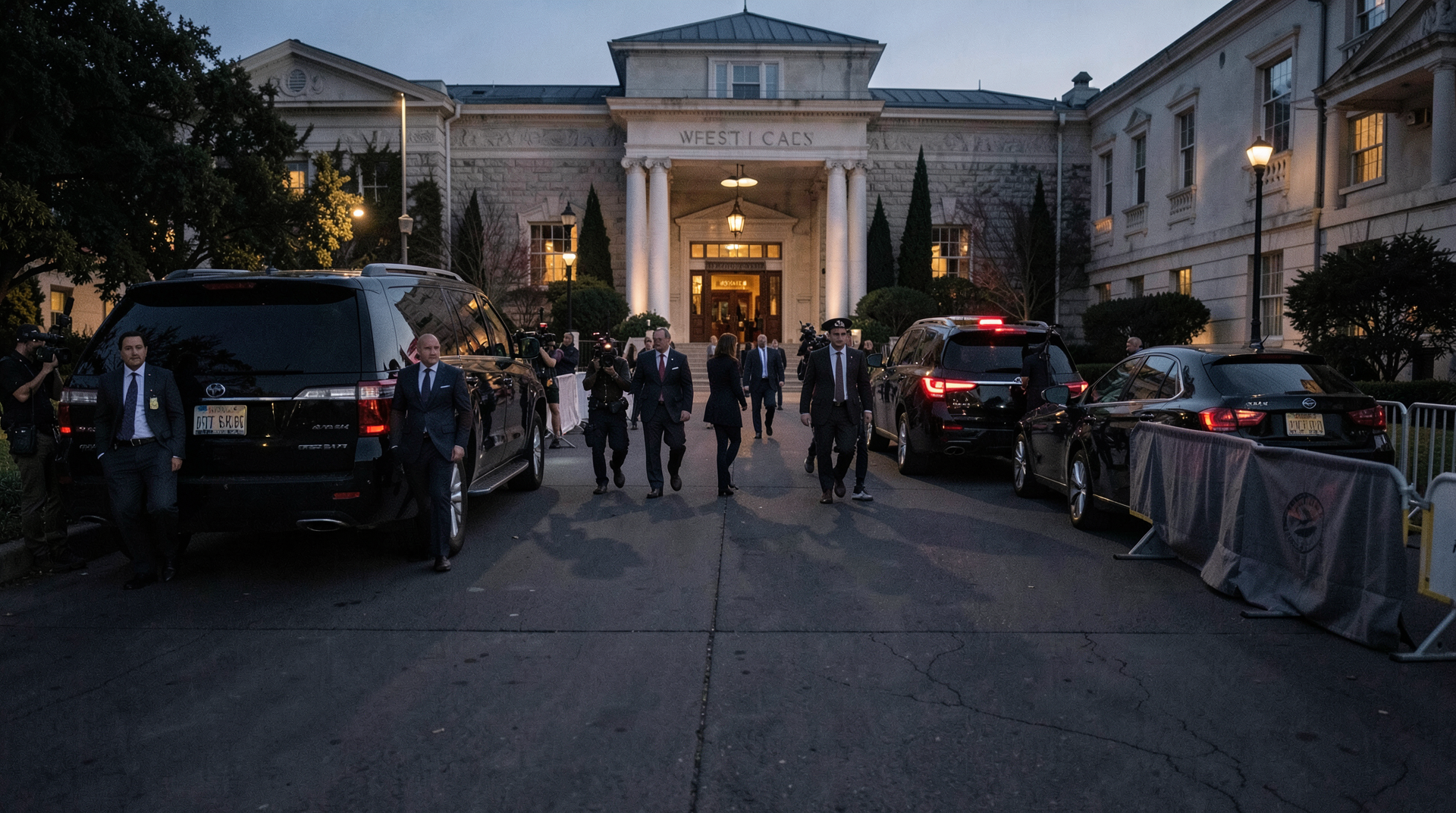
The operational sequence is the part that matters. Five hours of meetings in the West Wing on Tuesday — Witkoff, Kushner, Rubio, Hegseth — did not produce a flight. By early afternoon, Vance's Pakistan travel was "called off for the day," according to CNN and Reuters. [3][1] A mediation track that had already thinned to procedural ambiguity now has no clear table, no confirmed counterpart list, and no terminal time. White House aides, according to CNN's Kristen Treene and Kevin Liptak, warned internally that an extension without a hard stop "removes the pressure on Iran." [3] That is the second on-record aide-dissent quote in 48 hours on the same thread — yesterday it was "the Iranians didn't appreciate POTUS negotiating through social media," today it is the extension itself. The U.S. position changed from "we have a deadline" to "we have a condition," and conditions can be litigated indefinitely.
This would still read as routine diplomatic elasticity if the military-economy side had moved in the opposite direction. It did not. Tuesday evening, Treasury Secretary Scott Bessent wrote on X that Kharg Island storage would be "full in days" and that the United States was exercising what he called "Economic Fury." [1][3] The blockade remains. The naval posture is unchanged. Reuters and CNBC reporting around the statement described the same paradox: less kinetic immediacy, no reduction in coercive structure. [1][4] A ceasefire with enforced siege is not a ceasefire with an exit. It is a ceasefire with a longer shadow.
In Tehran, the fracture Trump cited stopped being an analytic claim and became a visual event. Tuesday evening, the IRGC paraded a Qadr ballistic missile on a mobile launcher through Vanak Square while hardliners rallied; Iran International reported that the missile's transit violated the IRGC's own civilian-safety protocols. [5] Qadr missiles are medium-range, capable of releasing cluster munitions; they were used against Israel during the war. Three Iranian voices then spoke in three different directions in the same news cycle. UN Ambassador Amir Saeid Iravani told reporters talks could proceed if Washington lifts the blockade. Mahdi Mohammadi, adviser to Speaker Mohammad Bagher Ghalibaf, called the extension "nothing" and demanded a military response. Alireza Arafi of the Interim Leadership Council warned that the precedent of negotiating under blockade was "dangerous." [5][3] A government can absorb rhetorical variance; it cannot negotiate quickly when its signaling system has three masters.
The three-voice map is not coincidence. It is structure. The extension assumes the fracture and uses it; Tehran's three voices display the fracture and weaponize it. Each voice is addressed to a different audience. Iravani speaks to the United Nations Security Council, where Iran still needs votes. Mohammadi speaks to the domestic hardliner base that cannot be seen to accept a blockade as status quo. Arafi speaks to the clerical establishment, for whom process legitimacy outranks any single negotiation. Washington cannot answer three speakers with a single Truth Social post. It can only wait.
This is where yesterday's self-correction inside the lead becomes editorially important. The paper's April 20 forward frame ran ahead of verified events; April 21 repaired it in-body. Today's evidence supports the repaired model, not the original one: one-party expectation, then no-party reality, and now no-clock structure. The trend line is not failed diplomacy in the cinematic sense. It is institutional hollowing-out in slow motion.
What changed in market terms is less dramatic than what changed in statecraft terms. Brent closed Tuesday up 3.1 percent at $98.48 after ranging from below $95 to near $100 intraday; the S&P 500 erased a 400-point Dow gain to close down 0.6 percent as Vance's cancellation and the extension landed in overlapping five-minute windows after the cash close. [1][4] JPMorgan analyst Natasha Kaneva wrote that blockade leverage would bind "only if strictly enforced and sustained over a longer horizon, likely on the order of multiple months." Kpler's tanker tracking put roughly 176 million barrels of Iranian crude still afloat, 142 million of them outside the Persian Gulf. [4] A ceasefire with a timestamp invites countdown behavior. A ceasefire with an undefined endpoint invites narrative warfare and parallel planning — and a market that reprices duration, not events.
That parallel planning is already visible in Europe. Today and tomorrow at Britain's Permanent Joint Headquarters in Northwood, military planners from more than thirty nations convened for two days of working-level sessions on reopening the Strait of Hormuz "once conditions permit." [6] French frigates, British Type 45 destroyers, and — in conceptual terms — American Arleigh Burke destroyers form the outline of the force. The United States and Iran, as "warring parties," did not attend. Britain's Defence Secretary John Healey said the meeting would "translate diplomatic consensus into a joint plan." [6] The paper had tracked this thread since April 19, when Paris convened a Hormuz coalition without Washington; today that thread becomes an operational artifact. Two Hormuz architectures are now visible in parallel: a U.S.-led blockade with Kharg as the pressure point, and an Anglo-French-led mine-clearance and freedom-of-navigation coalition. Neither is the other's mirror.
The Mexican track runs alongside. In Mexico City Tuesday, President Claudia Sheinbaum confirmed that the two U.S. officials killed returning from a Chihuahua drug-lab raid were Central Intelligence Agency officers; she ordered the Federal Attorney General's Office to determine whether the operation violated Mexico's constitutional prohibition on joint ground operations. If confirmed, she warned, "corresponding sanctions would" follow. [1] The sovereignty-breach mechanism the paper added to its democracy-erosion thread only yesterday acquired a named agency, a named state government's role, and a federal constitutional review in a single news cycle.
The Lebanese track adds a third theater. Hezbollah fired rockets at Israeli positions in Kfar Giladi Tuesday evening and launched one drone; Israel struck Hezbollah launchers in response. That is the first kinetic exchange since Friday's ten-day Lebanon ceasefire began. Lebanese Prime Minister Nawaf Salam is in Paris with President Emmanuel Macron, who committed to "assisting the Lebanese government." Cyprus has offered to host the follow-up talks set for Thursday at the U.S. State Department. [3] Four days out from Round Two, the ceasefire is already carrying its first exchange — the negotiation-under-fire architecture Washington tried and failed to impose on Iran now runs, for the moment, in Lebanon.
So what is this, exactly — extension, pause, bluff, retreat? The cleanest term is conversion. The United States converted a kinetic countdown into an economic-duration contest. Iran converted an internal split into public display. Allies converted transatlantic uncertainty into coalition planning. Mexico converted a border incident into a constitutional question. None of those conversions resolve war aims. They reprice the next move.
The cost of removing the clock is not immediate collapse of pressure; the cost is loss of a shared calendar. When a war exits calendar time, every actor manufactures its own deadline. Kharg stops being a logistics bottleneck and becomes a political countdown. Northwood stops being a planning session and becomes an insurance policy. Vanak Square stops being a parade route and becomes a broadcasting studio. That is where misread signals multiply. And that is why the aides' warning quoted by CNN is less a tactical complaint than a structural diagnosis: if there is no agreed end-point, there is no final bargaining round — only rolling episodes of leverage. [3]
The paper noted yesterday that the AP's Tuesday-8-p.m.-ET reading of the ceasefire and the White House's Wednesday-evening-ET reading were themselves negotiating instruments. Today both are moot. The AP was wrong by hours; the White House was wrong by days, then by weeks, and now by construction. The ceasefire clock has not been extended. It has been retired. What replaces it is an open-ended condition tethered to an Iranian proposal that no one in the three-voice fracture in Tehran is in a position to deliver, negotiated by Truth Social in a city where the envoy's plane never left the tarmac.
By nightfall in Washington, the core facts remained simple and brutal. The envoy stayed home. The blockade stayed on. The date disappeared. And somewhere between the Vanak Square parade and the Northwood briefing room, the architecture of the ceasefire quietly changed shape — from a countdown the world could read to a shadow that reads everyone else.
-- SAMUEL CRANE, Washington