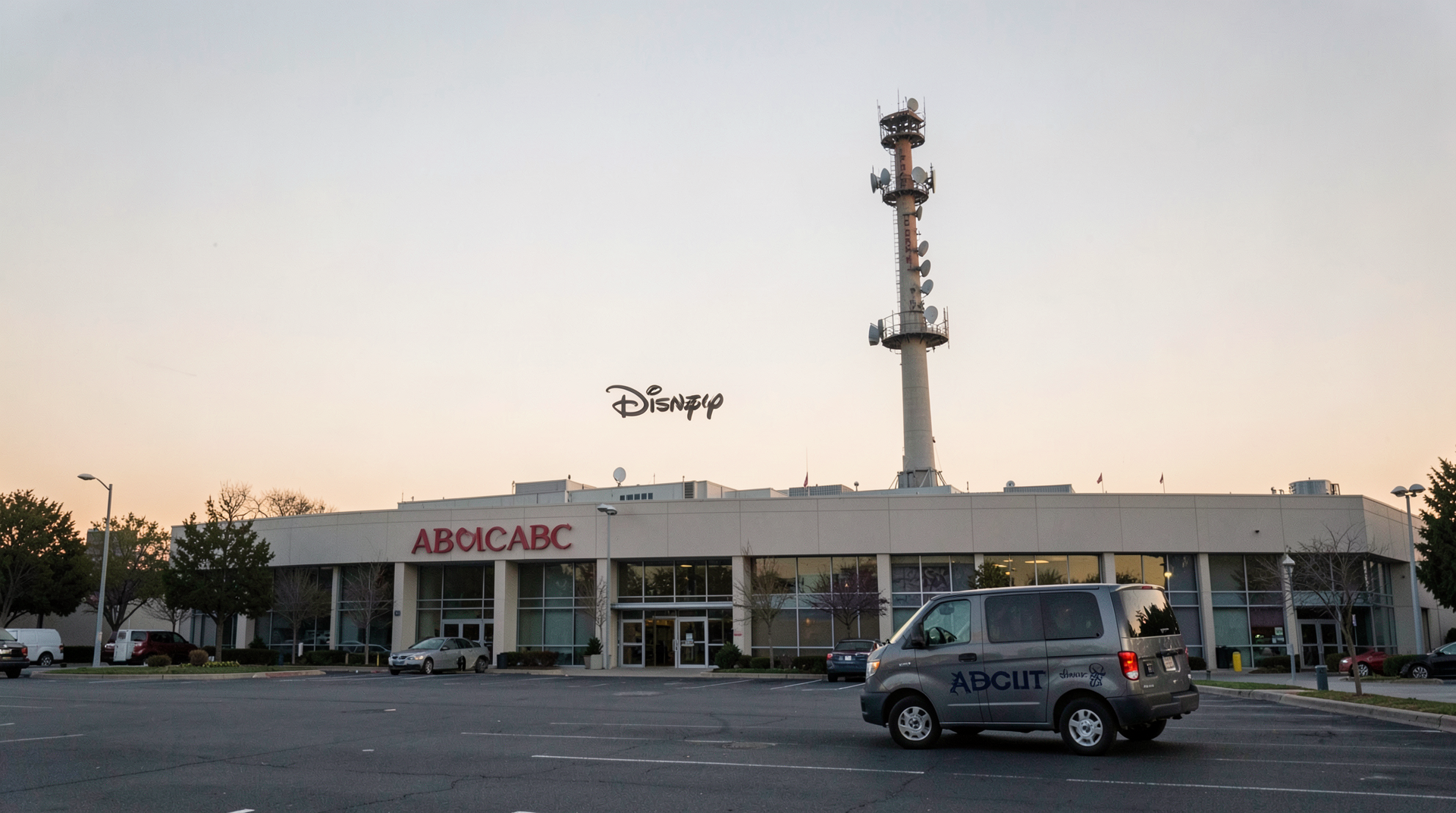
The Federal Communications Commission's April 28 order requires Disney to file early license renewals for eight owned-and-operated ABC television stations within thirty days. The thirty-day window opened today. The hard deadline is May 28. The eight stations are WABC New York, KABC Los Angeles, WLS Chicago, WPVI Philadelphia, KTRK Houston, KGO San Francisco, WTVD Raleigh-Durham, and KFSN Fresno. [1]
Friday is the first business day inside the cliff. The paper's Apr. 29 account of Paramount's FCC foreign-ownership petition read the 49.5% Saudi-Emirati-Qatari concentration as the most concrete press-freedom-wartime artifact since the Stars and Stripes ombudsman office was made ornamental; the Disney cliff is now the next concrete artifact of a different kind.
FCC Chair Brendan Carr's office, in a Tuesday statement, framed the order as a continuation of the agency's year-long investigation into Disney's "DEI policies" and said the early-renewal proceeding was "authorized by Section 309" of the Communications Act. Disney has not announced its intent to comply or contest. ABC News declined comment Thursday afternoon. NBC News reported Tuesday evening that the order "surprised FCC staff and shattered norms"; the Bloomberg reporting earlier the same day called the proceeding the first early-renewal call ordered for political reasons in the agency's history. [2] Senator Ted Cruz, whose office rarely splits with the administration on media policy, told Punchbowl News on Tuesday: "It is not government's job to censor speech, and I do not believe the FCC should operate as the speech police." [3]
The paper's Apr. 29 account of Paramount's FCC foreign-ownership petition read the 49.5% Saudi-Emirati-Qatari concentration as the most concrete press-freedom-wartime artifact since the Stars and Stripes ombudsman office was made ornamental. The Disney cliff is now the next concrete artifact, of a different kind. Where the Paramount petition disclosed who owns an American broadcaster, the Disney cliff disclosed what an FCC chair will do with the licensing power he holds when an ABC late-night host tells a joke about the First Lady the President's office calls offensive.
Section 326 of the Communications Act prohibits the FCC from censoring broadcast content. The agency has, since the 1934 Act, leaned on indirect mechanisms — license renewal, public-interest review, station-disclosure rules — to influence what gets aired. The early-renewal mechanism is the most powerful of these. A standard ABC O&O license renewal cycle is eight years; the next normal cycle for the New York and Los Angeles stations would have begun in 2030. Calling all eight stations in for an early renewal, with a thirty-day filing window, compresses what would normally be a multi-year administrative track into a calendar month, and changes the leverage balance. ABC's eight O&Os reach roughly 22% of the U.S. television-household population.
Carr's "DEI compliance" frame is the legal pretext, not the operative cause. The order's text references "ongoing review of broadcast licensee adherence to FCC equal-employment-opportunity rules and ABC's editorial decision-making consistent with Section 326's prohibition on government censorship." The temporal sequence undercuts the framing. Jimmy Kimmel's September 2025 monologue calling Melania Trump's appearance "an expectant widow" produced a same-week FCC chair X post that "the Communications Act authorizes the FCC to call in licenses for early renewal." Disney pulled Kimmel from the air within seventy-two hours of that post; Kimmel returned three weeks later under a settlement Disney has not disclosed. The DEI investigation Carr now cites pre-dates the Kimmel monologue but did not produce a license-renewal call until April 28. [4]
The substantive review track for the eight stations runs through the Media Bureau's renewal docket. The standard ABC O&O renewal application is roughly forty pages plus exhibits — equal employment opportunity reports, public file inventories, programming summaries, ownership filings. Each station files its own application. The bureau is required by statute to give "due consideration" to comments from the public; FCC rules permit petitions to deny by aggrieved parties. The chair can refer any individual application to the full commission for a hearing if "substantial and material questions of fact" exist about whether continued operation serves "the public interest, convenience, and necessity." That is the standard the agency invokes when it threatens to revoke a license. It is rarely invoked; it has never been invoked at this scale on a thirty-day cliff in modern FCC history. [5]
Disney's options are operational rather than constitutional. The company can comply with the May 28 filing deadline, accept whatever conditions the bureau attaches, and litigate any subsequent revocation in the D.C. Circuit. It can refuse to comply and force the agency to open enforcement proceedings, which would push the substantive review past the 2026 election and through whatever administrative posture the next chair adopts. It can file under protest and reserve administrative-procedure-act claims for review. Internal Disney legal-department guidance circulating in licensing circles suggests the company is leaning toward filing under protest — accepting the cliff while preserving every challenge. The settlement with Kimmel that returned him to air in October 2025 included, sources told Variety, a clause obligating the host's team to coordinate any "politically sensitive" monologue content with ABC standards-and-practices for ninety days; whether that clause has been activated since the early-renewal order, no Disney source would say. [6]
The friendly-right register has split. The FIRE foundation called the order "viewpoint retaliation." Cruz called it speech-policing. The Federalist and National Review have published silence. The Cato Institute has not issued a statement. Brett Cooper at the Free Press called it "an overreach we will not defend." [3] The pattern resembles the friendly-right capitulation register the paper has been tracking on the Comey indictment — a press-freedom mechanism the conservative legal establishment is unwilling to defend even when its target is one it dislikes.
The thirty-day cliff is operationally a soft cliff. The bureau can extend, the chair can suspend, the commission can vote to delegate or reclaim authority. The Wheeler-era convention that license-renewal review is a routine administrative matter, conducted on its own statutory timeline rather than at the chair's discretion, is the convention this order discards. Whether that discard becomes precedent depends on Disney's filing posture, the bureau's response, and whether any of the eight stations' market competitors files an opposing petition during the comment window. The first concrete date is May 28. The first answer is whether Disney files at all.
-- MAYA CALLOWAY, New York