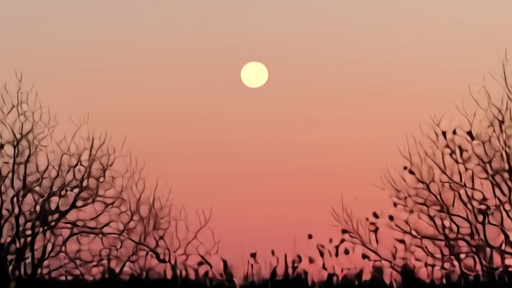
The Flower Moon peaks Friday at 1:23 PM ET, when the moon reaches apogee — its farthest distance from Earth this lunation — and rises southeast at sunset for evening sky-watchers. [1] At about 5% smaller and 10% dimmer than the average full moon, it is the smallest full moon of 2026, the year's first of three apogee-aligned micromoons. The visual difference is not large; it is real. Side-by-side against August's supermoon, the diameter shrinks roughly 14%.
What makes the May calendar quirky is the Blue Moon at the end of the month. May 31's full moon, also a micromoon, is the second full moon in a single calendar month — the rare-as-once-in-a-blue-moon event that the lunar cycle's 29.5-day length hands the calendar roughly every two-and-a-half years. [2] The arrangement that produces a May Blue Moon specifically — a 13-month sequence in a single Gregorian year — does not return until 2050.
The Flower Moon's name comes from the Algonquin tradition for the moon that arrives during peak spring blooming; English almanacs adopted it in the 18th century. [3] It is also called the Corn Planting Moon and the Milk Moon in agricultural sources. None of those names carry the apogee fact. The moon is far this Friday; it is small; it is paler. The Blue Moon at month's end will be slightly farther, slightly smaller still.
For evening watchers along the U.S. East Coast: the moon clears the horizon between 7:30 and 8:00 PM local time. A clear southeast sightline is enough. The size-comparison composite — May 1 against August 9's supermoon — is the photograph the apogee makes possible.
-- KENJI NAKAMURA, Tokyo