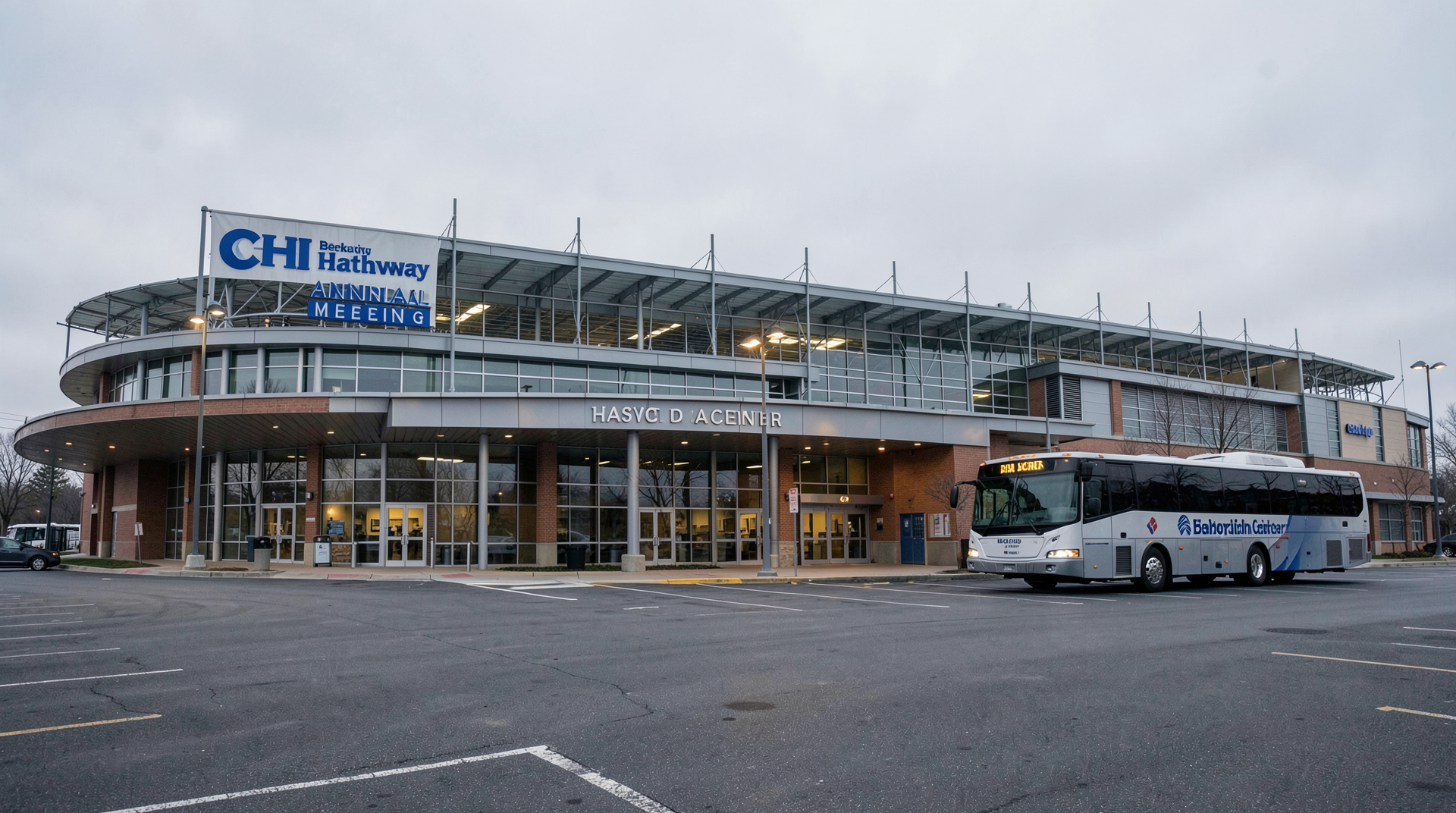
The CHI Health Center in Omaha unlocked at 6:30 a.m. Central on Saturday, May 2, the same hour Berkshire Hathaway's Q1 release crossed the wire and four months after Warren Buffett handed the chief-executive keys to Greg Abel and moved to chairman emeritus. Q1 revenue printed at $95.1 billion, in line with Zacks consensus, up six percent year over year. [1] Operating earnings rose modestly. The number nobody is parsing in the operating segments is the one printed inside the cash position: $373.3 billion, a record by any measure that has ever been measured, the largest single dry-powder reserve in S&P 500 history. [2] The meeting's livestream opens at 9:15 a.m. Eastern. Greg Abel, who became chief executive on January 1, is the only voice anyone will quote afterward — Buffett, ninety-five years old and present in the audience as chairman emeritus, will not take questions for the first time since 1965.
This is a regime change being tested in real time, on the same Saturday morning that Trump's Friday "termination" letter on Iran sits unanswered, the same morning the OPEC+ ministerial Sunday will publicly answer the UAE's midnight exit, the same morning Apple's $100 billion buyback authorization marks the cleanest Mag-7-versus-Berkshire capital-allocation contrast the cycle has produced. The paper's Friday account of XOM's $9 billion distribution print named the integrated-supermajor model as the war-premium beneficiary; today's print is the Saturday-only artifact that asks whether Berkshire's model still operates when the man who wrote it is four months off the podium.
The $373.3 billion cash figure is the one Abel must explain, and the explanation he cannot give is the one Buffett would have given on this stage every year since 1965: a paragraph about how nothing on offer met the standard, a line about waiting for the fat pitch, an aside about how owning Apple at the wrong price is worse than owning T-bills at five percent. Abel does not speak that language fluently. He speaks the operating-company language — Berkshire Hathaway Energy, BNSF Railway, Geico, where his career was made. The annual meeting is a 60-year capital-allocation catechism, and Saturday is the first time it is being recited by someone other than its author. What he says, and what he does not say, is the artifact.
The Q1 release itself, parsed against the backdrop of Friday's market action, contains four numbers that matter. Insurance underwriting income held steady at $2.1 billion despite the war-premium volatility in catastrophe reserves. [3] Railroad revenue at BNSF rose four percent on intermodal volume that has not yet absorbed the Hormuz shipping disruption. The energy segment, which now spans Berkshire Hathaway Energy's regulated utilities and the natural-gas pipelines Buffett added in 2020, posted operating earnings of $1.4 billion — a number that will rise next quarter as the war premium feeds through gas-fired generation rates. The investment portfolio's Apple stake, marked at quarter-end, gained roughly $4 billion on the AAPL rally that culminated in Apple's $100 billion buyback announcement Thursday. The Q1 buybacks line — Berkshire's own repurchases, not Apple's — printed positive for the first time in three quarters, suggesting Abel resumed the share-repurchase program Buffett had paused in late 2025. [2]
The buyback resumption is the first concrete capital-allocation decision attributable to Abel rather than to Buffett. Berkshire's repurchase policy under Buffett was famously elastic: buy when the price is below intrinsic value, never above. Abel inherits a stock trading at roughly 1.5 times book — high by Buffett's historical standards, low by post-2020 multiple expansion. A modest Q1 buyback at that valuation is either a signal that Abel views the stock as cheap, or a signal that he is using buybacks as a deployment instrument because the alternatives — a private-market acquisition, a public-equity stake, a Treasury rotation at five percent — looked worse. The annual meeting is where he will, or will not, distinguish the two readings.
The Mag-7-versus-Berkshire capex regime is now documented at the cohort level. Apple's $100 billion buyback into a memory-inflation guide, Meta's $25 billion bond raise into a $145 billion AI capex envelope, Amazon's $44 billion Q1 capex print, Microsoft's 45-percent OpenAI concentration — these are the four reference points against which Berkshire's Saturday print will be read. [4] Apple is the controlled experiment: a Mag-7 member that has chosen capital return over capital expenditure inside the AI cycle. Berkshire is the other controlled experiment: a non-Mag-7 conglomerate that has chosen cash hoarding over both. The market's question is whether Abel's regime preserves the Buffett distinction, breaks it toward an Apple-style return, or breaks it toward a Mag-7-style deployment.
Kingswell's Berkshire Beat on Friday — the high-quality independent voice in this beat — argued that Abel's first move will be incremental rather than declarative. [5] The argument: Abel cannot announce a strategic pivot at his first meeting without conceding that Buffett's strategy was wrong, which would be inadmissible inside the building Buffett built. The annual meeting therefore must be a continuity ritual on tone, with the substantive work — what Berkshire actually does with $373 billion in 2026 — done quietly across the second and third quarters. Saturday is the catechism; the deployment is the answer.
The X register on Friday split between two readings that map onto the same anxiety. Buffett-watcher accounts in the @CharlieMungerBot orbit treated the cash pile as a sell signal — "the moat was Buffett, not the model" — and read the buyback resumption as Abel's tacit admission that he has no other ideas. [6] The opposite camp, anchored by Stocktitan's morning thread on the consensus print, framed the cash pile as the largest single optionality value in capital markets and Abel as the one CEO with the institutional cover to deploy it counter-cyclically. [7] Both readings agree on the fact pattern. They disagree on whether Abel is the executor of an inheritance or the prisoner of one.
The meeting itself runs on the same architecture Buffett built. Doors open at 6:30 a.m. Central. The shareholders' film, narrated this year by Abel rather than by Buffett, runs at 8:30. The Q&A session begins at 9:15, broadcast exclusively by CNBC. [8] Abel takes questions for roughly three hours, joined by vice chairmen Ajit Jain (insurance) and Howard Buffett (chairman of the board, by family transition rather than operating role). Becky Quick handles the press desk; she has done so since 2007. The format is unchanged. The voice in the chair is not.
What the morning's print did not change is the structural position. Berkshire holds $373 billion in cash inside a market trading at record S&P highs, a war premium that is partly priced into oil and partly not, and a regulatory environment whose Friday letter declared a war over while the blockade that produced the war premium continues. The institutional question has been the same since Buffett stepped back: does Berkshire still know how to wait, or has waiting become a liability that the next generation cannot afford to inherit? Abel's first answer is the morning he gives. The second answer is what Berkshire owns by Labor Day.
The disclosed Q1 portfolio additions, when the 13F filings clear in mid-May, will be the second test. Buffett's last full quarter included no new portfolio adds; the trend was net selling, into the cash pile that arrived with him. If Abel's first 13F shows an Apple add at the buyback announcement, or a financial-sector entry at the Brent-induced banking volatility, or a Japanese-trading-house top-up — Buffett's last named position — the regime continuation thesis hardens. If the 13F shows a wholesale rotation, or a private-market block trade not visible until the 10-Q lands in August, the regime change is the story.
The Saturday meeting will not produce that filing. It will produce the catechism. What Buffett's last meeting in 2024 said, what his memorial in March said, and what Abel says today are the three documents the paper's bank-war-economy thread will be reading against each other for the rest of 2026. The first sentence Abel speaks at 9:15 a.m. Eastern is the data point. Everything else — the cash pile, the buyback line, the operating segments, the Mag-7 contrast — is context.
He has, by the count of those who have watched him in BHE earnings calls for the last fifteen years, two registers: a careful operator's voice that explains rate-base expansion at half-speed, and an unrehearsed Albertan candor that emerges when an analyst asks him something he was not expecting. Buffett's first meeting in 1965 ran on the second register exclusively. The annual ritual that grew up around him domesticated it into the first. Abel inherits the ritual. Whether Saturday produces any of the second register is the only thing the morning is for.
The market opens Monday at 9:30 a.m. Eastern with the OPEC+ technical committee's response to the UAE exit, with Cerebras's roadshow opening at a $40 billion target above the secondary-market clearing price, and with the disclosed contents of whatever Abel said on Saturday already priced. Berkshire's stock will move on the substance, not the ritual. The cash pile will stay where it is until somebody — probably Abel, possibly through a press release that bypasses the annual meeting entirely — names what it is for. That naming is the regime change the morning has been built to produce or to defer.
-- THEO KAPLAN, San Francisco