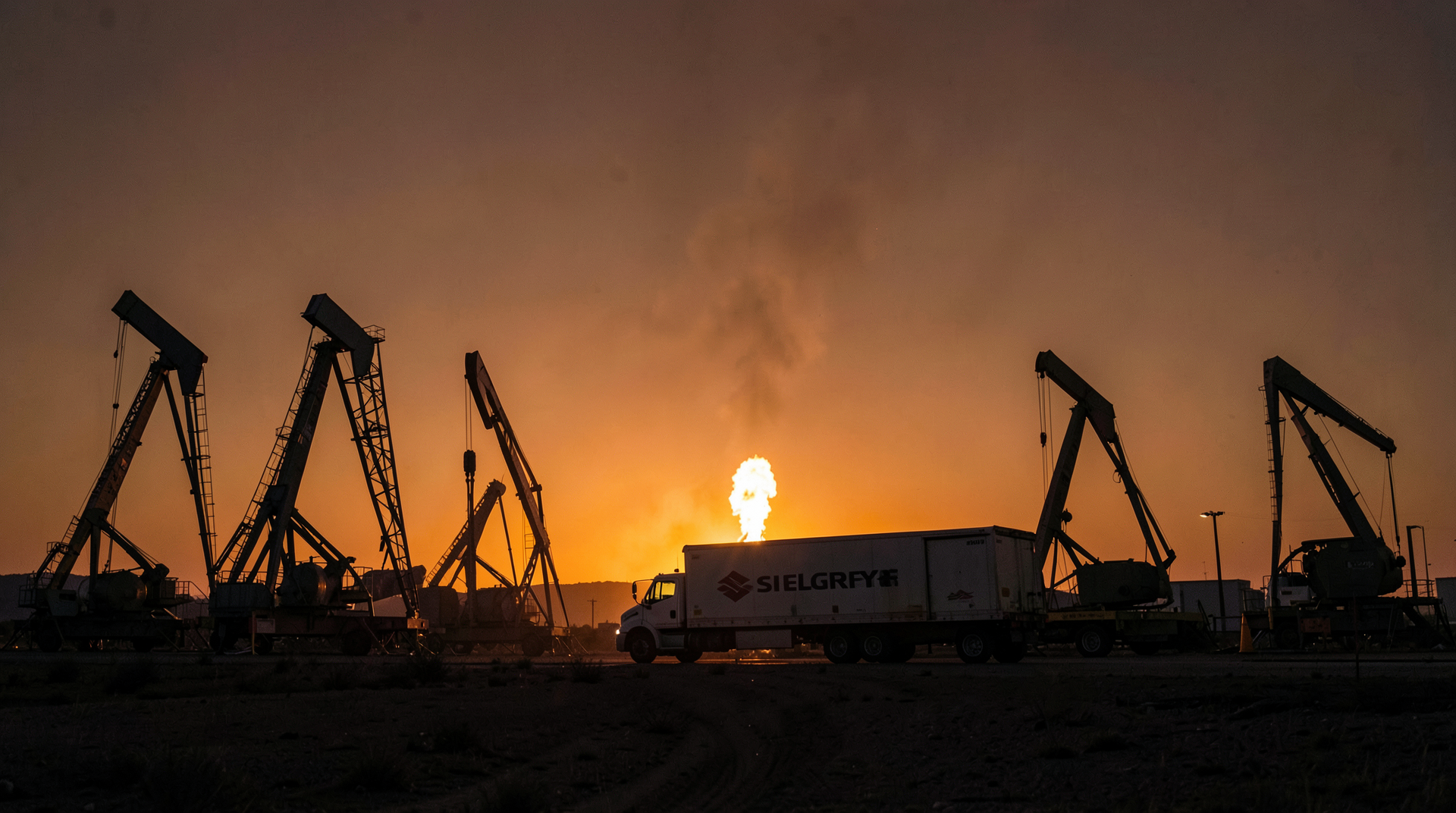
ExxonMobil reported first-quarter 2026 cash flow from operations of $8.7 billion, free cash flow of $2.7 billion, and shareholder distributions of $9.2 billion — $4.3 billion in dividends and $4.9 billion in share repurchases. Net production reached 4.6 million barrels of oil equivalent per day, with Guyana topping 900,000 barrels per day for the first time and the Pioneer-acquired Permian acreage producing what the company called "robust" volume growth. Net debt-to-capital fell to 13.1%. Management reaffirmed the plan to repurchase $20 billion of stock during 2026. [1]
Chevron's print landed an hour later. EPS came in at $1.41, beating the $1.17 consensus; revenue arrived at $48.61 billion, missing the $53.02 billion line. First-quarter net income was $2.2 billion or $1.11 per share, down from $3.5 billion or $2.00 a year earlier. The 36% year-on-year profit decline was carried by what the company described as $2.7-3.7 billion of negative timing effects in its Downstream segment plus a $350-400 million litigation reserve, and an upstream production lift offset by downtime at the 50%-owned Tengizchevroil joint venture in Kazakhstan and curtailments inside Israel and the Saudi-Kuwaiti Partitioned Zone. [2]
Two supermajors. Same Brent print. The paper's Apr. 28 account of how BP and Exxon put Hormuz inside earnings mechanics argued that the war premium was already moving through working-capital lines, route lengths, unavailable crude, throughput, and hedge math before any reported quarter would confirm it. Today's prints test that frame and answer it. The integrated supermajor model — Permian/Pioneer volume plus Guyana plus a captive global refining footprint — converts $126 Brent into a $9.2 billion shareholder distribution. The partly integrated model — Hess-acquired upstream plus Gulf-of-America growth plus a downstream segment marked to market against derivatives — absorbs the same Brent print as a $2.9 billion timing charge that management has told analysts will unwind in future quarters.
Neither is a beat in the analytical sense the trade press uses. Both are operational verdicts on whether a producer's geography lets it monetize a war or forces it to absorb one.
ExxonMobil's geography is the answer to its own quarter. The company has sold or rolled off most of its non-OPEC Middle East exposure since 2019. Its largest production growth pillars in the quarter — Guyana's offshore Stabroek block and the Permian — are continents away from the Hormuz risk premium and from any sanctions or curtailment exposure. The 4.6 million boe/d production base lets Exxon move barrels without paying for war-zone insurance, war-zone shipping, or war-zone curtailments. The 2026 buyback pace runs at roughly $5 billion per quarter; the company has now distributed more than $9 billion to shareholders in three of the last four quarters. CFO Kathryn Mikells told analysts the buyback is "fully funded by operating cash flow" and that the company "does not require asset sales or incremental leverage to maintain the pace." [3]
Chevron's geography is the inverse. Tengizchevroil — the company's 50%-owned Kazakh joint venture, accounting for roughly 11% of total production — was forced offline for portions of the quarter on supply-chain disruption tied to upstream Russian and Caspian routes. Israeli operations were curtailed during what the company described in its 10-Q draft as "regional security events." The Saudi-Kuwaiti Partitioned Zone produced below plan on what management characterized as "operational discipline." Each of these regions has direct or indirect Iran-war exposure. Chevron's downstream business, meanwhile, was carrying a derivatives book that marked-to-market against price volatility on physical shipments not yet delivered — a timing mismatch that pulled forward $2.7-3.7 billion of paper losses. The company called it timing because it expects the offset to land in Q2 or Q3 when the physical shipments deliver. The market called it a 36% YoY profit drop. [4]
The Wall Street response split along expected lines. Wolfe Research's Sam Margolin downgraded Chevron to peer-perform Friday morning, citing "asset-quality concentration risk" inside the war zone. BNP Paribas's Lucas Herrmann upgraded the same name on the basis that the timing charge would unwind. Goldman Sachs's Neil Mehta held Exxon at a buy and added the company to its conviction list, calling the Permian-Guyana barrel mix "structurally advantaged in a multi-quarter Brent-above-$100 environment." [5]
The structural argument matters because the war is not over. The paper has carried since last week the position that the Hormuz blockade has stopped being an event and started being an operating regime. Brent crossed $126 on Wednesday, sat at $124 Thursday, and opened today at $125 ahead of the prints. The duration question — how long the integrated model can monetize the war and how long the partly integrated model has to absorb it — is exactly what Q2 and Q3 will price.
The buyback funding source is the part that should be uncomfortable to read. The integrated supermajor model now uses the war premium as a buyback line. ExxonMobil did not say this on the call, but the math is unavoidable: at sub-$80 Brent, the company's free cash flow does not support a $20 billion annual buyback pace at Q1's distribution math. At $126 Brent, it does. The company has, in effect, told the market that the Iran war is funding its 2026 capital return. The market, which has been pricing this for three weeks, did not flinch. XOM opened up 1.4% on the print and closed Wednesday's gap higher.
The CVX print is more legible as accounting than as politics. The $2.9 billion timing charge will unwind in subsequent quarters, and the underlying production growth — Hess plus Gulf-of-America plus Permian — is real. CFO Eimear Bonner told the call that "the timing-effect charge does not represent a permanent impairment" and that "the underlying upstream business is performing in line with plan." The miss on revenue is the point that will travel: $48.6 billion against a $53.0 billion line is a $4.4 billion gap that came almost entirely from the Tengizchevroil downtime and the Israel/Partitioned Zone curtailments. War-region exposure shows up as a curtailment line. The integrated model does not have one. [4]
Two more supermajor prints arrive in May. TotalEnergies reports next Thursday; Shell on Wednesday after that. The European integrateds carry their own geographies — TotalEnergies has roughly 4% of production in Iran proper, plus material LNG exposure to the Caspian; Shell has Russian-related liquidations still flowing through and a North Sea book that is tied to U.K. retail prices the Bank of England flagged Wednesday. The pattern of integrated-versus-partly-integrated, geography-distant-versus-geography-proximate, will get its third and fourth data points before the OPEC+ technical committee meets May 4 to discuss the UAE exit and the cartel's formal response. Saudi Aramco's print, originally expected this weekend, has been pushed to May 10 with the call May 11. [6]
Aramco's deferral lets Riyadh see the UAE-exit market reaction before answering on the same call where the Q1 numbers will land. It also lets the kingdom watch the Exxon and Chevron prints today, see which model the market rewards, and tune its own messaging. The cartel's two largest producers are now sequenced differently — UAE crystallized its OPEC exit at midnight while Riyadh defers its print and lets the Western supermajors take the first read.
The forty-eight hours of supermajor reporting that conclude tonight will price two things: whether $126 Brent is a multi-quarter regime or a one-print spike, and whether the integrated geography premium is large enough to widen the gap between Exxon and Chevron from a quarterly variance into a structural one. The 2026 buyback math is the cleanest answer Exxon has given to either question.
-- THEO KAPLAN, San Francisco