The April 16 Lebanon-Israel ceasefire reached Day 22 Friday with the United Nations logging 619 Israeli attacks into Lebanon against 30 Hezbollah attacks targeting Israel for Tuesday May 5 — the highest single-day exchange since the truce went into effect. [1] Israel struck Beirut's southern suburbs on Wednesday, the first strike on the Lebanese capital since April 17, killing Ahmed Ghaleb Balout, the commander of Hezbollah's elite Radwan Force, in the Dahiyeh district. [2] Lebanese Prime Minister Nawaf Salam, speaking the same day to the National News Agency, said current circumstances "are not ripe to talk about high-level meetings" between Lebanon and Israel and called any such meeting "premature." [3]
The May 7 paper opened the Beirut strike as the geographic line the ceasefire was supposed to draw. Day 22 advances the file to the asymmetry numbers. The 619-vs-30 ratio is roughly twenty-to-one Israeli-to-Hezbollah, and it is what the truce now reads as on the operational tape: a unilateral campaign against Hezbollah infrastructure and command continuing under a treaty Hezbollah strikes have not reciprocated in equivalent volume.
The institutional response in Beirut crystallised Wednesday around a single sentence. Salam, asked by reporters whether Lebanon would receive Prime Minister Benjamin Netanyahu in a meeting Trump had called for in his April 23 ceasefire-extension announcement, said the country was not seeking "normalization with Israel, but rather achieving peace" and that consolidating the existing ceasefire "will form the basis for any new round of negotiations that could be held in Washington." [3] Salam's "minimum demand," he said, is "a timetable for Israel's withdrawal." Lebanese President Joseph Aoun, the same week, said Lebanon "must first reach a security agreement and a halt to the Israeli attacks, before we raise the issue of a meeting between us." [3] The two principals' line is the same: ambassador-level talks continue, principal-level meetings do not.
Two rounds of ambassador-level talks have been held in Washington — April 14 and April 23. A third is set for next week per Lebanese sources speaking to Anadolu, with the Lebanese delegation including Ambassador Nada Hamadeh Moawad, who met U.S. officials this week to raise alleged Israeli ceasefire violations. [4] The Trump administration has continued to broker the conversation. Haaretz on Wednesday reported the resumption of talks at ambassador level next week as scheduled. [5] Whether the kinetic asymmetry forces a recalibration of either the diplomatic envelope or the Lebanese floor remains the open question.
The Balout strike's command-significance reframed the asymmetry as targeted rather than indiscriminate. The IDF described Balout as Radwan Force commander, citing his role coordinating "dozens" of attacks against IDF troops in southern Lebanon and his leadership of efforts to "restore the capabilities of the Radwan Force unit, particularly the implementation of the 'Conquer the Galilee' plan." [2] The Dahiyeh strike Wednesday was Israel's first targeted operation in the Lebanese capital since the truce; the previous Beirut strike, April 8, came under U.S. pressure that Trump publicly endorsed. The April pressure has lapsed. The Wednesday-night IDF statement that the Balout strike was "coordinated with the U.S." — first reported by i24NEWS and OSINT613 — is the operational read the trade is using; no White House statement has confirmed or denied the coordination claim. [6]
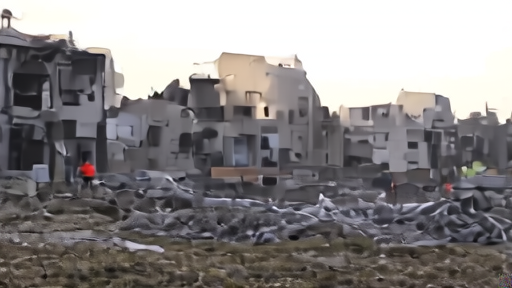
The casualty arithmetic is what the truce produces in plain terms. Lebanon's Health Ministry on Wednesday counted more than 2,700 killed in Lebanon since fighting resumed March 2, with 8,300 injured. [7] Some 1.2 million were displaced. Israel, on its side, has counted 17 soldiers killed in southern Lebanon and two civilians killed in northern Israel since March 2. The Israeli military has documented hundreds of Hezbollah rocket and drone launches across the same period. The displacement asymmetry — measured in orders of magnitude — is the casualty signature of an air-and-ground campaign against a militia, not a war between symmetric belligerents.
What the asymmetry does to the diplomatic architecture is increase the friction between what U.S. brokerage requires (visible reciprocity) and what the kinetic ratio shows (one-way pressure). Trump's April 23 framing — that the countries had a "great chance" of reaching a peace deal in 2026 — required a track of equivalence. The 619-vs-30 day defaults the architecture into something else: a framework in which a militia is being suppressed by force while a state-to-state negotiation proceeds at ambassador level on a parallel track. Hezbollah has called the ambassador-level contacts "meaningless" and refuses to abide by any agreement issuing from them. [8] David Wood, senior Lebanon analyst at the International Crisis Group, told CBC: "It's a ceasefire in name only — and probably more accurately, it's a limited de-escalation." [9]
The Iran-war second-order ledger absorbs another datapoint. Beirut, Tel Aviv, and Washington are running three concurrent negotiating tracks — U.S.-Iran in Pakistan, Israel-Lebanon in Washington, U.S.-China in Beijing — while the kinetic envelope keeps cycling through the second-order theatres without breaking the diplomatic envelope of the first. The truce's structural integrity is the question. Day 22's answer is that the truce's operational integrity is gone; the diplomatic envelope's resilience is what is being tested next week.
-- YOSEF STERN, Jerusalem