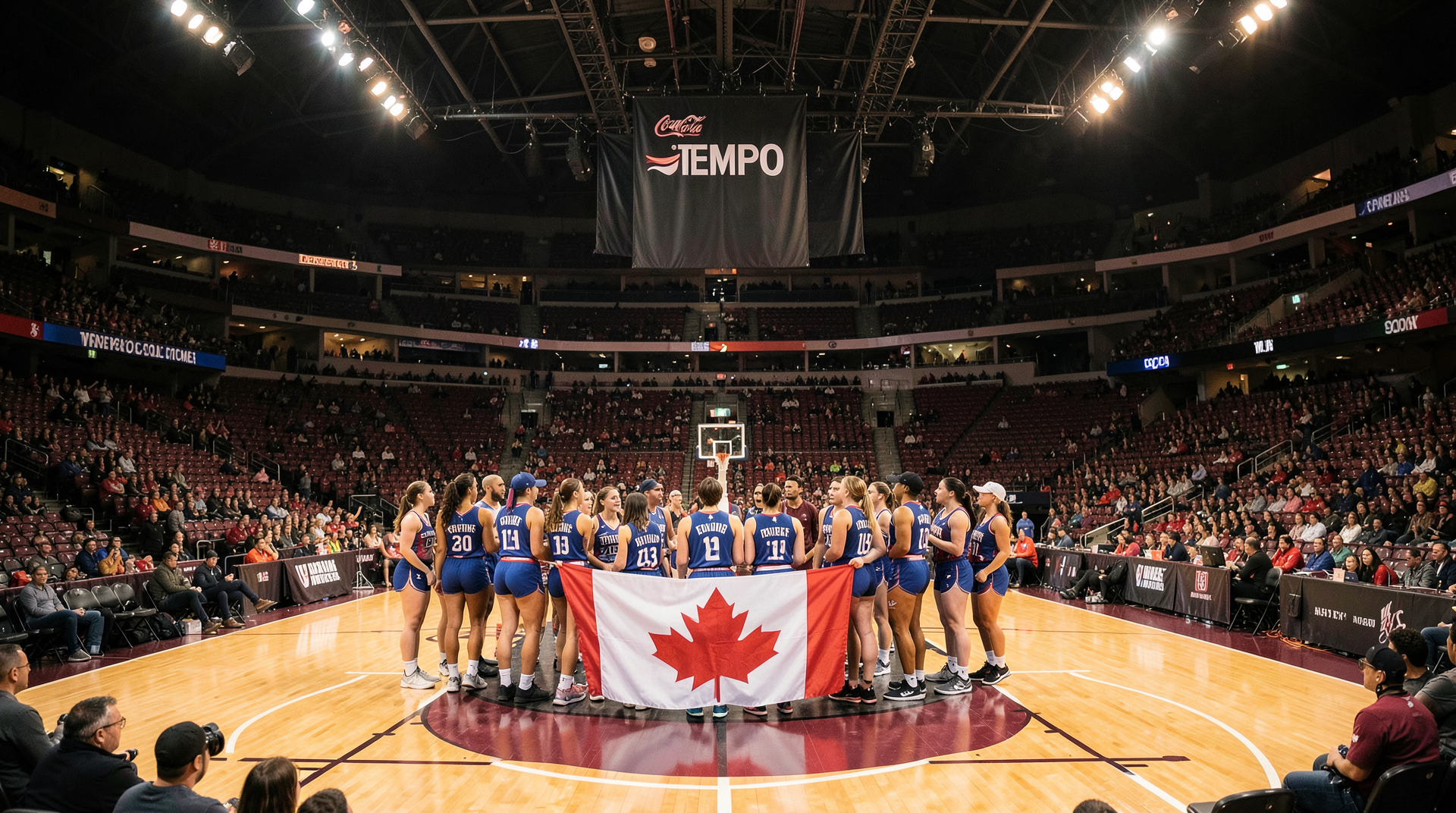
The Toronto Tempo tip off the WNBA's first cross-border home opener at Coca-Cola Coliseum on Friday at 7:30 p.m. Eastern, hosting the Washington Mystics in the league's first regular-season game played outside the United States in its 30-year history. [1] [2] The Tempo are the WNBA's 14th franchise. Their inaugural-season ownership group is led by Maple Leaf Sports & Entertainment chairman Larry Tanenbaum's holding company Kilmer Sports Ventures and includes principal owners Masai Ujiri, the former Toronto Raptors president whose team won the city's only NBA title in 2019, and Serena Williams. [3] [4] Sandy Brondello, who has won two WNBA championships as a head coach, runs a roster the league has called the youngest in its 2026 alignment. [5] The 44-game schedule includes 22 home games at four Canadian venues — fifteen at Coca-Cola Coliseum, three at Scotiabank Arena, two at Bell Centre in Montreal, and two at Rogers Arena in Vancouver. [6] [7] The team sold out its inaugural-season ticket memberships on December 11, 2025. [6]
The paper's Thursday brief at T-minus-one named tonight as the day the supply-side argument the WNBA has been building for two years gets tested by an actual ticketed crowd. The frame to watch is league-as-real-estate. Each new building — Toronto this season, Portland next — adds inventory the players' side can price against in the next collective bargaining agreement. The opener is the first time that inventory has tenants and a turnstile.
What is sometimes lost in the schedule-page rendering of a first game is what it means to write the franchise into the country. Toronto in May 2024 was where the WNBA announced it was leaving its home market, and the announcement was made at Hotel X with then-Prime Minister Justin Trudeau and Drake in the room. [8] The team name was chosen from more than 10,000 fan submissions across more than 1,000 unique names; the organization said the rhythm-and-pace framing was the closest fit between the country and the game. [8] What sits underneath that brand-builder's prose is something more like a wager: that women's professional basketball can build a fan base in a country whose only previous WNBA encounter was a single regular-season game in Vancouver in August 2025, when the Atlanta Dream and Seattle Storm drew nearly 16,000 fans to Rogers Arena and the Storm guard Skylar Diggins called the crowd "electric." [9] Toronto is the wager. Tonight is the first reading.
Masai Ujiri's ownership is the part of the franchise architecture that asks more from the city than from the league. He grew up in Nigeria, became the Denver Nuggets' general manager in 2010 — the first African GM in major American team sports — and won NBA Executive of the Year in 2013. [3] He spent 12 years in the Raptors front office and built the roster that won Toronto's 2019 NBA title before parting ways with the team last June. He told ESPN's Ramona Shelburne in March that ownership "is a unique opportunity for me and my family." [3] He told the Canadian Press the same week that "the big dream is being in ownership." [4] On the announcement day Larry Tanenbaum's statement called Ujiri's leadership and "deep belief in the power of sport" an extraordinary addition to the ownership group; Tempo team president Teresa Resch, who has worked with Ujiri since 2008 when she attended one of his Africa basketball camps, said he plans to be a hands-on owner. [3] The Tempo Rising mentorship program he launched in March supports women-identifying and non-binary coaches at the introduction-to-competition level, with Ujiri, general manager Monica Wright Rogers, and head coach Sandy Brondello as mentors. [3] The franchise is operating as a supply-side institution from the front office down. That is what makes tonight more than a schedule item.
The on-floor question is whether Brondello's veteran-bench plan against the Mystics' veteran core produces a competitive opening half. Brondello, the former Phoenix Mercury coach who guided that franchise to two championships before leaving New York after the 2024 season, has been building the Tempo roster around a core of WNBA-experienced players acquired through the December 5, 2025 expansion draft, free agency, and the April college draft. The expansion draft and free agency took place over a tight window in March and April after the league and players' association agreed to a new collective bargaining agreement that includes a US$7-million salary cap per team. [8] What makes the build harder is that the architecture had to be assembled in roughly four weeks. Most expansion franchises in major American sport — the Vegas Golden Knights, the Seattle Kraken — had at least nine months. The Tempo had four. That is the second wager the league has made in this expansion: that the new collective bargaining agreement, with its larger paychecks and better travel and facility standards, can absorb a compressed roster-build window without producing a 12-22 inaugural season.
The supply-side reading of tonight is what the paper has been carrying as the women-breaking-ceilings thread for the 2026 calendar year. Caitlin Clark generated a measurable demand curve in 2024-25 that the WNBA, under Commissioner Cathy Engelbert, has been attempting to convert into franchise economics: more cities, larger arenas, deeper ownership groups, longer schedules. The Tempo are the first cross-border answer to that demand. The Portland Fire, who debut at home Saturday against the Chicago Sky, are the second. [10] Together they push the league from twelve teams to fourteen and from 40 regular-season games per team to 44. The architectural bet is that the demand curve absorbs the supply expansion at a rate that keeps the per-game revenue line intact. Sportswire reporting this week framed Friday's tip-off as the beginning of "Canada's WNBA era." [11] What that phrase means in operating terms is that the league has staked an entire new national broadcast region on a single ticketed crowd at the Coca-Cola Coliseum tonight, and on the four-venue Canadian footprint over the rest of the summer.
The Mystics-against-the-Tempo register is itself a structural one. Washington enters the season after a 2025 finish below .500 and a coaching change earlier this offseason; the franchise's veteran core has been written about in the league as the kind of group that can either run an expansion team off the floor in the first half or be exposed by the home crowd in the second. The Tempo will run a deeper-than-expected nine-player rotation tonight, on the strength of the expansion-draft acquisitions Resch and Wright Rogers built around. [8] Brondello, in pre-game remarks earlier this week, framed the team's identity as defense-first and pace-second — a return to the structural formula that produced her two Mercury championships, but transposed to a younger roster than she has previously coached at this level.
What sits beside the on-floor question is the Canadian basketball-development question. The Tempo's launch coincides with what the league's basketball-operations side has been calling the largest single-year expansion of women's basketball infrastructure in Canada — the Tempo Rising mentorship program, the four-venue regular-season schedule, and the broadcast deal with TSN that puts every game on free national television. [3] The Globe and Mail's Friday-morning fan guide noted that Coca-Cola Coliseum's 8,000-plus capacity and the merchandise queue at the first preseason game — a sellout, with fans queuing in long lines for inaugural jerseys, hats, and insulated cups — already point to the demand the league projected when it awarded the franchise in May 2024. [8] The risk is regional spread. Four venues across a country that spans six time zones is an ambitious distribution model for a 44-game schedule. The reward, if the demand curve carries, is a national footprint no other WNBA franchise has had.
Two markers compress the next 90 days. The Coca-Cola Coliseum gate tonight is the first read on whether the demand the league projected in 2024 has materialized at street level. The Vancouver and Montreal home games — Bell Centre July 10 and 12 against Dallas and New York; Rogers Arena August 21 and 23 against Portland and Las Vegas — are the test of whether the regional-spread model converts to actual ticketed crowds outside the home market. [6] [7] What this paper carries forward as a position is that the WNBA's investment cohort has, on the available evidence, caught up to the demand curve, and that Canada — not Houston, Cleveland, or Charlotte, the next three U.S. expansion candidates — is the venue. Whether that bet pays starts at 7:30 p.m. tonight, when the floor opens at the Coca-Cola Coliseum and Masai Ujiri's third championship pursuit, his second in this city, formally begins.
-- AMARA OKONKWO, Lagos