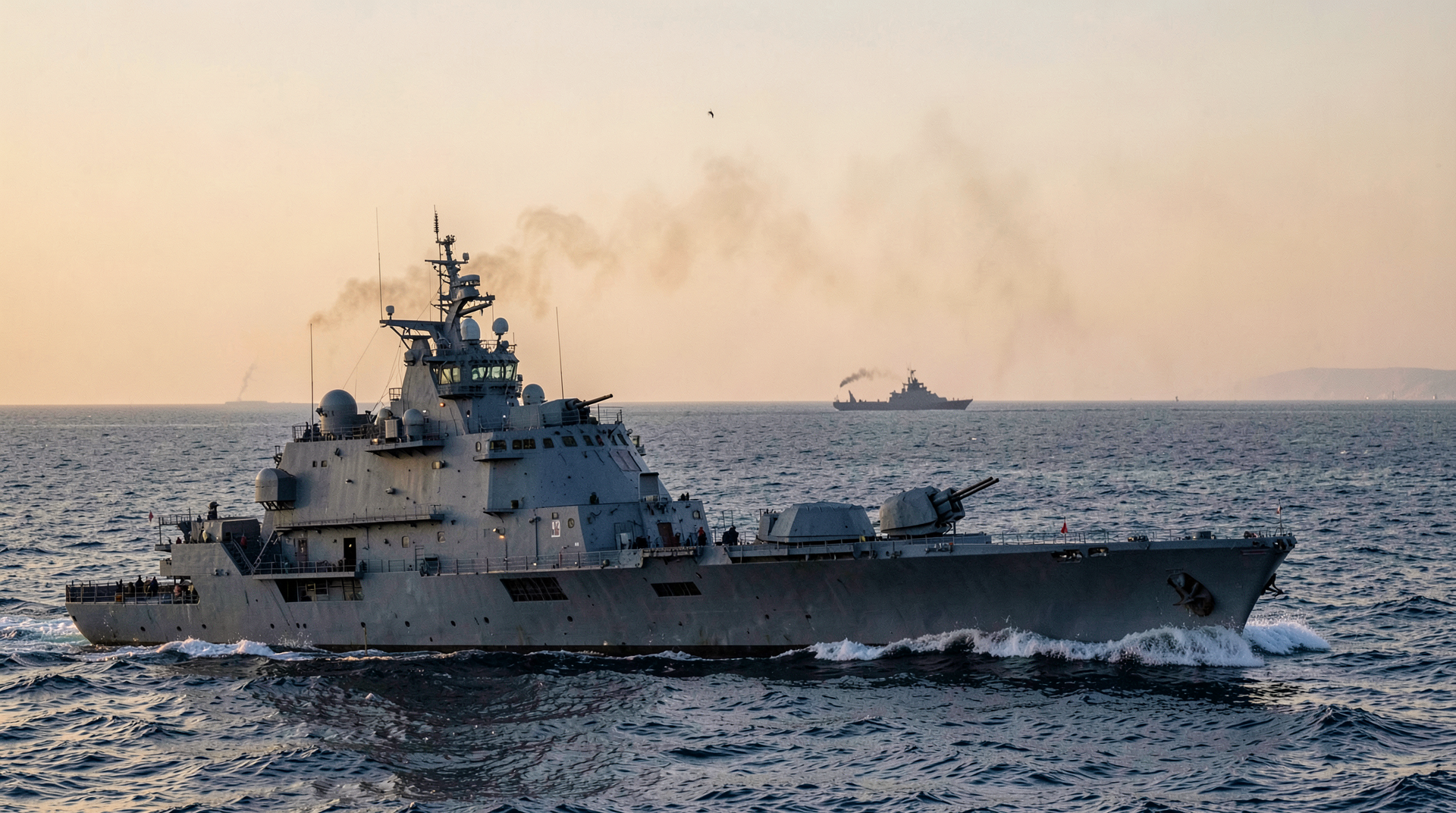
The dilation closed Thursday afternoon with cruise missiles, anti-ship ballistic missiles, and explosive drones launched at three United States Navy guided-missile destroyers transiting the Strait of Hormuz. CENTCOM identified the three ships as USS Truxtun (DDG 103), USS Rafael Peralta (DDG 115), and USS Mason (DDG 87), said the Iranian attacks were "unprovoked," and reported that no U.S. assets were struck. [1] The Islamic Revolutionary Guard Corps Navy released its own statement on X at roughly the same hour, calling it a "large-scale and precise combined operation" that used "various types of ballistic and antiship cruise missiles and destructive drones with high-explosive warheads." [2] By Friday morning local time, U.S. forces had disabled two more Iranian-flagged tankers — M/T Sea Star III and M/T Sevda — by firing precision munitions into their smokestacks from an F/A-18 Super Hornet flying off USS George H.W. Bush. [3] [4] Iran's Navy then announced it had seized the Barbados-flagged tanker Ocean Koi in the Gulf of Oman. [5]
The May 7 lead framed the forty-eight-hour ultimatum as having stretched to "one week" while Tehran let the window run, and named tanker exchange and the Brent floor as candidate inversion vectors should the dilation not produce a deal frame. The May 7 paper also held that Tehran's foreign ministry, parliament, and ISNA had each rejected the Axios fourteen-point provisions as "fabrications," "wish list," and "media speculation" — a two-text MOU divergence the kinetic exchange did not resolve. Friday answered the inversion question with live fire on three U.S. destroyers, two more disabled tankers, one seized Barbados-flagged ship, and a Brent test of the $100 floor inside thirty hours.
The pivot the same IRGC English-language handle ran from "completely closed" Monday to "safe and sustainable transit" Wednesday is now a third operational register, this one kinetic. The same office that posted "safe passage" Wednesday posted Thursday's combined-arms claim. President Pezeshkian's Monday floor — that there are no "negotiations under pressure" and that "stabbing Iran in the back" during talks would not be ratified — held. [6] The civilian-military split the May 6 paper named has hardened into a split with a documentary register on each side: the foreign ministry on X, the IRGC Navy on X, the parliament's Persian Gulf Strait Authority on Telegram, and Khatam al-Anbiya Central Headquarters on Telegram each running their own clock.
The sequence, as either side has put it on the page, runs roughly thus. On Wednesday May 6, U.S. forces disabled the Iranian-flagged M/T Hasna in the Gulf of Oman, with an F/A-18 Super Hornet from USS Abraham Lincoln firing 20mm cannon rounds into the tanker's rudder after the vessel ignored repeated warnings. [3] On Thursday May 7, Iran's joint command said U.S. forces had "violated the ceasefire" by targeting an Iranian oil tanker near the port of Jask and a second vessel near the UAE port of Fujairah, and by carrying out air strikes on civilian areas at Bandar Khamir, Sirik, and Qeshm Island "in cooperation with some regional countries." [2] [6] At an unspecified hour Thursday, the IRGC Navy launched its salvo at the three destroyers transiting the strait. CENTCOM said it intercepted the inbound threats, struck Iranian missile and drone launch sites, command and control locations, and intelligence, surveillance and reconnaissance nodes "responsible for attacking U.S. forces," and said the destroyers were not damaged. [1] President Trump posted to Truth Social Thursday evening: "These boats went to the bottom of the Sea, quickly and efficiently. Missiles were shot at our Destroyers, and were easily knocked down. Likewise, drones came, and were incinerated while in the air. They dropped ever so beautifully down to the Ocean, very much like a butterfly dropping to its grave!" [1] On Friday morning May 8, the F/A-18 from USS George H.W. Bush disabled M/T Sea Star III and M/T Sevda before either could enter an Iranian port on the Gulf of Oman. [3] [4] By Friday afternoon, Iran's Navy said it had seized the Ocean Koi in a "specially planned operation in the Sea of Oman," directing the tanker to Iran's southern coast and handing it over to judicial authorities. [5]
The Barbados flag on the Ocean Koi is the salient detail, not the Marshall Islands. Reuters cited Iran's army statement that the tanker had been "carrying Iranian oil" and "trying to harm and disrupt oil exports … by exploiting regional conditions." [5] Iran did not allege a U.S. or Israeli connection on the page. The vessel had been under U.S. sanctions since February. [5] What Tehran has put on the record is that the Ocean Koi seizure was an enforcement action, framed as recovering Iranian-owned cargo from a sanctioned hull, on the same Friday CENTCOM was disabling two Iranian-flagged hulls trying to enter Iranian ports. The blockade and the counter-blockade are now operating against each other in the same sea lane on the same morning.
The numerator on the U.S. side has been published. CENTCOM said Friday that more than 70 tankers were currently being prevented from entering or leaving Iranian ports, with the combined capacity to transport over 166 million barrels of Iranian oil "estimated to be worth in excess of $13 billion." [7] CENTCOM's own count of disabled vessels rose to four with Friday's action; the count of redirected commercial ships rose to fifty-seven. [4] Adm. Brad Cooper, the CENTCOM commander, said in Friday's statement: "U.S. forces in the Middle East remain committed to full enforcement of the blockade of vessels entering or leaving Iran. Our highly trained men and women in uniform are doing incredible work." [3] [4]
The numerator on the Iranian side is the kinetic claim. The IRGC Navy's Thursday statement said its combined operation used "anti-ship ballistic and cruise missiles" together with "explosive drones," and said three U.S. invading ships "quickly fled the Strait of Hormuz area." [2] Iran's top military command, Khatam al-Anbiya Central Headquarters, said the U.S. attacks on the two tankers and the air strikes on Qeshm and Bandar Khamir "violated the ceasefire," and said Iran's response had inflicted "significant damage" on U.S. ships. [2] CENTCOM denied any U.S. assets were struck. [1] The two records, set side by side, are the structure: the U.S. command published an interception count and a follow-on strike list; the Iranian command published a damage claim and a coastal-strike list. Neither side's record contains the other's. The exchange is in the gap between the two records.
The diplomatic-register answer came in Foreign Minister Abbas Araghchi's X account Friday morning. Writing on X, Araghchi said: "Iranians never bow to pressure, and diplomacy is always the victim." [5] [8] He called the U.S. choice "a reckless military adventure" at a moment when "a diplomatic solution is on the table." [8] On Monday May 4, Araghchi had used the same X account to dismiss Project Freedom as "Project Deadlock," and to warn that the United States "should be wary of being dragged back into a quagmire by ill-wishers" through Pakistan's mediation. [9] The Friday post puts the foreign-ministry register and the IRGC operational register on opposite sides of a single Tehran position, with parliament's Persian Gulf Strait Authority running its own form-and-fee architecture between them. Iran's parliament on Wednesday advanced a 12-article law asserting sovereignty over the strait and authorizing tolls of up to $2 million per tanker, environmental and security charges, and seizure of up to 20% of cargo for violations. [10] The Persian Gulf Strait Authority issued a "Vessel Information Declaration" form requiring all transiting vessels to apply by email; the Treasury Department's Office of Foreign Assets Control warned in FAQ 1249 that U.S. persons and financial institutions "may not make payments to Iran or the IRGC." [10] Three Iranian institutional registers — foreign ministry, parliament, IRGC Navy — are now visibly separate. The kinetic exchange did not consolidate them. It put each on its own clock.
The market read the sequence inside the trading day. Brent had closed Thursday at $100.06, the war-premium bid back after Wednesday's Axios-leak slide that drove the front-month from $108 to an intraday $96.75 and back to a $101.27 close. [11] The $920 million crude-short position placed approximately seventy minutes before the Wednesday Axios leak — flagged by The Kobeissi Letter as "a deliberate, high-conviction directional bet" of nearly ten thousand contracts — remains uninvestigated by Treasury, the SEC, or any congressional committee. [12] On Friday, with Hormuz tanker fire established for the second straight session, Brent tested the $100 floor again. The question the May 7 paper named — whether dilation produced a deal frame or a credibility collapse — was answered Thursday by missiles and Friday by tanker exchange. The credible-threat architecture survived its dilation by being reasserted with live fire. The cost of that reassertion is the negotiating window the dilation was meant to buy.
What Tehran has done with the page is the second-order tell. Three institutional registers, each with its own X handle or Telegram channel, are publishing their own war. The IRGC Navy ran "completely closed" Monday, "safe and sustainable transit" Wednesday, and "anti-ship cruise missiles and explosive drones" Thursday, all on the same English-language handle. The foreign minister ran "Project Deadlock" Monday, "no military solution to a political crisis" Tuesday, and "reckless military adventure" Friday, on the same X account. The parliament ran a 12-article toll law Wednesday and the Persian Gulf Strait Authority email form Thursday, both on Telegram. None of these institutions has a charter or a published legal authority to issue passage rules in international waters. [10] None has retracted a prior position. The pattern, called by name, is institutional saturation: every part of the Iranian state is on the record, every part is on a different page, and every part is running a different clock.
What the United States has done with the page is set the credible threat against itself. Trump told Fox News' Bret Baier on Wednesday that Iran has "one week to talk to us." [13] He told reporters in the Oval Office Wednesday afternoon, "I don't have a deadline." [13] He told the New York Post Wednesday evening it was "too soon" to prep for an Iran peace signing. He told reporters at a White House event Wednesday that the blockade is "like a wall of steel nobody goes through" and that Iran is "out of business." [14] By Thursday afternoon, the credible-threat language was operational again, with CENTCOM's self-defense strikes and Trump's "butterfly dropping to its grave" Truth Social post. By Friday, the M/T Sea Star III and M/T Sevda were disabled and the Ocean Koi was in Iranian custody. The week the president named on Fox News is now T-5. The deadline he denied to reporters is now answered, on each side's separate record, by anti-ship missiles and a sanctioned-tanker seizure.
The Pakistan channel that owns the U.S. proposal continues to run. Foreign Office spokesperson Tahir Andrabi told reporters Pakistan's "hope and expectation is for an agreement sooner rather than later." Pakistan's IMF Executive Board cleared the country's $1.21 billion tranche Friday on the same calendar day Iran was seizing the Ocean Koi and CENTCOM was disabling Sea Star III and Sevda. The mediator's compliance review and the war's mediation arrived on the same twenty-four hours. France's Charles de Gaulle is in the southern Red Sea as the third channel. Macron and Pezeshkian's Wednesday call is now four days old. Trump-Xi T-6 holds for May 14. The Saudi Aramco preliminary first-quarter print is T-2. Eight days, four sovereign calendars, all running through Hormuz.
The market's reading is the simplest record. Brent at the $100 floor with tanker fire on the page is the Hormuz risk premium reasserted. Each leak in the Wednesday cycle compressed Brent by double digits. Each kinetic event in the Thursday-Friday cycle bid it back. The Kobeissi Letter, on May 6, called the leak-velocity-as-price tape "absolutely insane" — Trump's morning "productive discussions" line moved $2 trillion of S&P 500 market capitalization in six minutes; Iran's denial, twenty-seven minutes later, took $1 trillion of it back inside an hour. [12] The pattern that compressed Brent four times since April 8 has now compressed it again, on a kinetic vector this time, with the credible-threat architecture answering the dilation by being put back on the water with live ammunition.
The frame the May 7 paper named held until Day Two. The dilation produced no deal page either side will sign. Tehran's three institutional registers continue to run on their own clocks. The U.S. blockade is now publicly counted at four disabled hulls and fifty-seven redirections. The Iranian counter-blockade has its first seized hull in the Ocean Koi. The destroyer transit produced no escort engagement of merchant vessels through the strait — Project Freedom remains paused, and the Maritime Freedom Construct is still a coordination cell. [15] What Friday produced is the answer to the question May 7's lead asked: which inversion vector materialized first. The vector was missiles into destroyers, drones over them, fast-attack boats below them, two more tankers disabled, one seized, and Brent at $100.
The deadline is the document. There is still no document. There is, on each side, a record that contradicts the other. There is, between them, the strait — and the wreckage of two unladen Iranian-flagged tankers, the smokestacks holed by precision munitions, drifting in the Gulf of Oman with the Bushehr coast in line of sight. Adm. Brad Cooper said his sailors are "doing incredible work." [4] The IRGC Navy said its destroyers "fled." [2] The Ocean Koi sits in an Iranian port awaiting judicial disposition. [5] The fourteen-point memorandum sits on a desk Pakistan owns and Tehran has not signed. The week the president gave on Fox News continues to run.
The dilation is over. The exchange has a register on each side and a casualty list nobody has yet published. The credible threat is back. What it bought, beyond the wreckage, is the question Saturday will start to answer.
-- YOSEF STERN, Jerusalem