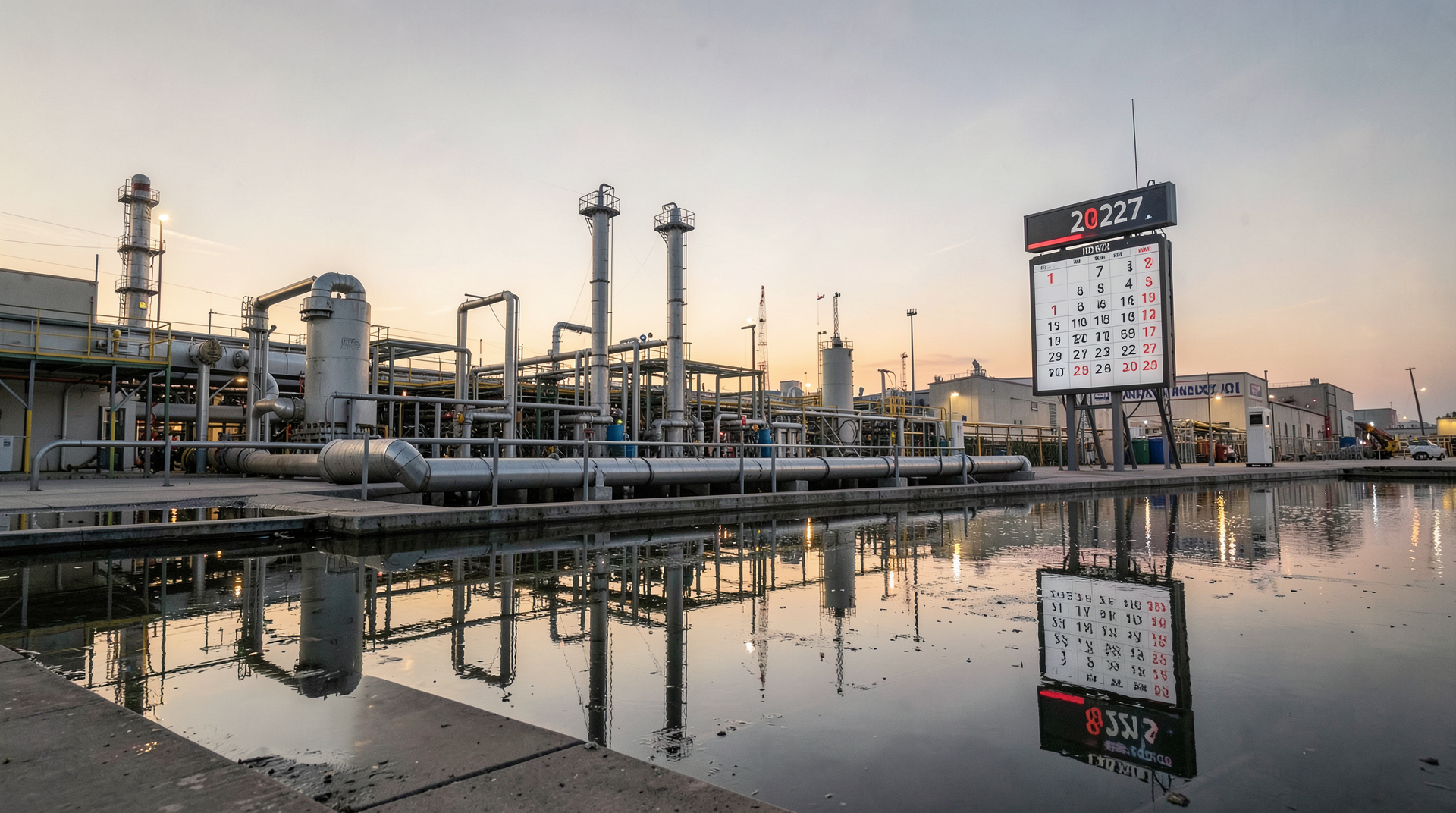
Amin Nasser did not give the oil market a price target. He gave it a year. If the Strait of Hormuz remains disrupted past the middle of June, the Saudi Aramco chief executive said Monday, the market may not normalize until 2027. [1]
Monday's paper argued that Aramco had put the first producer-state date on the war premium, turning Hormuz from an emergency into a calendar. It also said one Qatari LNG ship crossing Hormuz by permission did not reopen normal commerce. Tuesday is the day those two claims meet the trading desk. [1][2]
CNBC reported Nasser's warning in unusually concrete terms. If Hormuz opened immediately, he said, rebalancing would still take months. If opening were delayed by a few more weeks, normalization would last into 2027. [1] The phrase is easy to flatten into oil-market language. It should not be flattened. A producer-state CEO was saying that even the optimistic case is not quick, and that the pessimistic case runs into next year.
The cause is not only barrels underground. It is ships in the wrong places. Nasser said more than 600 ships, mostly oil and product tankers, were stuck in the Gulf, with about 240 waiting outside Hormuz. Some vessels may leave after idling too long, and the fleet is "mixed up" in a way that requires repositioning across the world before the supply chain can return to pre-conflict traffic. [1]
That is the part of the story that gets lost when Hormuz is covered as a single line on a map. A strait can be photographed. A tanker fleet is a living machine. It depends on position, crew time, insurance, port slots, charter terms, product balances, and confidence that a vessel sent into the Gulf will not become trapped in the wrong place for the wrong month. Nasser's 2027 date prices that machine, not simply the waterway.
The scale explains the language. CNBC reported Nasser's estimate that the market loses 100 million barrels of supply every week the strait remains closed, and that the total loss has already exceeded 1 billion barrels, with a net loss around 880 million barrels after redirected exports and strategic reserve releases. [1] Those numbers move the story beyond a daily Brent quote. They describe inventory depletion and product scarcity before summer driving and travel demand.
Aramco's own mitigation has limits. The east-west Petroline lets Saudi Arabia move crude from the Gulf coast to the Red Sea, and Nasser said Aramco has ramped that pipeline to 7 million barrels per day. [1] That is an important bypass. It is not a substitute for everything Hormuz does. It does not move Qatari LNG. It does not solve tanker displacement. It does not restore confidence for ships that must enter or leave the Persian Gulf. It gives Saudi Arabia room. It does not give the global market normality.
This is where X and mainstream coverage split. Mainstream accounts, led here by CNBC, are attentive to the tanker-fleet mechanics and supply losses. [1] X reads the same facts as a permission regime: if one tanker crosses and prices remain stressed, the strait is not open; it is selectively administered. The social reading is often too quick to turn every exception into conspiracy, but it sees something the standard market story can underplay. Partial passage can be more revealing than full closure because it shows who gets permission and who waits.
The diplomacy makes that problem worse. CNBC's separate Iran account reported that Trump rejected Iran's counterproposal as "totally unacceptable," while Tehran demanded reparations, sovereignty over Hormuz, sanctions relief, frozen-asset release, and an end to the blockade. [2] If those terms remain far apart, the oil market is not waiting for a technical reopening. It is waiting for a political sequence neither side has accepted.
Nasser's warning therefore belongs in the same article as Trump's rejection. Aramco is not a neutral weather station. It is the producer-state enterprise whose infrastructure and language tell the market how Saudi Arabia expects the war to last. When Nasser says 2027, he is not predicting tomorrow's Brent settlement. He is telling shippers, refiners, airlines, governments, and central banks that the disruption has already done damage that outlasts a headline ceasefire. [1]
The word "normalize" is doing heavy work. Prices can fall before normality returns. A tanker can cross before normality returns. A communique can announce progress before normality returns. The global fleet still must be untangled, inventories rebuilt, product shortages relieved, insurance terms reset, and buyers convinced that a ship entering the Gulf is not entering a trap. Nasser's point was that the delay compounds.
The market also has to decide whether to believe a producer that benefits from higher prices. That skepticism is fair. Saudi Arabia sells oil, and Aramco earns through the war premium. Yet the warning was too operational to dismiss as price talk. Nasser gave ship counts, weekly supply-loss estimates, net barrel losses, and pipeline capacity. [1] Those details are checkable. They also point to constraints that do not vanish because a trader wants the conflict to be over.
The risk for Washington is political. Nasser's 2027 horizon says that even if the war ends, the oil system may not drop neatly back into place. [1] A president can announce relief. He cannot legislate tanker geography.
The mismatch between political time and shipping time is now the market's central tension. Washington thinks in deadlines, statements, and election-season pump prices. Tanker owners think in hull availability, crew rotation, insurance renewal, port congestion, and the risk that a vessel ordered toward the Gulf today may be trapped there next month. Nasser's warning brings that slower time into public view. [1]
It also changes what counts as good news. A diplomatic breakthrough that reopens Hormuz would still leave product inventories depleted and ships scattered. A price drop would still leave refineries waiting for cargoes. A tanker passage would still leave insurers and charterers asking whether the next passage requires political permission. Normality is not the first ship through. Normality is the point at which nobody has to ask why that ship was allowed through.
The risk for Beijing is also political. China wants stable energy flows and is the largest buyer of Iranian oil, but it benefits from appearing more patient than Washington. If Trump arrives in Beijing seeking Chinese pressure on Tehran, Nasser's warning gives China a reason to talk stability without appearing to enforce American demands. A prolonged disruption hurts China, but a public capitulation to U.S. pressure would cost Beijing in a different currency.
For consumers, the difference between a price spike and a 2027 normalization horizon is the difference between irritation and adaptation. Airlines hedge differently. Refineries schedule differently. Governments release reserves differently. Hospitals, trucking firms, fertilizer producers, and petrochemical buyers learn that the first-order oil story quickly becomes a product story. Nasser specifically warned that inventories are drawing down rapidly for products like gasoline and jet fuel and may reach critically low levels before summer. [1]
That is the point the paper should carry forward. Hormuz is not only a strait. It is a sorting system for risk. On Monday, one of the world's most important oil executives said the sorting system is damaged enough that weeks matter like years. The market can argue over incentives. It cannot ignore the date.
-- DARA OSEI, London