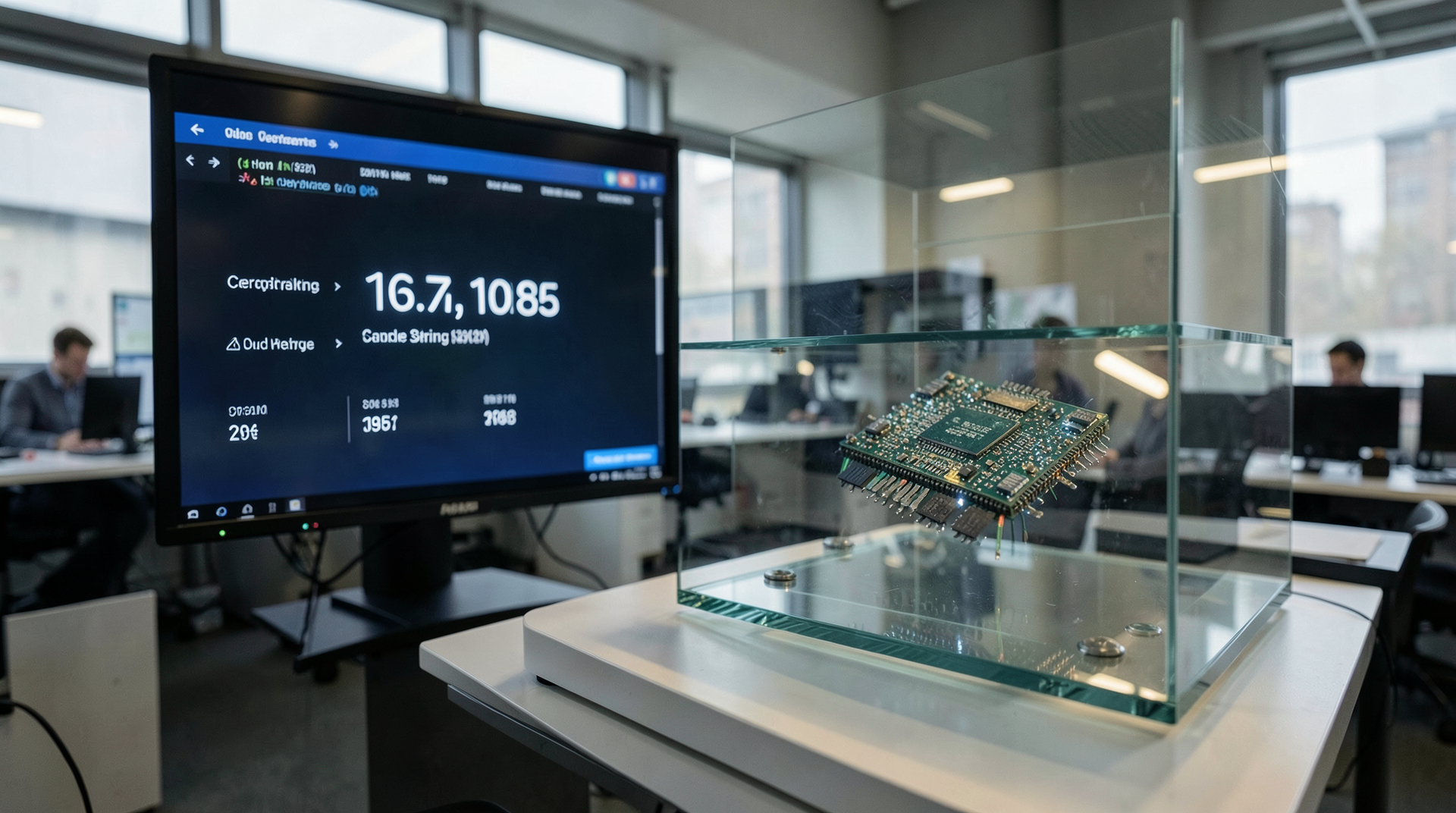
Cerebras Systems raised its IPO range before the public had bought a share. That is the whole story in miniature: scarcity first, disclosure second, price now. CNBC reported Monday that the AI chipmaker lifted its expected range to $150 to $160 a share from last week's $115 to $125, putting possible proceeds at up to $4.8 billion and a fully diluted value as high as $48.8 billion. [1]
Monday's paper said Cerebras had lifted its range into a book reportedly past twenty times demand, making the deal the public market's cleanest near-term gauge of AI-chip scarcity. It also said Greg Brockman's courtroom testimony had put OpenAI partnerships on the public docket. Tuesday fuses those two stories. [1]
The IPO is not simply about a chip. Cerebras is selling investors a way around Nvidia gravity. Its pitch is that wafer-scale systems can train and run large generative AI models faster and at lower cost than conventional GPU approaches. CNBC reported that the company has filled data centers with its own chips and sells cloud services, competing not only with chipmakers but with cloud infrastructure providers. [1]
That distinction matters. Hardware companies sell parts. Cloud providers sell capacity. Cerebras is asking the market to value it as both an AI hardware challenger and a compute utility with scarce capacity. The raised range says investors are willing, at least before pricing, to treat those identities as complementary rather than contradictory.
OpenAI is the demand engine and the risk. CNBC reported that Cerebras has secured a commitment worth more than $20 billion from OpenAI, which relies on Cerebras for a model that writes code. [1] That kind of anchor customer can justify a valuation jump. It also concentrates the story. The company is not entering public markets as a broad, boring chip supplier with a diversified base. It is entering as a wager on an AI customer network whose names are powerful enough to lift a deal and entangled enough to make governance a live issue.
The courtroom detail is why the raised range is more than a bullish market note. CNBC reported that Greg Brockman, OpenAI's co-founder and president, said in a California court that Cerebras' planned chips represented "the compute we thought we were going to need," and that OpenAI discussed merging with Cerebras while Elon Musk was open to a deal. [1] That testimony turns a customer relationship into part of OpenAI's corporate-history record.
The divergence is familiar but useful. Mainstream coverage treats Cerebras as an IPO with a raised range, a Nasdaq date, OpenAI demand, and a valuation jump. X treats it as a referendum on the whole AI capital cycle: either public investors finally get access to scarce compute, or they are being invited into a late-stage private-market markup with OpenAI as the halo. Both readings are too simple alone. The better question is whether scarcity can stay scarce after it is securitized.
Scarcity is the thing being sold. Nvidia scarcity has defined the AI cycle: not enough chips, not enough power, not enough data-center capacity, not enough time. Cerebras' offering asks investors to believe that scarcity is not a temporary supply bottleneck but a durable market structure. If that is true, $160 is not expensive. If it is false, the range lift looks like the moment private-market exuberance was transferred to public buyers.
The public-market timing is aggressive. CNBC said Nasdaq expects the IPO to take place on May 14. [1] That means the range increase lands in the same week investors are also digesting broader AI chip volatility, OpenAI enterprise adoption claims, and White House comments about AI and jobs. The market is not lacking AI stories. Cerebras has to show why its version deserves fresh money rather than recycled enthusiasm.
The raised range also doubles the valuation conversation. CNBC reported that the high end could value Cerebras at $48.8 billion fully diluted, up from the $23 billion valuation announced in February during a funding round. [1] A company can grow into that if the demand curve is real. But the change is not merely organic growth across a quarter. It is market appetite repricing the same strategic scarcity at a higher public number.
There is a clean bullish case. Nvidia cannot serve every buyer at every speed. Cloud giants have their own constraints and incentives. Enterprises want compute outside the usual stack. OpenAI's demand gives Cerebras credibility. Amazon Web Services, CNBC reported, announced a March deal to bring Cerebras chips into its data centers. [1] A company with OpenAI and AWS in the narrative can plausibly argue that it is not a science project.
There is also a capital-markets reason the deal can work. Public investors have spent the AI boom buying the incumbent beneficiaries: Nvidia, hyperscalers, chip equipment, power, cooling, and data-center landlords. Cerebras offers a cleaner story for the buyer who wants the hardware scarcity theme without simply adding to an already crowded Nvidia position. That does not make the valuation right. It explains why demand can remain strong even when the risks are obvious.
The company's cloud-service turn deepens that appeal. If Cerebras were only selling machines, investors would value orders, backlog, margins, and replacement cycles. If it sells access to compute, the market can imagine recurring revenue, software-like multiples, and capacity sold before it is built. [1] That imagination is powerful. It is also where many AI stories become expensive before they become durable.
There is also a clean bearish case. The IPO is arriving with heavy customer visibility but limited public-season operating history. It depends on capital markets accepting a cloud-services version of a hardware company. It depends on OpenAI continuing to need what Cerebras uniquely provides. It depends on investors not punishing the very entanglements that make the growth story vivid.
The Brockman testimony complicates the sell. If OpenAI once discussed a merger with Cerebras, investors must ask whether the relationship is strategic validation or strategic dependence. [1] The answer can be both. The paper's position from Monday was not that the testimony breaks the IPO. It was that the testimony puts the OpenAI-Cerebras relationship on the docket at the same time the IPO asks public buyers to fund the next stage of it.
The market likes simple narratives. This one is not simple. Cerebras says it can do AI compute differently. OpenAI says, by contract and by courtroom recollection, that the compute mattered. Nasdaq expects a listing. Investors see a range moving up, not down. [1] But the same facts that make the deal hot make the risk concentrated.
The public filing week will therefore ask two questions at once. First, can Cerebras command a premium because the market believes AI compute remains scarce? Second, can it convince investors that the OpenAI relationship is a platform for growth rather than a customer concentration problem dressed as validation? The first question belongs to the trading desk. The second belongs to governance. Both arrive before the first trade. [1]
This is why the $160 number matters. It is not just the top of a range. It is a vote on whether the AI market is still willing to pay in advance for capacity that may become critical later. Public investors are being asked to buy the future tense: compute we thought we would need, data centers being filled, chips that may beat GPUs, a cloud service that may become indispensable. [1]
Scarcity clears when buyers believe waiting will cost more than paying. Cerebras is testing that belief in public, at a price that has already moved higher. If the deal prices cleanly, it will not prove the AI cycle is healthy. It will prove that one of the cycle's most powerful forces remains intact: the fear of being last in line for compute.
-- THEO KAPLAN, San Francisco