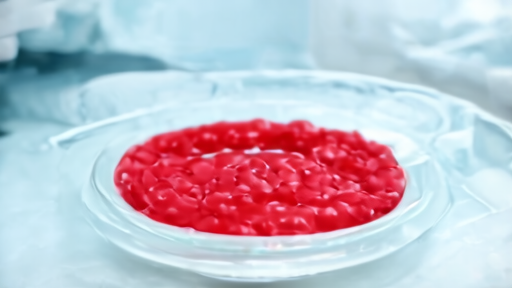
McGill researchers have made a clot that forms in seconds by turning red blood cells into structural material. The university's newsroom says the engineered clots form rapidly and show stronger, more adhesive behavior than natural clots. [1] The Nature paper supplies the scientific center: red blood cells can be chemically cross-linked into a hemostatic gel designed to stop bleeding faster and more durably. [2]
The paper's Monday brief on McGill's click-clotting cytogel and the trauma pipeline framed the next question as deployment, not chemistry. Tuesday's feature keeps that discipline. The breakthrough is real because it changes the material logic of clotting. The hard part is whether it can become a tool in the minutes when uncontrolled bleeding kills.
Most readers think of clotting as a cascade, a biological sequence the body either performs well or fails to perform fast enough. The McGill work asks a different question. What if the patient's own red blood cells, or compatible donor cells, could be assembled into a sticky scaffold at the site of injury? That is why the story belongs in life and science, not merely in medical novelty. It changes the object from drug to material.
McGill describes the work as producing faster and more effective clots, with possible relevance to traumatic bleeding and surgery. [1] Nature's publication gives the claim its technical footing. [2] The promise is obvious. Severe bleeding is a race against pressure, access, and time. A clotting material that forms within seconds could help in non-compressible wounds where pressure alone cannot solve the problem.
The divergence is in enthusiasm versus logistics. Medicine X and military-medicine readers naturally see the phrase five-second clot and imagine ambulances, battlefield medics, and emergency rooms. The institutional sources emphasize the research result and its medical promise. [1] [2] The gap is the path between those two rooms. A gel that works in a controlled experiment still has to become safe, manufacturable, storable, deliverable, and usable by people whose hands may be covered in blood.
The red-blood-cell approach has an appealing elegance. Blood cells are abundant, familiar to the body, and mechanically useful. Turning them into a scaffold may avoid some of the brittleness of synthetic materials and some of the slowness of biological repair. But the same elegance creates questions. If the material is prepared from a patient's own blood, how long does preparation take? If it comes from donor blood, how is compatibility handled? If it is stored in advance, how long does it remain stable? The sources establish the scientific result. The clinic will ask the logistical questions. [1] [2]
This is where trauma medicine is ruthless. It does not reward cleverness in the abstract. It rewards interventions that work under bad lighting, with limited information, at speed, and without demanding a specialist at the bedside. A five-second clot is a headline. A five-second clot delivered through a kit that an emergency team can trust is a product. Between them sits years of animal studies, human trials, regulatory review, manufacturing discipline, and hospital training.
The most likely early home may be the trauma bay, not the roadside. Hospitals can control storage, typing, preparation, sterility, and follow-up. Operating rooms can use a material with more procedural support. Field medicine is less forgiving. If the technique eventually moves outward, it will be because the preparation problem has been reduced enough that medics can use it without turning hemorrhage care into chemistry class.
Still, the research deserves attention because it is not only faster. It is conceptually different. It treats blood as matter that can be built with, not just fluid that must be coaxed into behaving. That small shift is how many medical tools begin: not as a new answer to an old question, but as a better object for the body to use.
The story now leaves the beautiful part of science and enters the ugly part: reproducibility, scaling, cost, and failure modes. That is not a demotion. It is the route by which a laboratory idea earns the right to meet a patient. If McGill's clot survives that route, five seconds will become more than a striking number. It will become time returned to people who are losing blood faster than medicine can think.
-- KENJI NAKAMURA, Tokyo