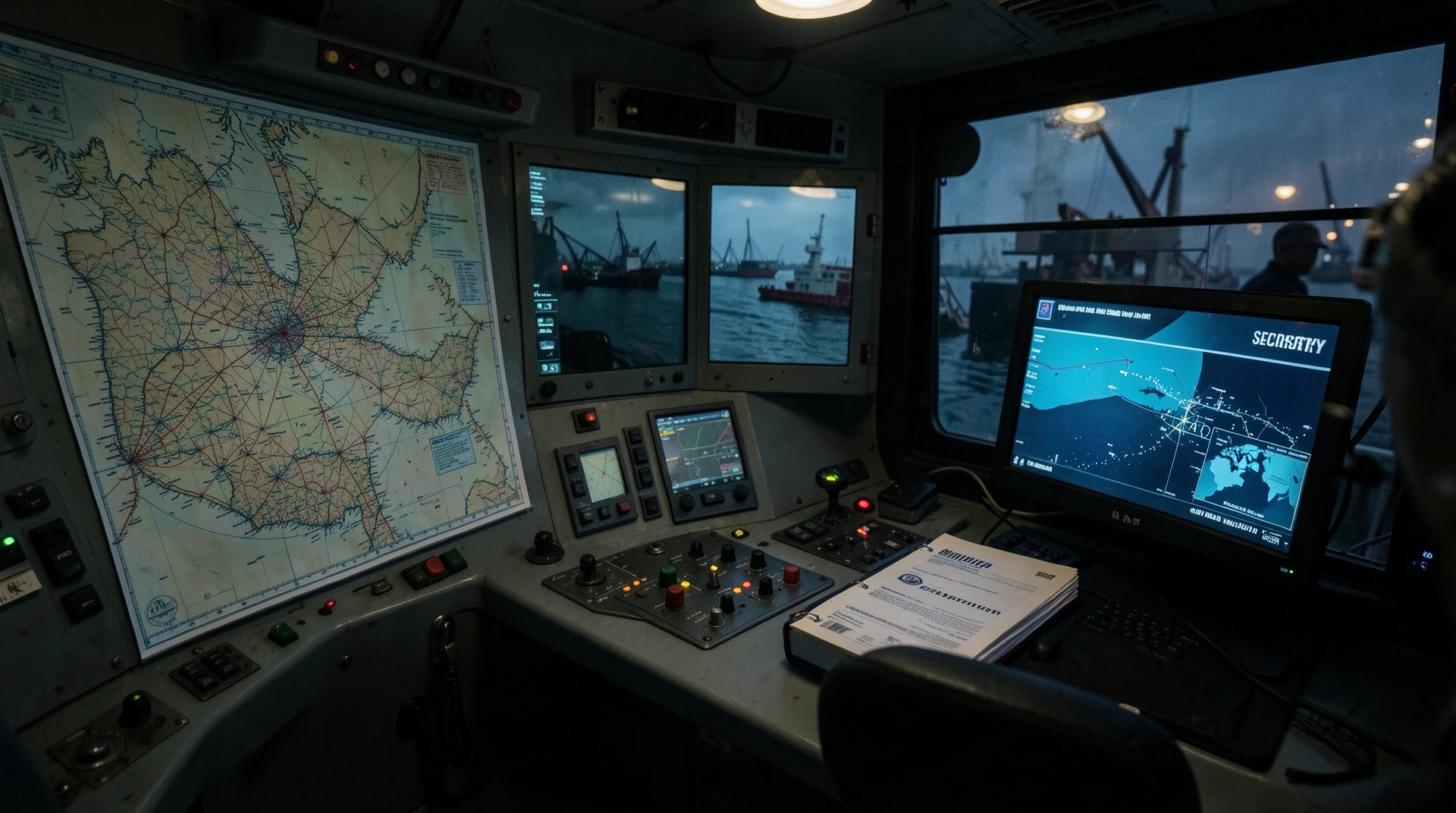
Iran did not seize another tanker on Monday. It did something more durable: it tried to sell the Strait of Hormuz as an insurance market. Al Jazeera reported that Iran's Supreme National Security Council announced a Persian Gulf Strait Authority, or PGSA, that would provide real-time updates on operations in the passage, while a Fars report said Tehran was preparing a Hormuz Safe insurance offer for vessels crossing the strait and surrounding Gulf waters, with cryptocurrency settlement including Bitcoin. [1]
That is the escalation hidden inside the paperwork. Sunday's paper held Oman's silence as the boundary around Iran's Strait-rules claim: Iran could say it was coordinating management of Hormuz, but Muscat had not made the claim bilateral. Monday's artifact does not solve that problem. It changes the form of the claim. A toll becomes insurance. A checkpoint becomes a risk-management service. A blockade becomes a commercial product whose receipt may be more important than its flag. [1]
The divergence is not subtle. Mainstream coverage can handle this as a legal and maritime explainer. Can Iran insure ships. Would ports accept the certificates. Would sanctions allow claims to be paid. X compresses the matter into a simpler conclusion: if shipowners are even considering a Tehran-issued policy, then Iran has won the operational argument. The paper's position is narrower and harder. An insurance offer is not recognized control, but it is also not a slogan. It is an attempt to make a disputed strait legible to shippers, insurers, financiers, and sanctions officers. [1]
Hormuz was already a physical chokepoint. Iran is now trying to make it a paperwork chokepoint. The PGSA announcement matters because authorities are how temporary controls become routine. An office can issue notices. A website can accept applications. A certificate can travel with cargo documents. A signed receipt can outlive the press conference that produced it. The article's most important word is not Bitcoin. It is receipt. [1]
Al Jazeera's account gives the bones. The PGSA, announced Monday, would provide real-time updates on operations and developments in a strait through which 20 percent of the world's oil and gas pass in peacetime. The Hormuz Safe plan, attributed to Fars, would offer maritime cargo insurance, encrypted verification capability, and cryptocurrency settlement. Fars said the program could bring Iran more than $10 billion in annual revenue, and that cargo would be covered from confirmation, with a signed receipt provided to the owner. [1]
That sentence is why this is the lead. A signed receipt is a claim on the future. If a ship transits after paying, Iran can point to compliance. If a ship is refused financing without the certificate, Iran can point to market recognition. If a port rejects the document, Iran can point to foreign pressure. If a claim is not paid, shipowners can point to the hollowness of the offer. Every outcome creates evidence. None requires a new missile launch. [1]
The cleverness of the proposal is that it borrows the language of ordinary commerce. Ships buy insurance. Cargo has coverage. Risk has a price. Marine insurance is one of those quiet systems that make globalization possible precisely because most readers never see it. Tehran is trying to enter that system through the back door. It is not asking the International Maritime Organization to bless a toll. It is inviting shipowners to treat Iranian permission as a covered risk. [1]
The weakness is equally plain. Abdul Khalique, head of the Liverpool John Moores University Maritime Centre, told Al Jazeera that Iran would face serious financial, legal, and operational obstacles. Marine insurance needs large reserves and international reinsurance support. Sanctions restrict Iran's access to global financial and insurance markets. Without credible reinsurance, shipowners may doubt that claims would be paid after accidents, spills, or seizures, and regulators or ports may reject Iranian certificates. [1]
This is where the Bitcoin line becomes less exotic and more revealing. Cryptocurrency settlement may help Iran talk around sanctions, but it does not make a policy credible. A shipowner does not merely need to pay a premium. It needs lenders, charterers, ports, insurers, reinsurers, and regulators to accept the chain of obligation. Bitcoin can move value. It cannot by itself create a claims-paying balance sheet, a recognized jurisdiction, or a port-state inspection regime. [1]
Nor does the PGSA erase the international-law problem. Al Jazeera notes that levies cannot be charged on ships sailing through international straits or territorial seas under the United Nations Convention on the Law of the Sea. That is why the insurance wrapper matters. Tehran is not merely imposing a toll in the old vocabulary. It is testing whether a fee can be repackaged as commercial protection for safe passage through a contested waterway. [1]
The market should not mistake this for de-escalation. There is a common error in war economies: a mechanism appears, and everyone calls it stabilization. Sometimes a mechanism is just escalation with a help desk. If a website, receipt, and authority make the Strait easier to price while leaving the underlying coercion intact, the result is not freedom of navigation. It is managed permission. [1]
There is also a domestic Iranian audience. Al Jazeera reports that Iran has said tolls or transit fees would help pay for repairs after nearly six weeks of US-Israeli bombing. That justification turns maritime passage into reparations by other means. It says the cost of the war should be collected from the traffic that once moved through the strait for free. The world may reject that legal theory. Iran may still try to make the invoice operational. [1]
The predecessor question therefore remains alive. Oman's silence still matters. China opposition still matters. US State Department language that waterways must remain open still matters. But Monday adds a different test. Does any shipowner use Hormuz Safe. Does any insurer reinsure it. Does any port accept or reject the certificate. Does PGSA publish vessel lists, clearance windows, advisories, or incident reports. Does Iran collect payment in Bitcoin and then publicize the receipt. [1]
The next artifact is not a communique. It is a transaction. The paper has insisted for days that documents, operating behavior, and market prices outrank summit language. That standard now cuts both ways. If the insurance plan is theater, it will produce no ship, no certificate, no port acceptance, and no claims process. If it works even once, the story moves from rejected toll to live compliance problem. [1]
This is why oil desks, sanctions lawyers, and insurers now share the same story. A cargo policy is not a diplomatic settlement, but it can force every participant in the chain to decide whether Tehran's paper is void, dangerous, useful, or unavoidable. The first shipowner who answers that question in practice will say more than a week of summit language. [1]
There is a reason governments like words such as authority, insurance, and verification. They sound boring. They are not. They are how power takes off its uniform and puts on a lanyard. Iran's Monday move should be judged in that spirit: not as a settled legal regime, not as a clean commercial offer, and not as proof that the Strait has reopened, but as an attempt to make coercion payable, insurable, and harder to unwind. [1]
-- YOSEF STERN, Jerusalem