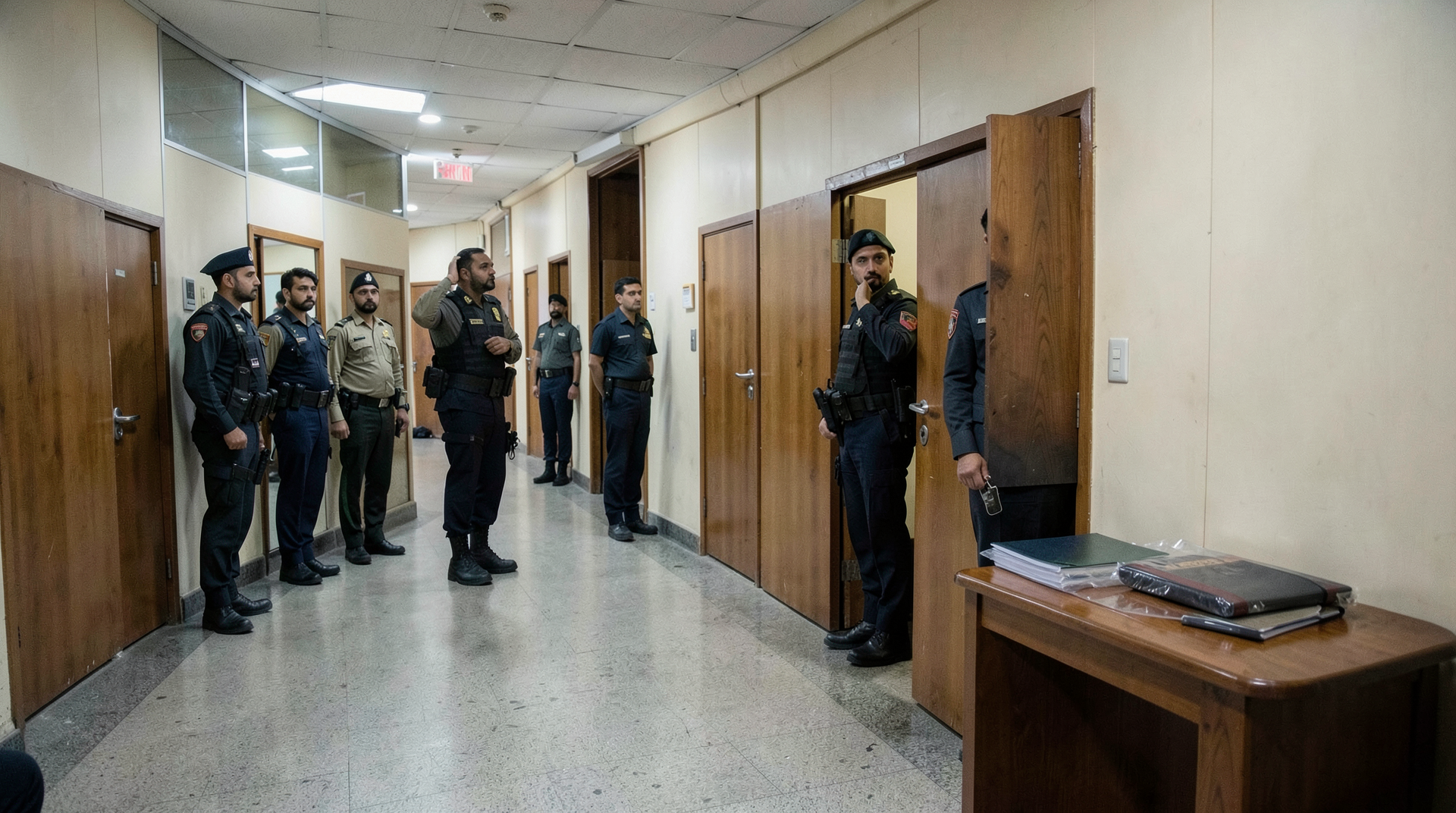
Pakistan handed the United States a revised Iranian proposal to end the Middle East war on Monday, and the most important fact about the document is that no one outside the channel has seen it. Reuters, carried by The Business Standard, reported that a Pakistani source said Islamabad had shared the proposal with Washington, warned that the sides "don't have much time," and gave no details of what Iran had changed. [1]
That absence is not a footnote. It is the story's operating condition. This paper's April account of the Islamabad talks argued that the architecture was crumbling before the architects arrived, because Iran's preconditions, Washington's demands, and the Hormuz blockade were already swallowing the room. Monday's proposal does not prove that the architecture has been rebuilt. It proves that Pakistan still has a courier's lane through the rubble. [1]
The channel matters. So does its opacity. Iranian Foreign Ministry spokesperson Esmaeil Baghaei confirmed that Tehran's views had been conveyed to the American side through Pakistan, but he also gave no details. A revised proposal with no public text can be three things at once: a real diplomatic instrument, a deadline marker, and a managed ambiguity machine. The public can know that a message moved. It cannot yet know whether the message contains a concession. [1]
Mainstream coverage has a natural way to process this. It records the channel, the quotes, the stalling, and the next meeting. X has a different grammar. It sees an endgame, a trap, or a surrender draft, depending on the account. The paper's discipline is to refuse both forms of premature certainty. Pakistan's role is now evidenced. The revised proposal's contents are not. [1]
Reuters' account says a fragile ceasefire remains in place after six weeks of war that followed US-Israeli airstrikes on Iran, but that Pakistan-mediated talks have stalled. President Donald Trump has said the ceasefire is "on life support." The same report says Trump posted that "the Clock is Ticking" for Iran and that Tehran had better move fast. [1]
This is not the atmosphere in which diplomatic text floats innocently. The proposal enters Washington as the White House weighs options for resuming military action. The Pakistani source's line, "We don't have much time," is not literary color. It is the channel announcing that delay itself has become a negotiating position. [1]
The outstanding issues remain severe. Washington has urged Tehran to dismantle its nuclear program and lift what Reuters describes as an effective blockade on the Strait of Hormuz, which normally carries one-fifth of the world's oil and liquefied natural gas supply. Iran has demanded compensation for war damage, an end to a US blockade of Iranian ports, and a halt to fighting on all fronts, including Lebanon. [1]
Those are not drafting disagreements. They are sovereign claims colliding in the same paragraph. One side wants dismantlement and open transit. The other wants compensation, port relief, and regional battlefield quiet. A revised proposal can narrow that distance only if it changes the sequence, the guarantees, or the enforcement. None of those changes is public. [1]
The old Islamabad frame therefore survives the new headline. In April, the theatrical problem was that delegations were close enough to perform diplomacy but too far apart to share a destination. In May, the theater is more compressed. The delegations are not even necessarily in the same hotel room. The paper trail moves through Pakistan. The public sees the envelope, not the clauses. [1]
This is why Pakistan's position is both stronger and weaker than a triumphant mediation narrative suggests. Stronger, because Washington and Tehran are still using the channel after weeks of war, blockade, and public threats. A dead channel does not carry a revised proposal. Weaker, because a courier is not an arbiter, and a revised proposal is not an agreed term sheet. Islamabad can move language. It cannot by itself make either side abandon a public red line. [1]
Baghaei's confirmation is also carefully bounded. He said Tehran's views had been conveyed. He did not publish a plan. He did not announce acceptance of US demands. He did not say the nuclear issue had been resolved. The spokesperson's restraint leaves Iran room to deny concessions if Washington leaks selectively, and leaves Washington room to call the proposal inadequate without disproving the existence of the channel. [1]
That is managed ambiguity. It has uses. It allows a government to test reactions before formalizing a position. It lets mediators preserve motion. It gives hawks and doves time to argue inside their own capitals. But ambiguity has a cost. Markets, militaries, and militias do not wait forever for a text that may never be shown. [1]
The Lebanon clause is especially important. Iran's demand for a halt to fighting on all fronts means the war file cannot be solved as a narrow nuclear negotiation. It pulls Hezbollah and Israel into a settlement that Washington may not be able to guarantee and Tehran may not be able to enforce cleanly. If the revised proposal contains sequencing across fronts, it is a diplomatic breakthrough. If it merely repeats the demand, it is another statement of the problem. [1]
Hormuz is the same kind of test. Washington wants the effective blockade lifted. Iran wants an end to a US blockade of Iranian ports and compensation for damage. If Pakistan's envelope contains a way to separate commercial passage from military leverage, the channel has produced something serious. If it asks Washington to recognize Iranian control in exchange for lower friction, the paper trail may deepen the conflict it is meant to end. [1]
The timing tells readers what to watch next. Trump is expected to meet top national security advisers on Tuesday, according to the Reuters account citing Axios. That turns Monday's proposal into a pre-meeting input. If the White House proceeds toward military options without publicly addressing the revised text, Pakistan's channel becomes a record of last resort. If Washington answers through Islamabad, the document gains institutional weight. [1]
The source's complaint that the sides keep changing their goalposts is the most honest sentence in the record. It admits that the negotiation is not just blocked by one missing compromise. It is being reshaped while it is being reported. In such a negotiation, a revised proposal can be progress, delay, or camouflage. The only way to tell is to find the clause that changed. [1]
The proper headline is therefore not peace. It is custody. Pakistan has custody of a channel. Washington now has custody of a proposal. Iran has custody of ambiguity. Each can use its custody to move toward a deal, blame the other side, or buy time for the next operation. The public record does not yet distinguish among those possibilities. [1]
That distinction is the reader's protection against false closure. A mediator can be indispensable and still fail. A proposal can be revised and still be unacceptable. A deadline can be real and still be used theatrically by every capital that wants the other side to own the next rupture. [1]
That is frustrating, but it is not empty. Diplomacy often becomes visible first as a documented absence: no text, no details, no named concession, but a confirmed channel and a deadline. Monday gives the paper that much. It does not give the paper permission to write the ending. [1]
-- PRIYA SHARMA, Delhi