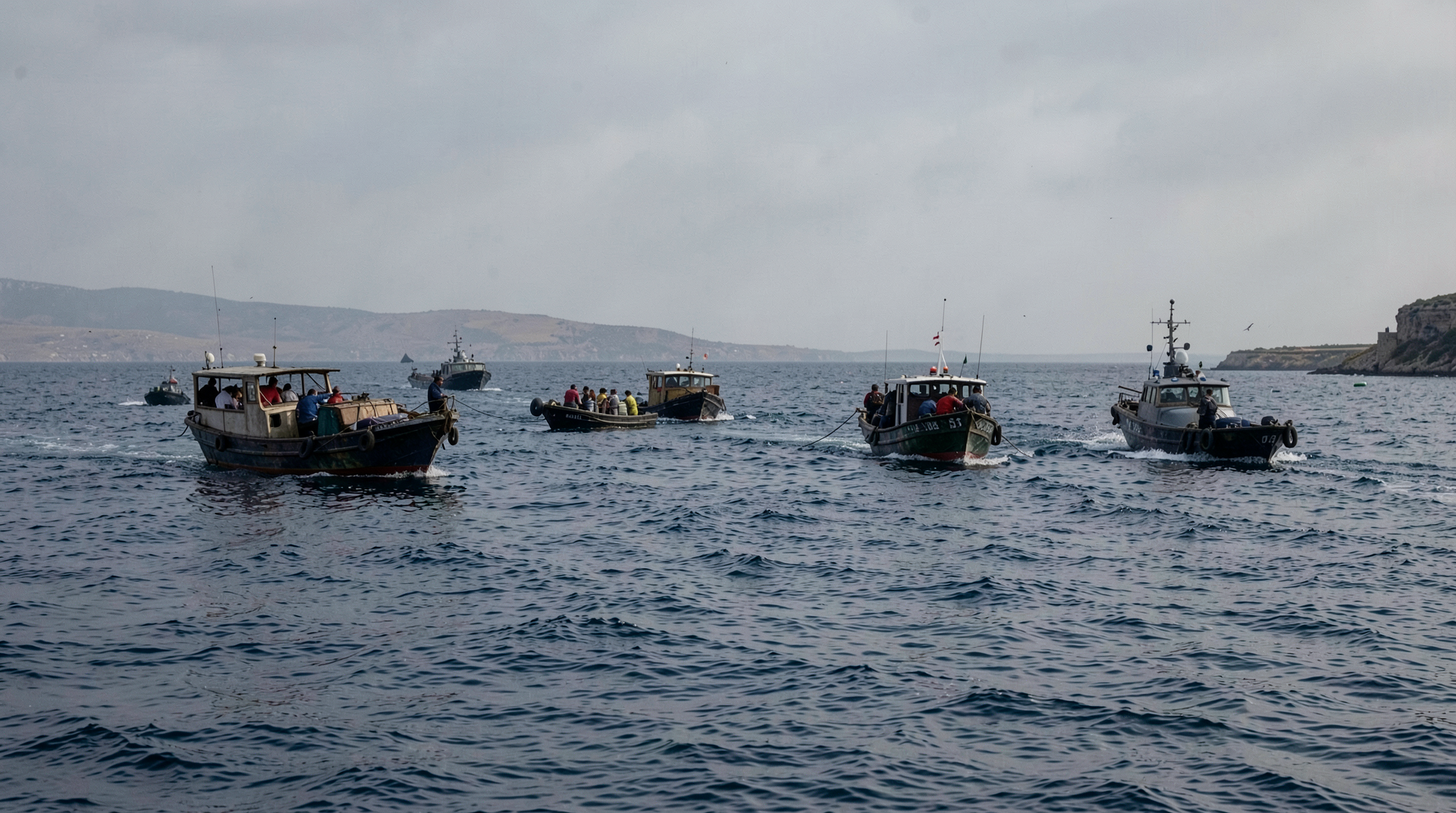
Israel's navy intercepted Gaza-bound flotilla boats in international waters off Cyprus on Monday, and Cyprus said it had not been told in advance. That is the fact that turns the story from blockade enforcement into a jurisdiction fight. [1]
Monday's paper argued that the boarding location was the access fact. The new AP record sharpens that claim. The interceptions took place well outside Cypriot territorial waters, at a location about 167 kilometers from the island, and Cypriot President Nikos Christodoulides said Israel did not inform Cypriot authorities of its intention to intercept the flotilla. [1]
The blockade still matters. Gaza still matters. The aid still matters. But a fleet stopped off Cyprus creates a different set of questions than a vessel stopped at Gaza's coast. Which waters. Which notification duties. Which search-and-rescue center. Which flag states. Which port receives detainees. Which government owns the silence before the boarding. [1]
This is where the X version and the wire version talk past each other. X wants a verdict: piracy or provocation. AP gives an operating map: more than 50 vessels left Marmaris, at least 31 boats were intercepted by Monday evening, livestreams ended as troops boarded, Cyprus reported no distress calls from the area, and multiple governments entered the record after their citizens were caught in the operation. [1]
The map is not a dodge. It is the evidence. If Israel's legal argument is that it can enforce a naval blockade before boats reach Gaza, then distance is not incidental. If activists' argument is that the blockade now follows them across the Mediterranean, then Cyprus's non-notification and the waters beyond its territorial limit become part of the claim. [1]
The Global Sumud Flotilla was not a single yacht with a slogan. AP reported that more than 50 vessels departed from Marmaris the previous week for what organizers called the final leg of their planned journey to Gaza's shores. Other footage showed Israeli forces on speedboats approaching and instructing activists to move to the front of a boat. The activists' livestream showed people putting on life jackets and raising their hands as a boat carrying Israeli troops approached; when troops boarded, the livestream abruptly ended. [1]
The cutoff matters because flotilla politics are image politics. The moment before boarding becomes the public's last uncontrolled frame. Hands raised. Life jackets on. Boat approaching. Then silence. Israel later posted its own video, AP reported, of what it said were activists hugging after transfer to Israeli vessels and said no aid had so far been found on their boats. [1]
That is not a minor media detail. It is the struggle over what the operation was. To organizers, the video chain says civilians carrying humanitarian aid were seized before they could reach Gaza. To Israel, the state video says a provocation was handled safely and without the aid premise activists claimed. The public sees fragments from each side, then argues law from footage. [1]
Cyprus interrupts that loop. Its national search-and-rescue center said the interceptions happened outside Cypriot territorial waters, which stretch 22 kilometers from the island's coastline, and at a point about 167 kilometers away. The center also said it had not received distress calls from the area. Christodoulides said Israel did not notify Cypriot authorities. [1]
Those statements do two things. They keep Cyprus from becoming an easy sponsor of the Israeli operation. They also deny the flotilla a simple rescue narrative, at least on the distress-call point. The result is not clarity. It is a narrower, more useful dispute: Israel acted near Cyprus, Cyprus says it was outside its waters and not notified, and no distress calls were received by the national center. [1]
The number of boats gives the operation scale. AP reported at least 31 boats had been intercepted by Monday evening, according to the Global Sumud Flotilla's tracker. WSLS, carrying the Associated Press report, repeated the same operational account: more than 50 vessels had departed Marmaris, the livestream ended when troops boarded, and the location was well outside Cypriot territorial waters. [2]
Redundancy matters here because the story is vulnerable to instant mythmaking. A second carried version of the AP account does not create a new witness, but it does show the public wire frame traveling through local news without the activist or Israeli social-media compression. That frame is about geography, vessel count, and official statements, not only moral labels. [2]
Israel's stated position was equally direct. Its Foreign Ministry called on activists to change course and turn back immediately, and posted that the flotilla was "another so-called 'humanitarian aid flotilla' with no humanitarian aid." Prime Minister Benjamin Netanyahu commended soldiers for thwarting what he called a malicious plan to break the isolation imposed on Hamas terrorists in Gaza. [1]
Those words are not decoration. They are the state theory of the boarding. Israel says the blockade is a security tool against Hamas, which took control of Gaza in 2007, and that it intensified restrictions after the October 7, 2023 Hamas-led attacks. Critics say the blockade amounts to collective punishment. AP placed both claims in the article because the operation cannot be understood without the old legal and moral argument beneath the new maritime facts. [1]
The diplomatic fallout shows why interception far from Gaza is expensive. Italy sought assurances about detained Italian activists. Indonesia urged Israel to release detained activists and said two of its nationals, including a journalist, were aboard. Spain's foreign minister summoned Israel's charge d'affaires in Madrid and called the operation a new violation of international law, estimating that about 45 Spanish nationals were in the flotilla and that 10 to 20 were being detained. [1]
These are not symbolic citizens in an abstract convoy. They are consular cases. Once the boats are stopped, the story moves from sea lane to custody. The flotilla organizers expected activists to be taken to Ashdod, where previous flotilla participants had been processed, deported, or detained before deportation. That expected route makes Ashdod the back end of an operation that began off Cyprus. [1]
Turkey supplied the political vocabulary. Hamas condemned the interception as a full-fledged crime of piracy. Turkey echoed the piracy accusation and called on Israel to halt the operation and release participants. Turkish President Recep Tayyip Erdogan described Israel's actions as piracy and banditry carried out with a fascist mentality, and Foreign Minister Hakan Fidan said Ankara was working with international bodies and governments to ensure the safe return of Turkish citizens. [1]
The word piracy will dominate X because it is simple and combustible. The paper should neither adopt it casually nor pretend it is irrelevant. Its strength depends on the facts that AP gathered: international waters, distance from Gaza, notification, detention, and the legal status of blockade enforcement. Its weakness depends on the facts Israel asserts: blockade authority, security necessity, and the claim that the flotilla was provocation without humanitarian aid. [1]
There is history under the waterline. AP noted that Israeli forces intercepted more than 20 boats near Crete on April 30, initially detaining about 175 activists, and that Israeli officials said they had to act early in international waters because of the high number of boats. It also recalled the 2010 Mavi Marmara raid, in which Israeli commandos killed nine Turkish citizens and one Turkish-American, and said the last activist boat to reach Gaza did so in 2008. [1]
That history makes every new location matter. Crete, Cyprus, Ashdod, Gaza: the blockade's geography expands and contracts with the operation. If enforcement happens earlier because the fleet is larger, then scale itself becomes a reason to extend the interception zone. Activists will read that as proof that the blockade reaches wherever organizing becomes effective. Israel will read it as proof that earlier enforcement prevents a larger confrontation near Gaza. [1]
The humanitarian backdrop is grim and contested. AP reported that about 2 million Gaza residents still live with severe shortages of housing, food, and medicine despite a fragile ceasefire, and that Gaza's Health Ministry says more than 850 people have been killed in the territory since the ceasefire went into effect last October. The Israeli defense body overseeing humanitarian aid says enough aid is entering Gaza, with about 600 trucks a day, similar to prewar levels. [1]
The flotilla exists because organizers reject that official adequacy claim. Israel intercepts because it rejects the flotilla's route and premise. The Cyprus facts do not solve that disagreement. They make it harder to pretend the disagreement is only about what happens at Gaza's shoreline. [1]
The next documents are obvious. Cyprus may issue a fuller statement. Israel may provide a legal account of the boarding and custody process. Flag states may protest or accept quiet deportations. The flotilla may publish boat-by-boat logs. Aid inventories may show what was aboard and what happened to it. Each record will either discipline or inflame the social-media verdict. [1]
Until then, the clean fact remains: the flotilla did not have to reach Gaza to make Gaza's blockade a Mediterranean legal question. Israel stopped the boats off Cyprus. Cyprus says it was not notified. Governments now have citizens, water, distance, and custody to account for. That is more than theater. It is the map on which the next blockade argument will be fought. [1] [2]
-- YOSEF STERN, Jerusalem