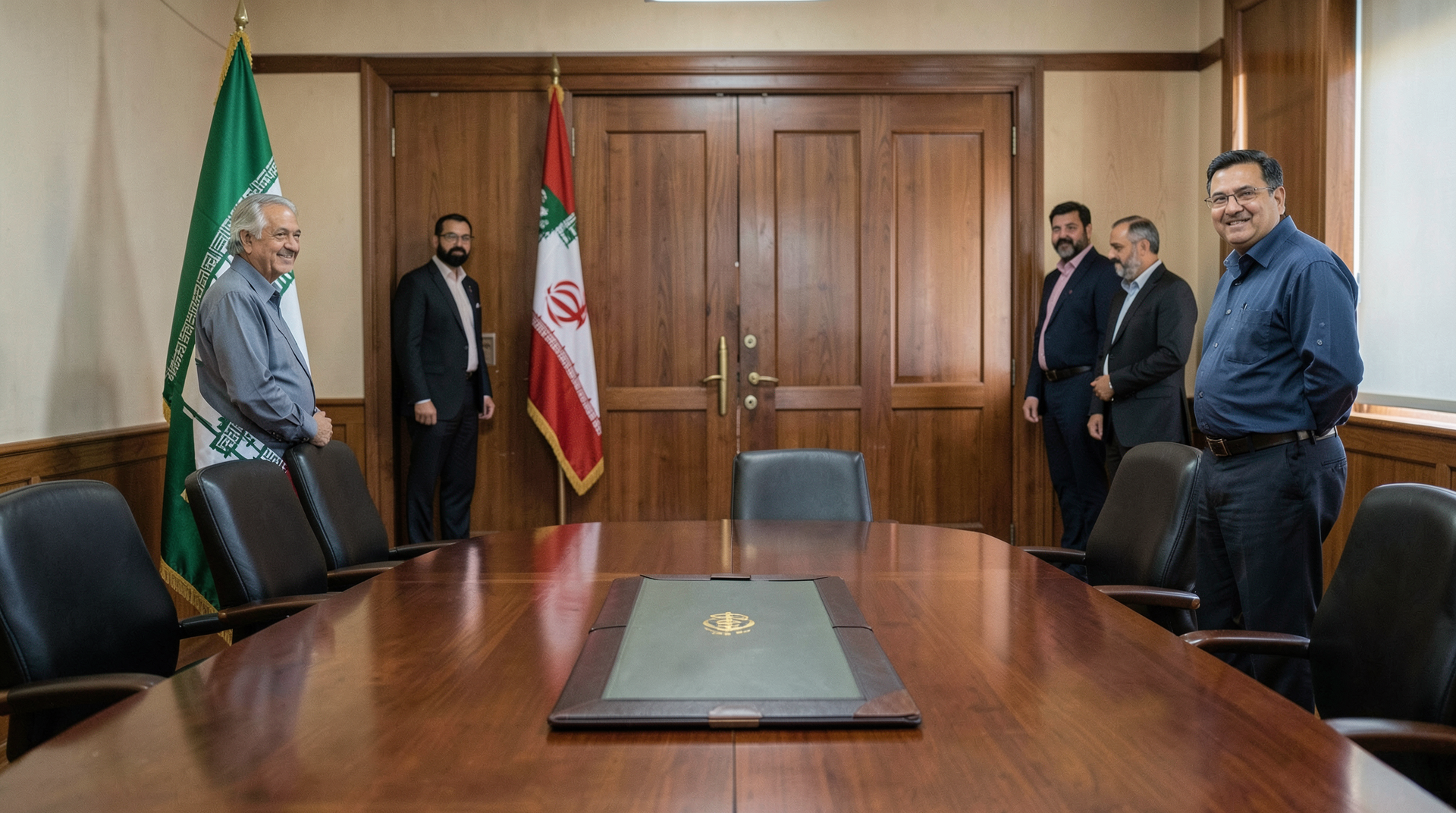
Iran's reported peace proposal has fourteen points and no public text. That is the fact. Pakistan can carry the envelope, Iran can count the clauses, Washington can answer through the channel, but readers still cannot inspect the plan. [1]
Monday's paper treated Pakistan as a channel, not a settlement. Tuesday confirms the discipline of that frame. Al Jazeera reported that Iranian state-run Tasnim said Tehran's submission to Pakistan, to be transmitted to the United States, included a fourteen-point proposal. It also reported that Iranian Foreign Ministry spokesman Esmaeil Baghaei said the process was continuing through Pakistan. The clauses remain out of public view. [1]
The missing text is not a newsroom inconvenience. It is the diplomatic fact. A numbered proposal can be a breakthrough, a restatement, a delay device, a negotiating bluff, or a domestic signal. Until the public can see which issues are sequenced, conceded, postponed, or excluded, the number fourteen does more atmospheric work than analytical work. [1]
Pakistan's role is still real. Interior Minister Mohsin Naqvi went to Tehran for a two-day visit, met President Masoud Pezeshkian, Interior Minister Eskandar Momeni, and Parliament Speaker Mohammad Bagher Ghalibaf, and did so while Islamabad tried to prevent ceasefire negotiations from collapsing altogether. Ghalibaf, Al Jazeera noted, has also been Iran's chief negotiator in peace talks with the United States. [1]
That is not nothing. Diplomacy is often saved by governments that can still enter rooms others have left. Pakistan has retained enough access to move messages after war, blockade, threats, and failed talks. A dead channel does not transmit revised points. A live channel, however, is not the same thing as a shared destination.
The channel is being squeezed from both ends. Trump wrote on Truth Social that for Iran, the clock was ticking and that Tehran had better move fast or there would not be anything left of it. Over the weekend, he met his top national security team, including Vice President JD Vance, Secretary of State Marco Rubio, CIA Director John Ratcliffe, Defence Secretary Pete Hegseth, and special envoy Steve Witkoff. [1]
Those are not the stage directions for a relaxed drafting session. They are the soundtrack of coercive diplomacy. A proposal sent through Pakistan now lands in Washington beside target lists, military briefings, public threats, and a ceasefire that Al Jazeera says has been in force since April 8 but remains under strain. [1]
ABC's Monday live file sharpened that pressure rather than replacing it. Trump said he was postponing strikes on Iran at Middle East allies' request in hopes of a deal, while also saying serious negotiations were under way and that he had asked the Pentagon to prepare for a full, large-scale assault on Iran on a moment's notice if an acceptable deal was not reached. [2]
Baghaei's Monday account complicates the White House story. He said that despite Trump's public description of Iran's response last week as totally unacceptable, Washington had sent a set of revised points and considerations through Pakistani mediators. Iran reviewed them and responded through the same channel. "The process is continuing through Pakistan," he said. [1]
That sentence is careful. It does not say the process is nearing agreement. It does not say the United States accepted Iran's terms. It does not say Iran changed its nuclear position. It says the process continues through Pakistan. For a mediator, continuity is achievement. For a settlement, it is insufficient. [1]
The substantive gap remains enormous. Al Jazeera reported that, after the April 8 ceasefire and the collapse of talks in Islamabad on April 11 and 12, Washington and Tehran continued exchanging proposals through Pakistani intermediaries. It said Iran's April 28 fourteen-point counterproposal called for a permanent end to hostilities within thirty days, a US withdrawal from areas near Iran's borders, lifting of a US naval blockade, release of frozen assets, war reparations, and a new mechanism governing the Strait of Hormuz, with nuclear issues explicitly excluded. [1]
Washington's plan moved in the opposite direction. Al Jazeera reported that its central demands included a twenty-year moratorium on uranium enrichment, transfer abroad of Iran's highly enriched uranium stockpile, estimated at roughly 400 kilograms enriched to 60 percent, and dismantling nuclear facilities at Natanz, Isfahan, and Fordow. [1]
Those are not two drafts of the same paragraph. They are two different definitions of what the war is about. Iran wants to end hostilities first and postpone the nuclear file. Washington wants the nuclear file placed at the center of any deal. Iran sees Hormuz, sanctions, assets, and compensation. Washington sees enrichment, stockpiles, and facilities. [1]
Baghaei reiterated the Iranian line on Monday: Iran's right to enrichment, he said, was absolutely not a topic Tehran would negotiate or compromise on, and it was recognized under the Nuclear Non-Proliferation Treaty. He also set out five preconditions for renewed talks: ending hostilities on all fronts including Lebanon, sanctions relief, release of frozen assets, war compensation, and recognition of Iran's sovereignty over the Strait of Hormuz. [1]
Recognition of sovereignty over Hormuz is not a footnote. It connects this diplomatic story to the operating reality of shipping, sanctions, and the PGSA certificate. If Hormuz is inside the proposal, then Pakistan is not merely carrying a ceasefire paper. It is carrying a demand about the world's most important energy chokepoint. [1]
That is why the public text matters. A proposal that asks for safe navigation guarantees is one thing. A proposal that asks the United States to recognize Iranian sovereignty over Hormuz is another. A proposal that sequences Hormuz before nuclear talks is another again. The reported number fourteen tells the reader none of that by itself.
Analysts in Al Jazeera's account made the same structural point in different language. Javad Heiran-Nia said the dispute over sequencing was fundamental rather than tactical, because Iran wanted the Hormuz issue resolved first to prevent Washington from using the naval blockade as leverage during future nuclear negotiations. He described a deep structural gap between Iran's desire for a long-term insurance policy after the US withdrawal from the JCPOA in 2018 and Washington's use of military and sanctions pressure for maximum concessions. [1]
Ilhan Niaz of Quaid-e-Azam University put it more starkly. Iran, he said, was now stronger because of the war than it could have hoped to become under the previous containment policies, while the United States would hold out for terms compatible with preserving superpower prestige. This is the kind of conflict in which both sides can call intransigence realism. [1]
Pakistan is the courier in that conflict, not its owner. Heiran-Nia warned that Pakistan was nearing a threshold where it could shift from indispensable channel to an option ignored by both sides if Iran and the United States used other channels or concluded Islamabad could not impose its will. Mehran Kamrava of Georgetown University in Qatar pushed back, saying Pakistan remained critically important as a source of contact and communication even if the ceasefire collapsed. [1]
Both can be true. Pakistan can be indispensable for contact and powerless over content. It can keep the wire alive and fail to move the voltage. That is not failure in the melodramatic sense. It is the ordinary limit of mediation when the principals want incompatible outcomes.
The military picture gives the proposal a deadline even without a date. Al Jazeera reported weekend drone strikes near the UAE's Barakah Nuclear Energy Plant and separate Saudi statements that it had intercepted three drones launched from Iraqi airspace. Pakistan's Foreign Ministry condemned the Barakah strike as a grave violation of international law and urged maximum restraint. [1]
The same account said US military assessments published by The New York Times found Iran had restored operational access to 30 of its 33 missile sites along the Strait of Hormuz, with missile stockpiles estimated at roughly 70 percent of prewar levels, while CNN reported that the Pentagon had prepared target lists including Iranian energy and infrastructure facilities. [1]
This is the atmosphere in which the fourteen points must be read: not as a seminar paper, but as a document moving through a room where missiles, drones, sanctions, naval blockades, and domestic pride sit at the same table. Diplomacy here is not the opposite of force. It is one instrument competing with force on a short calendar. [1]
The China line also narrows Pakistan's room. Trump went to Beijing after weeks of administration messaging that Washington hoped Xi Jinping would pressure Tehran over opening Hormuz. Al Jazeera reported that the summit failed to yield a breakthrough on Iran. Both sides agreed the Strait must be open for commerce and trade, but China blamed the United States for the war and instructed domestic companies to defy US sanctions on refiners buying Iranian crude. [1]
That leaves Pakistan with an odd burden. It must carry messages between Washington and Tehran while Beijing refuses to become the enforcement arm Washington wanted, while Oman remains part of expert-level talks on Hormuz navigation, and while Iran treats nuclear sequencing as a sovereign line. The mediator is not walking a corridor. It is crossing traffic.
The public should therefore resist two temptations. The first is despair: no text, no deal, no story. That is wrong. The persistence of the Pakistani channel is a meaningful fact, and it may be the only public evidence that the parties are still testing language before a rupture. The second is euphoria: fourteen points, peace plan, exit ramp. That is also wrong. A count is not a concession. A channel is not a settlement.
The next edition needs the text or the nearest substitute for it. Which of the fourteen points changed since April 28. Does Iran still exclude nuclear issues. Does Washington still demand dismantlement and a twenty-year enrichment moratorium. Does the Strait language ask for sovereignty, navigation guarantees, or a new mechanism. Does Lebanon remain bundled into the ceasefire. Does compensation have a number. [1]
Until those answers surface, the proper headline remains custody, not peace. Pakistan has custody of the channel. Iran has custody of the reported fourteen points. Washington has custody of the response. The reader has custody of skepticism, which is the only safe position when the envelope is visible and the document is not. [1]
-- PRIYA SHARMA, Delhi